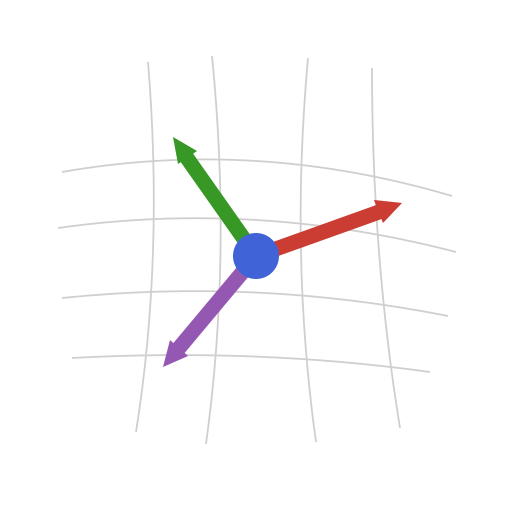
Rotations and Euler angles
Every symmetry class in this library is defined up to an orientation — an axis for transverse isotropy, a full frame for orthotropy — so the angular convention is part of the specification, not a detail. This page states the one TensND implements, read off _rot3_raw in src/tens_projection.jl and rot2/rot3/ rot6 in src/special_tens.jl.
The convention: Z–Y–Z, in the order
Note the argument order: the function takes Rotations.jl terms this is exactly RotZYZ(ϕ, θ, ψ).
Explicitly, with
The columns of Basis(θ, ϕ, ψ) builds the RotatedBasis they span.
The third column is the axis
ext/TensNDNLoptExt.jl filter those duplicates.
Spherical coordinates use the same angles in a different slot order
The predefined spherical coordinate system returns its coordinates as
Rotating tensors of each order
A rotation acts on an order-TensND provides the three cases that occur in practice:
| Function | Returns | Acts on |
|---|---|---|
rot2(θ) | 2-D | |
rot3(θ, ϕ, ψ) | vectors, order-2 tensors | |
rot6(θ, ϕ, ψ) | order-4 tensor | minor-symmetric order-4 tensors |
with
the symmetrized box product being what preserves minor symmetry. In the Kelvin–Mandel picture this order-4 object is the
sometimes called the Bond matrix. Its orthogonality — the property Voigt notation lacks — is what Kelvin–Mandel representation is about.
Recovering angles from a frame
The inverse problem, extracting angles(M, Val{3}) in src/bases.jl. It is used when a symmetry frame has been obtained as an eigenvector basis and must be reported as angles.
Two caveats, inherent to any three-angle parametrization of
the map is not injective —
and ; it degenerates at the poles (gimbal lock): at
Neither affects the projections: the objective functions of Projection onto a symmetry class depend on the frame, not on the angles chosen to name it, so a degenerate parametrization costs at worst a redundant starting point.