
A sorbent that appears and disappears
Before this page
Adsorption on a single site family, Chemistry that happens on a surface §10 and Standard states §4.
Everywhere else in this documentation, a surface is something that is simply there: you say how many moles of binding sites the system holds, and that number stays what you said. This page is about the case where it cannot — where the solid carrying the sites is itself dissolving, or has not precipitated yet.
It is the ordinary case in a cement paste, where the C-S-H that binds alkalis grows as the paste hydrates. It is shown here on a simpler material whose numbers are published, so that every step can be checked.
What a site is, and why its budget is a separate quantity
A mineral grain in water is not a clean cut through the crystal. The atoms at the surface have bonds that stop, and water completes them: an iron at the surface of a ferric oxide ends in a hydroxyl, written ≡FeOH. That hydroxyl is a site — one place where something can happen. It can take a proton and become positive, give one up and become negative, or hand its place to a metal ion arriving from solution.
What makes a site different from an element is that it is conserved without being matter. Turning ≡FeOH into ≡FeOH₂⁺ changes no count of iron, oxygen or hydrogen on the grain as a whole — the proton came from the water — but the number of sites is unchanged too, and nothing in the element balance says so. So the package carries a conservation row of its own for it, exactly as it does for electric charge. Surface complexation explains why that row is the right way to write it.
Why a fixed number cannot describe a dissolving sorbent
Suppose you post the site budget as a constant: 2 × 10⁻⁴ mol, say. Now add acid. The oxide dissolves; at some point half of it is gone. Half the sites went with it — but the budget still says 2 × 10⁻⁴, so the calculation keeps half a surface that no longer exists, and whatever was bound to it stays bound.
You could of course work out how much oxide survives, then re-post the budget. But how much survives depends on the surface, because the surface consumes acid too. You would need the answer before you could set up the question.
The way out is to stop posting a number and state the relation instead: one mole of this solid carries ν moles of sites, whatever amount of it there turns out to be. That relation is linear, it fits in the conservation matrix next to the element balances, and the solver then finds the amount of solid and the amount of sites together.
The material, and where its numbers come from
Hydrous ferric oxide — amorphous Fe(OH)₃, the rust-colored precipitate that forms wherever dissolved iron meets oxygen — is the reference sorbent of the field. (Dzombak and Morel, 1990) measured its site densities and its binding constants, and those are the numbers PHREEQC ships to this day.
Two numbers define the surface:
0.2 mol of weak sites per mole of Fe(OH)₃. That is
ν. (There is a second, much rarer family of "strong" sites at0.005 mol/mol; leaving it out changes nothing about what this page shows, and the two-family case is in Two families of sites, and a metal between them.)log K = 7.29and−8.93for taking up and giving up a proton.
and one more for the metal: log K = −3.50 for ≡FeOH + Mn²⁺ ⇌ ≡FeOMn⁺ + H⁺. Manganese is chosen because it binds firmly enough that the release is visible, and because the database used here carries its aqueous chemistry.
using ChemistryLab, DynamicQuantities, SciMLBase, OptimaSolver, LinearAlgebra

const RT = R_GAS * 298.15
lnK(logK) = -RT * log(10.0^logK)         # ΔrG° = −RT ln K
energy(v) = SymbolicFunc(v * u"J/mol")

ν = 0.2                                  # mol of sites per mole of Fe(OH)₃
logK_prot, logK_depr, logK_Mn = 7.29, -8.93, -3.50
The aqueous side
Everything that is not the surface comes from a database the package ships — PSI/Nagra here, because it is the one that carries amorphous ferric hydroxide as a solid. See Where the numbers come from.
subs = build_species(datapath("psinagra-12-07-thermofun.json"); verbose = false)
db = Dict(symbol(s) => s for s in subs)
host = db["Fe(OH)3(am)"]

# Iron in one oxidation state only: there is no reductant here, so the ferrous
# species would be an unused half of a redox couple. Carbonate, sulfate and
# fluoride are left out for the same reason — nothing in the recipe supplies
# them.
aqueous = speciation(
    subs, ["Fe(OH)3(am)", "Cl-", "Mn+2"];
    aggregate_state = [AS_AQUEOUS],
    exclude_species = split(
        "H2@ O2@ Fe+2 FeOH+ FeO+ FeCl+ Cls ClO4- " *
            "MnSeO4@ MnSeO3w2(cr) Mn(CO3)@ Mn(HCO3)+ MnF+ Mn(SO4)@"
    ),
)
symbol.(aqueous)
19-element Vector{String}:
"H2O@"
"Fe2(OH)2+4"
"Fe3(OH)4+5"
"FeCl3@"
"MnCl2@"
"MnCl3-"
"FeCl2+"
"Cl-"
"H+"
"Mn+2"
"FeO2-"
"FeOH+2"
"FeO2H@"
"MnOH+"
"OH-"
"Fe+3"
"FeCl+2"
"MnCl+"
"Fe(OH)3(am)"The surface species
A surface species is an ordinary species. What marks it is its aggregate state and the site symbol in its formula — Xw here — which is what puts it in the site balance.
surface(sym, g) = (
    s = Species(sym; aggregate_state = AS_SURFACE, class = SC_SURFCOMPLEX);
    s[:ΔₐG⁰] = energy(g); s
)
The one number a novice will get wrong
The free site needs a standard energy, and the obvious choice — zero — is wrong here, in a way worth understanding because it is invisible everywhere else.
With a fixed site budget, zero is genuinely free. Every surface reaction has a site on both sides, so whatever you put there cancels; the package measures that invariance as part of its test suite.
With a budget that follows its host it does not cancel, and the reason is simple once said: ≡FeOH is made of something. It carries a real oxygen and a real hydrogen. Saying its formation costs nothing says that a hydroxyl appears from the elements for free — and now that the host is the thing supplying the sites, that free energy is charged to the host, which changes how soluble the host is.
So the reference is not a convention to pick. It is the energy of the matter the free site carries, and the package reads it off the same matrix the constraint is built from:
G(s) = ustrip(us"J/mol", s[:ΔₐG⁰](T = 298.15u"K", P = 1.0e5u"Pa"; unit = true))
reference = G(db["H2O@"]) - G(db["H+"])        # μ°(H₂O) − μ°(H⁺)
reference / 1000 # kJ/mol-237.183free = surface("XwOH", reference)
prot = surface("XwOH2+", reference + lnK(logK_prot))
depr = surface("XwO-", reference + lnK(logK_depr))
# The manganese complex carries the aqueous manganese's own energy, because
# ≡FeOH + Mn²⁺ = ≡FeOMn⁺ + H⁺ puts it in the balance.
mn = surface("XwOMn+", reference + lnK(logK_Mn) + G(db["Mn+2"]))
atoms(free)OrderedCollections.OrderedDict{Symbol, Int64} with 3 entries:
:Xw => 1
:O => 1
:H => 1Declaring the coupling
Three pieces: the support says what carries the sites and that they follow it; the capacity says how many per unit of it; the family gathers the species.
M = ustrip(us"kg/mol", host[:M])               # kg per mole of Fe(OH)₃

support = SurfaceSupport(
    "hydrous ferric oxide", "Fe(OH)3(am)", FixedSurfaceArea(1.0);
    coupling = SITES_FOLLOW_HOST,
)
family = SiteFamily(
    "Xw", free, [prot, depr, mn];
    capacity = MassSiteDensity(ν / M),         # mol of sites per kg of host
    support,
)
ChemistryLab.sites_per_host(family, M) # back to ν, by the same arithmetic0.2Naming a host does not couple anything by itself — a rate law has named one since long before, to know what amount it scales with. The coupling is asked for, with coupling = SITES_FOLLOW_HOST.
The capacity has to be one that is proportional to how much host there is, which is why it is given per unit mass. The package does not take that on trust: it evaluates the capacity at two host amounts and checks that the budget scales with them. A capacity posted as a total number of moles is refused, because a total is not a relation.
The system, and one declaration that is not obvious
bare = Species("Xw+"; aggregate_state = AS_SURFACE, class = SC_SURFCOMPLEX)

cs = ChemicalSystem(
    AbstractSpecies[vcat(aqueous, [free, prot, depr, mn])...],
    AbstractSpecies[db["H2O@"], db["H+"], db["Fe+3"], db["Cl-"], db["Mn+2"], bare];
    site_families = [family],
)
symbol.(cs.SM.primaries)
6-element Vector{String}:
"H2O@"
"H+"
"Fe+3"
"Cl-"
"Mn+2"
"Xw+"Xw+ is in that list of components and not in the list of species, which looks like a mistake and is not. A component is a bookkeeping direction, not a substance: it is the bare site, with no matter attached, and the host supplies ν of them per mole. It carries the charge the free site carries with its site symbol — ≡FeOH is a site plus an OH⁻, so the site is positive. Surface areas works through both ways of getting this wrong, and the package refuses both by name.
Now the check that catches the reference-energy mistake before it costs you an afternoon:
host_coupling_bias(cs) # log units of solubility, on the host itselfOrderedCollections.OrderedDict{String, Float64} with 1 entry:
"Xw" => 0.0Zero, because the reference was set. Had it been left at zero, the same call would read 8.3 — and a family worth more than 0.05 log units is refused at construction, with the value to use in the message.
The starting state
One kilogram of water, one millimole of the oxide, a tenth of a millimole of manganese, and enough chloride to balance it.
state = ChemicalState(cs)
set_quantity!(state, "H2O@", 1.0u"kg")        # `set_quantity!` converts
set_quantity!(state, "Fe(OH)3(am)", 1.0e-3u"mol")
set_quantity!(state, "Mn+2", 1.0e-4u"mol")
set_quantity!(state, "Cl-", 2.0e-4u"mol")

# Derive the free-site amount from the declaration rather than typing it: the
# state and the capacity then say the same thing by construction.
state = host_consistent_state(state)
site_budget_residual(state)
OrderedCollections.OrderedDict{String, Float64} with 1 entry:
"Xw" => 0.0That residual is the difference between the sites the state carries and the sites the capacity declares. Zero means they agree. If you set the amounts by hand and they disagree, check_site_budget turns it into an error rather than a quietly different calculation.
Dissolving the sorbent
The experiment is a titration: add hydrochloric acid, in steps counted as moles per mole of Fe(OH)₃. Three moles is the stoichiometric amount to dissolve it all, and rather more than that is needed in practice, because the surface and the dissolved iron both take a share.
A = conservation_matrix(cs)                    # the coupled matrix, not SM.A
b0 = A * Float64[ustrip(us"mol", x) for x in state.n]
prim = string.(symbol.(cs.SM.primaries))
iH, iCl = findfirst(==("H+"), prim), findfirst(==("Cl-"), prim)
idx = Dict(s => i for (i, s) in enumerate(symbol.(cs.species)))
model = DaviesActivityModel()

acid = [0.0, 0.05, 0.1, 0.2, 0.35, 0.5, 0.75, 1.0, 2.0, 4.0, 6.0, 6.5]

function titrate(x)
    b = copy(b0)
    b[iH] += x * 1.0e-3                        # HCl: a proton and a chloride
    b[iCl] += x * 1.0e-3
    eq, cert = equilibrate_certified(state; model = model, b = b)
    n = Float64[ustrip(us"mol", v) for v in eq.n]
    sites = sum(n[idx[s]] for s in ("XwOH", "XwOH2+", "XwO-", "XwOMn+"))
    return (
        eq = eq, optimal = cert.optimal,
        oxide = n[idx["Fe(OH)3(am)"]], sites = sites,
        bound = n[idx["XwOMn+"]] / 1.0e-4, pH = pH(eq, model),
    )
end

runs = titrate.(acid)
all(r -> r.optimal, runs) # every point is a certified minimumtrueusing Printf
println(" HCl/Fe Fe(OH)₃ mol sites mol sites/Fe(OH)₃ Mn bound % pH")
for (x, r) in zip(acid, runs)
@printf(
"%6.2f %10.3e %10.3e %12.6f %9.2f %6.3f\n",
x, r.oxide, r.sites, r.sites / r.oxide, 100r.bound, r.pH
)
end HCl/Fe Fe(OH)₃ mol sites mol sites/Fe(OH)₃ Mn bound % pH
0.00 1.000e-03 2.000e-04 0.200000 48.97 7.538
0.05 1.000e-03 2.000e-04 0.200000 31.75 7.284
0.10 1.000e-03 2.000e-04 0.200000 16.81 7.030
0.20 1.000e-03 2.000e-04 0.200000 0.03 5.499
0.35 9.995e-04 1.999e-04 0.200000 0.00 3.839
0.50 9.978e-04 1.996e-04 0.200000 0.00 3.542
0.75 9.924e-04 1.985e-04 0.200000 0.00 3.287
1.00 9.837e-04 1.967e-04 0.200000 0.00 3.133
2.00 9.141e-04 1.828e-04 0.200000 0.00 2.817
4.00 6.281e-04 1.256e-04 0.200000 0.00 2.569
6.00 2.058e-04 4.116e-05 0.200000 0.00 2.456
6.50 8.593e-05 1.719e-05 0.200000 0.00 2.437Two different things happen, in that order, and telling them apart is the point of the page.
Up to about 0.2 mol of acid per mole of oxide, nothing dissolves. The oxide column does not move and neither does the site column. What the acid does is protonate the surface, and in doing so it takes the manganese back off it: bound manganese falls from half of the inventory to essentially none while the sorbent is still entirely present. A fixed site budget describes this perfectly well.
Past that, the oxide goes, and the sites go with it. The two columns fall together, and the ratio in the middle column stays at ν to six decimals all the way down — that is the relation being enforced, not fitted.
using Plots

p = plot(
    layout = (2, 1), size = (700, 620), link = :x,
    left_margin = 5Plots.mm, bottom_margin = 4Plots.mm,
)
plot!(
    p[1], acid, [r.oxide for r in runs] .* 1e3;
    label = "Fe(OH)₃ present", color = :firebrick, linewidth = 2, marker = :circle,
    ylabel = "mmol", title = "The sorbent, and the sites it carries",
)
plot!(
    p[1], acid, [r.sites for r in runs] .* 1e3 ./ ν;
    label = "sites ÷ ν  (should lie on top)", color = :black,
    linewidth = 2, linestyle = :dash,
)
plot!(
    p[2], acid, [100r.bound for r in runs];
    label = "manganese bound", color = :steelblue, linewidth = 2, marker = :circle,
    xlabel = "mol HCl per mol Fe(OH)₃", ylabel = "% of the manganese",
    legend = :topright,
)
plot!(twinx(p[2]), acid, [r.pH for r in runs];
      label = "pH", color = :seagreen, linewidth = 2, linestyle = :dot,
      ylabel = "pH", legend = :right)
p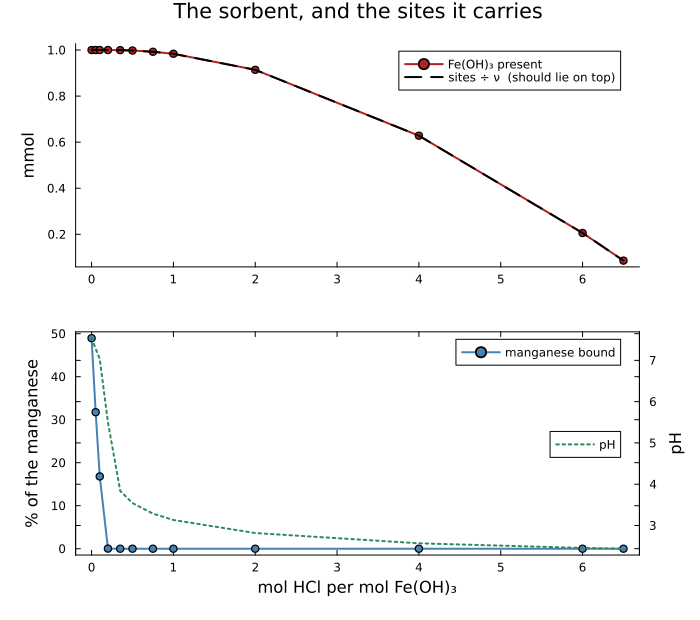
The dashed line is the site total divided by ν. It lies on the solid one because the constraint says it must; if it ever did not, the calculation would not be the one that was declared.
The three things worth checking afterwards
A solve that converges, an answer that is physically admissible and a certified minimum are three different statements. Here they are separately.
worst_ratio = maximum(abs(r.sites / r.oxide / ν - 1) for r in runs)1.714137745079114e-7The relation holds. The site total is ν times the host amount, everywhere, to that relative accuracy.
element(n, e) = sum(
    n[i] * Float64(get(atoms(cs.species[i]), e, 0)) for i in eachindex(n)
)
n0 = Float64[ustrip(us"mol", x) for x in state.n]
worst_element = maximum(
    abs(element(Float64[ustrip(us"mol", v) for v in r.eq.n], e) - element(n0, e)) /
        element(n0, e) for e in (:Fe, :Mn), r in runs
)1.3955579313690292e-11The elements are conserved, computed from the species' own declared formulas rather than from the matrix, so this checks the matrix too. It is the test that would have caught the tempting shortcut of subtracting the coupling from the free site's row, which quietly invents ν moles of oxygen and ν of hydrogen per mole of host.
worst_si = maximum(
    abs(saturation_indices(r.eq, model)["Fe(OH)3(am)"])
        for r in runs if r.oxide > 1.0e-9
)9.800652908074367e-12Every phase that is present sits at log SI = 0. That is not a coincidence to be admired: it is the definition of being at equilibrium with the solution, and an index that disagreed with it would be a diagnostic that lies.
What PHREEQC does, and where this differs
PHREEQC has been able to tie a surface to a mineral since version 2, written
Hfo_wOH Fe(OH)3(a) equilibrium_phase 0.2which reads exactly as SITES_FOLLOW_HOST does here. The generator test/reference/phreeqc_evolving_surface.py titrates a sorbent to exhaustion with it, and the two codes agree on the coupling law to 2 × 10⁻¹⁰ over five partially dissolved states.
They are not running one surface model, and the difference is worth knowing before comparing anything else. PHREEQC scales the site totals from the phase and stops there: the phase's own stability is untouched. This package carries the coupling in the conservation matrix, so the host's saturation index picks up the site potential — which is why the free site's reference energy matters here and not there. The two therefore agree on the ratio of sites to phase and on the amounts the acid budget fixes, and are expected to differ on dissolved iron.
What this page does not cover
The sorbent exhausted. Past about seven moles of acid per mole of oxide the solid is gone, its whole family sits at the solver's floor, and the solve stops certifying. The sweep above stops before that on purpose; a surface with no host is a system to describe differently, not a limit to take.
A sorbent that appears. Everything here runs backwards as well — the same declaration describes a phase precipitating and bringing its sites with it — but the case that matters, a C-S-H forming as a paste hydrates, needs site densities for the C-S-H that nobody has published. That is a missing measurement, not a missing feature.
Electrostatics. The surface here has a charge and no potential; see A charged surface, screened.
The reference energy, taken seriously. Setting it to the matter the free site carries is what this package does, and it is stated rather than inherited from a database. (Kulik, 2002) avoids needing it at all, by keeping the free site out of the balance as a surface monolayer solvent of fixed activity. That is a different formulation, and the one to read before pushing this to site densities where the approximation would show.
See also
Surface areas — the syntax, and the two ways of declaring the component that are refused.
Surface complexation — why a site balance is a conservation row, and how Langmuir falls out of it.
Two families of sites, and a metal between them — the same oxide with a fixed budget, against PHREEQC.