
A thermogram, and the windows it takes to have one
Before this page
Calibrating hydration kinetics on measured calorimetry, whose parameters this page constrains further.
Calorimetry constrains three combinations of six kinetic parameters and no more — the calibration example measures exactly that. Breaking the remaining correlations needs a measurement that sees the phases rather than the heat, and thermogravimetry is the obvious one.
This page builds the forward operator, and then does the thing that makes it useful: recovers its own parameters from a curve.
What leaves, and how much
using ChemistryLab, DynamicQuantities, Printf

c18 = Dict(symbol(s) => s for s in
           build_species(datapath("cemdata18-thermofun.json"); verbose = false))
aq = Dict(symbol(s) => s for s in
          build_species(datapath("slop98-inorganic-thermofun.json"); verbose = false))

cs = ChemicalSystem(
    vcat([aq[k] for k in ("H2O@", "H+", "Ca+2", "SO4-2", "CO3-2")],
         [c18[k] for k in ("Portlandite", "Gp", "Cal")]),
    [aq[k] for k in ("H2O@", "H+", "Ca+2", "SO4-2", "CO3-2")],
)
i = Dict(symbol(sp) => k for (k, sp) in enumerate(cs.species))
n = Any[fill(1.0e-12u"mol", length(cs.species))...]
n[i["H2O@"]] = ustrip(us"mol", 1.0u"kg" / aq["H2O@"][:M]) * u"mol"
n[i["Portlandite"]] = 1.0u"mol"; n[i["Gp"]] = 2.0u"mol"; n[i["Cal"]] = 3.0u"mol"
state = ChemicalState(cs, n)

loss = ignition_loss(state)
# `uconvert` and not `ustrip(us"g", …)`: a symbolic unit does not convert
# implicitly, and kilograms asked for in grams is a DimensionError rather than
# a silent rescale — which is the behavior to want.
@printf("water  %7.3f g\nCO2    %7.3f g\ntotal  %7.3f g\n",
        ustrip(uconvert(us"g", loss.water)), ustrip(uconvert(us"g", loss.carbon_dioxide)),
        ustrip(uconvert(us"g", loss.total)))
┌───────────────────────────────────────────────────┐
│ Loading database: data/cemdata18-thermofun.json │
└───────────────────────────────────────────────────┘
┌────────────────────┐
│ Building species │
└────────────────────┘
Progress: 45%|████████████████████████████████████████████████████████████████████████ | ETA: 0:00:00[K
Progress: 84%|██████████████████████████████████████████████████████████████████████████████████████████████████████████████████████████████████████▉ | ETA: 0:00:00[K
Progress: 99%|███████████████████████████████████████████████████████████████████████████████████████████████████████████████████████████████████████████████████████████████▋ | ETA: 0:00:00[K
Progress: 100%|█████████████████████████████████████████████████████████████████████████████████████████████████████████████████████████████████████████████████████████████████| Time: 0:00:00[K
┌──────────────────────────────────────────────────────────┐
│ Loading database: data/slop98-inorganic-thermofun.json │
└──────────────────────────────────────────────────────────┘
┌────────────────────┐
│ Building species │
└────────────────────┘
Progress: 14%|█████████████████████▊ | ETA: 0:00:01[K
Progress: 27%|███████████████████████████████████████████▊ | ETA: 0:00:01[K
Progress: 41%|█████████████████████████████████████████████████████████████████▌ | ETA: 0:00:00[K
Progress: 54%|███████████████████████████████████████████████████████████████████████████████████████▍ | ETA: 0:00:00[K
Progress: 68%|█████████████████████████████████████████████████████████████████████████████████████████████████████████████ | ETA: 0:00:00[K
Progress: 81%|██████████████████████████████████████████████████████████████████████████████████████████████████████████████████████████████████▌ | ETA: 0:00:00[K
Progress: 89%|███████████████████████████████████████████████████████████████████████████████████████████████████████████████████████████████████████████████▋ | ETA: 0:00:00[K
Progress: 92%|████████████████████████████████████████████████████████████████████████████████████████████████████████████████████████████████████████████████████▎ | ETA: 0:00:00[K
Progress: 95%|████████████████████████████████████████████████████████████████████████████████████████████████████████████████████████████████████████████████████████▍ | ETA: 0:00:00[K
Progress: 98%|█████████████████████████████████████████████████████████████████████████████████████████████████████████████████████████████████████████████████████████████▊ | ETA: 0:00:00[K
Progress: 100%|█████████████████████████████████████████████████████████████████████████████████████████████████████████████████████████████████████████████████████████████████| Time: 0:00:01[K
water 90.075 g
CO2 132.028 g
total 222.103 gignition_loss counts hydrogen, not formula water. Portlandite is Ca(OH)₂, has no H₂O written in it, and loses one per formula unit; a rule that searched the formula for H₂O would report zero for it.
bound_water_per_phase(state)2-element Vector{Pair{String, DynamicQuantities.Quantity{Float64, DynamicQuantities.SymbolicDimensions{DynamicQuantities.FRInt32}}}}:
"Gp" => 0.0720599999750976 kg
"Portlandite" => 0.0180149999937744 kgThat is the total, per phase. It is not a thermogram.
Windows, and saying where they came from
A thermogram needs to know when each phase goes. That is not a consequence of a formula, so it comes from a publication or from a measurement — and DecompositionWindow makes a curve say which.
The ones below are neither. They are placeholders, chosen to exercise the forward path, and they print as placeholders for exactly as long as they are placeholders.
placeholder(phase, T½, w; releases = :water) = DecompositionWindow(
    phase, T½, w; releases,
    kind = PROV_PLACEHOLDER, source = "illustrative, not measured",
)
windows = [
    placeholder("Gp", 400.0, 15.0),
    placeholder("Portlandite", 720.0, 12.0),
    placeholder("Cal", 950.0, 20.0; releases = :carbon_dioxide),
]
provenance_report([w.midpoint for w in windows])
(total = 3, counts = Dict{ProvenanceKind, Int64}(PROV_PUBLISHED => 0, PROV_PLACEHOLDER => 3, PROV_MEASURED => 0, PROV_ESTIMATED => 0, PROV_FITTED => 0, PROV_UNSTATED => 0), weakest = PROV_PLACEHOLDER, all_evidence = false, without_uncertainty = 3)weakest = PROV_PLACEHOLDER is the report doing its job: whatever comes out of a calculation resting on these is a picture, not a measurement.
grid = range(300.0, 1200.0; length = 451)
tg = thermogram(state, windows; temperatures = grid)
@printf("starts at %7.3f g, ends at %7.3f g, loses %7.3f g (ignition_loss says %7.3f)\n",
        ustrip(uconvert(us"g", tg.mass[1] * us"kg")), ustrip(uconvert(us"g", tg.mass[end] * us"kg")),
        ustrip(uconvert(us"g", tg.loss[end] * us"kg")), ustrip(uconvert(us"g", loss.total)))
starts at 718.586 g, ends at 496.575 g, loses 222.103 g (ignition_loss says 222.103)The curve integrates to what the formulas say, which is the first thing to check and the one a wrong window silently breaks.
A phase with no window never leaves
It contributes to the starting mass and stays there, so a curve computed without noticing integrates to less than ignition_loss — and says nothing about it. phases_without_windows is how to see it — reporting phase => product, because a carbonated hydrate needs two windows and counting per phase would call it covered when half of it is.
phases_without_windows(state, windows[1:2]) # calcite left out1-element Vector{Pair{String, Symbol}}:
"Cal" => :carbon_dioxide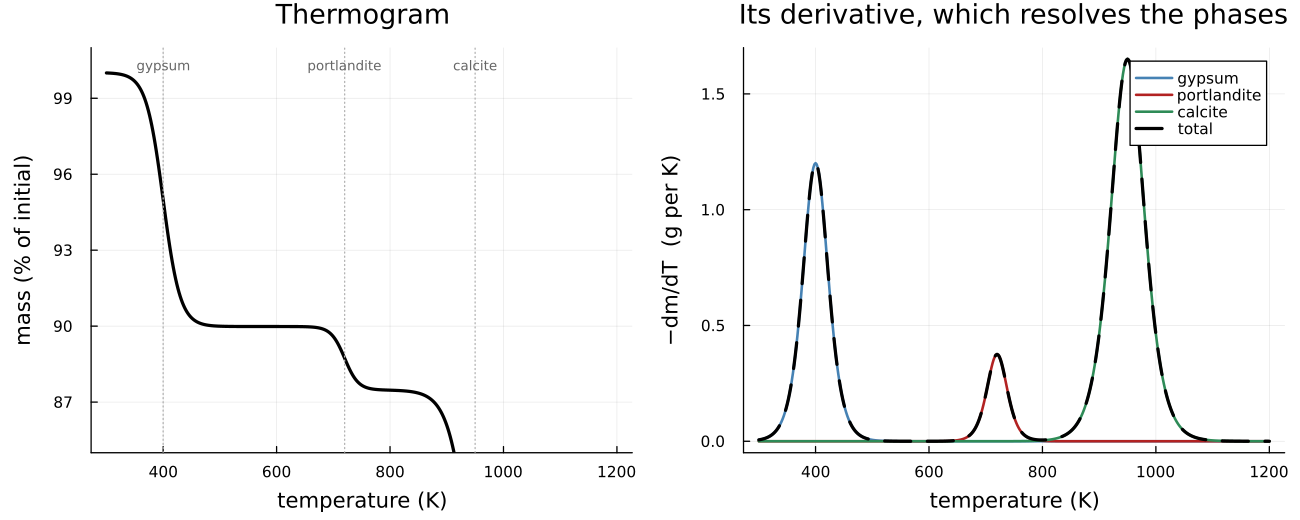
Recovering the windows from the curve
Here is why the operator is written as a smooth function of its windows. Given a thermogram, the windows are identifiable, and the machinery that says whether a parameter is determined is the machinery that determines it.
target = tg.dtg       # a measured curve, in a real case

forward(θ) = thermogram(
    state, with_window_parameters(windows, θ; kind = PROV_UNSTATED);
    temperatures = grid,
).dtg

# Gauss-Newton in log space, on the same sensitivity matrix `identifiability`
# uses — the machinery that says whether a parameter is determined is the
# machinery that determines it.
function identify(θ0; iterations = 40)
    θ = copy(θ0)
    for _ in 1:iterations
        J = log_sensitivity(forward, θ; relstep = 1.0e-3)
        θ = θ .* exp.(clamp.(-(J \ (forward(θ) .- target)), -0.3, 0.3))
    end
    return θ
end

θ0 = window_parameters(windows)[1] .* [1.1, 1.4, 0.945, 0.6, 1.042, 1.4]
θ = identify(θ0)
truth = window_parameters(windows)[1]
@printf("started %4.0f K and %2.0f%% away; recovered to %.2e relative\n",
        maximum(abs.(θ0 .- truth)), 40, maximum(abs.(θ .- truth) ./ truth))
started 40 K and 40% away; recovered to 0.00e+00 relativeAnd then the question that matters more than the numbers:
id = identifiability(forward, θ; observed = target,
                     names = window_parameters(windows)[2])
id
Identifiability of 6 parameters
singular values [0.111, 0.053, 0.0206, 0.00692, 0.00436, 0.00122]
condition 91.19
constrained 6 of 6 directions
residual RMSE 0.0
most collinear T½(Portlandite) / w(Cal) r = -0.003Six parameters, six directions constrained — because the three peaks are well separated, and the spectrum falls off by factors of two and three with no drop anywhere. That is not the usual case.
Where it stops, and why that is the useful part
overlapped = [placeholder("Gp", 400.0, 15.0), placeholder("Portlandite", 405.0, 15.0)]
fwd2(θ) = thermogram(state, with_window_parameters(overlapped, θ; kind = PROV_UNSTATED);
                     temperatures = grid).dtg
θ2, names2 = window_parameters(overlapped)
identifiability(fwd2, θ2; names = names2)
Identifiability of 4 parameters
singular values [0.0546, 0.00538, 0.000482, 0.000164]
condition 332.4
constrained 2 of 4 directions
most collinear T½(Gp) / T½(Portlandite) r = -0.999Two phases releasing 5 K apart, and the rank comes out two of four — which is exactly what the curve looks like: one peak, with a position and a width, rather than two with four parameters between them. The spectrum says the same thing more bluntly, [0.055, 0.0054, 0.00048, 0.00016]: two drops of about ten and then nothing. A fit would still return four numbers.
This is the ordinary case in a cement paste — C-S-H, AFt and AFm all release below 200 °C — which is why running identifiability on the windows is not a formality.
null_participation(identifiability(fwd2, θ2; names = names2))4-element Vector{Float64}:
0.03937868262107411
0.3473264300457502
0.6508763528281261
0.962418534505049That is what as_traced reads to decide which parameters to report as fitted and which as PROV_PLACEHOLDER — a number the curve did not determine is one the optimizer had to leave somewhere. It reads the subspace, not the parameter's position relative to the rank: the rank counts directions, the position is the packing order, and confusing them flags whichever of a trading-off pair happened to be listed second.
What this settles
The total comes from the formulas, exactly, and counts hydrogen rather than formula water.
The shape comes from windows, which are published, measured, or declared placeholders — and which of the three is carried by the value, not by a comment.
The windows are recoverable from a curve, so a phase nobody has titrated is a parameter to identify rather than a reason to stop.
And what a curve cannot determine is reported as not determined, which is the difference between a fit and a measurement.
See also
The water budget of a hydrating paste — what bound water is, and why the pore solution is not it.
Where the numbers come from — provenance, and what to do when the number does not exist yet.
Calibrating hydration kinetics — the measurement this one is meant to join.