
De Leeuw's Problem — Consolidation of a Cylinder
The axisymmetric member of the Mandel–Cryer family: a long saturated cylinder, drained on its lateral surface, compressed radially at
That ordering is the point of running all three. The overshoot grows with the number of directions in which drainage is constrained, and reproducing the sequence is a far stronger statement about the coupling than reproducing any single case.
This benchmark also exercises the cylindrical kinematics — the coordinate system the Barcelona Basic Model will need for axisymmetry, unlike Cryer's spherical one.
Problem
Cylinder of radius
| Boundary | Condition |
|---|---|
| symmetry: | |
| drained |
Reference solution
Derived by the same route as Cryer's, from the single-porosity formulation of (Mehrabian and Abousleiman, 2018). The displacement field is again irrotational, so
In cylindrical coordinates the Laplace-space pressure is built on modified Bessel functions rather than hyperbolic sines:
with
The check that this solution has to pass
The undrained limit is not Skempton's
uniform in
include("biot_common.jl")

using SpecialFunctions
Model
The material of Mandel's and Cryer's problems, so the three overshoots are comparable.
const DELEEUW_MATERIAL = HomogeneousBiot(;
    E = 1.0e8, nu = 0.2, k = 1.0e-13, mu_l = 1.0e-3, b = 1.0, N = 7.2e-9,
)

const R_CYL = 1.0       # radius [m]
const P_LAT = 1.0e6     # lateral confining traction [Pa]

# `compaction_coefficient` and `storage_coefficient` come from the package.


"""
    undrained_pressure(m; Pc)

Initial pore pressure ``p(r,0^+) = \\tfrac{2}{3} B (1+\\nu_u) P_c`` for radial compression
of a cylinder in plane strain.
"""
undrained_pressure(m::HomogeneousBiot; Pc = P_LAT) =
    2 * skempton(m) * (1 + undrained_poisson(m)) * Pc / 3
undrained_pressure (generic function with 1 method)Reference solution
besseli overflows for large arguments, so the exponentially scaled besselix is used and the exponential factor restored by hand.
_I0_ratio(a, x) = besselix(0, a * x) / besselix(0, x) * exp((a - 1) * x)
_I1_over_xI0(x) = besselix(1, x) / (x * besselix(0, x))

"""
    deleeuw_laplace(m, r, ŝ; Pc)

Pore pressure in Laplace space, `ŝ` conjugate to the dimensionless time `t* = ct/R²`.
"""
function deleeuw_laplace(m::HomogeneousBiot, r, ŝ; Pc = P_LAT)
    _, G = lame(m)
    S = storage_coefficient(m)
    q = m.b * compaction_coefficient(m) / S
    x = sqrt(ŝ)
    D = 1 / (2 * (1 - 2m.nu)) + q / 2 - q * _I1_over_xI0(x)
    return (Pc / ŝ) * (m.b / (2G * S)) * (1 - _I0_ratio(r, x)) / D
end

"""
    deleeuw_pressure(m, r, t; Pc) -> p [Pa]

Stehfest inversion of [`deleeuw_laplace`](@ref).

Unlike Cryer's, this transform cannot be evaluated in `BigFloat`: `SpecialFunctions` provides
Bessel functions in `Float64` only. The weights stay in `BigFloat`, which is where the
cancellation actually bites; `Float64` values of the transform are enough, and the agreement
between `N = 10`, `14` and `16` confirms it.
"""
function deleeuw_pressure(m::HomogeneousBiot, r, t; Pc = P_LAT)
    t <= 0 && return undrained_pressure(m; Pc = Pc)
    return stehfest(ŝ -> deleeuw_laplace(m, r, Float64(ŝ); Pc = Pc), t)
end
deleeuw_pressure (generic function with 1 method)Solving
The element is radial_element_matrices! with nhoop = 1 — one hoop direction and an
"""
    run_deleeuw(; m, nel, T_probe, T_start, dT)

Return `(m, r, T_probe, profiles, T_hist, p_axis)`.
"""
function run_deleeuw(;
        m = DELEEUW_MATERIAL,
        nel = 80,
        T_probe = [0.01, 0.03, 0.05, 0.1, 0.3, 0.8],
        T_start = 1.0e-4,
        dT = 5.0e-4,
    )
    c = consolidation_coefficient(m)
    t_of_T(T) = T * R_CYL^2 / c

    grid = generate_grid(Line, (nel,), Vec(0.0), Vec(R_CYL))

    ip = Lagrange{RefLine, 1}()
    dh = DofHandler(grid)
    add!(dh, :u, ip)
    add!(dh, :p, ip)
    close!(dh)

    qr = QuadratureRule{RefLine}(2)
    cv_u = CellValues(qr, ip, ip)
    cv_p = CellValues(qr, ip, ip)

    ch = ConstraintHandler(dh)
    add!(ch, Dirichlet(:u, getfacetset(grid, "left"), (x, t) -> 0.0))
    add!(ch, Dirichlet(:p, getfacetset(grid, "right"), (x, t) -> 0.0))
    close!(ch)
    update!(ch, 0.0)

    n_loc = ndofs_per_cell(dh)
    K1 = allocate_matrix(dh)
    K2 = allocate_matrix(dh)
    A = allocate_matrix(dh)
    as1 = start_assemble(K1)
    as2 = start_assemble(K2)
    ke1 = zeros(n_loc, n_loc)
    ke2 = zeros(n_loc, n_loc)

    for cell in CellIterator(dh)
        reinit!(cv_u, cell)
        reinit!(cv_p, cell)
        radial_element_matrices!(ke1, ke2, m, cv_u, cv_p, getcoordinates(cell); nhoop = 1)
        assemble!(as1, celldofs(cell), ke1)
        assemble!(as2, celldofs(cell), ke2)
    end

    u_dof = zeros(Int, getnnodes(grid))
    p_dof = zeros(Int, getnnodes(grid))
    u_range = dof_range(dh, :u)
    p_range = dof_range(dh, :p)
    for cell in CellIterator(dh)
        d = celldofs(cell)
        for (loc, node) in enumerate(cell.nodes)
            u_dof[node] = d[u_range[loc]]
            p_dof[node] = d[p_range[loc]]
        end
    end

    # Boundary term of the weak form, δu σ_rr r, evaluated at r = R.
    coords = [node.x[1] for node in grid.nodes]
    surface_node = argmax(coords)
    f_ext = zeros(ndofs(dh))
    f_ext[u_dof[surface_node]] = -P_LAT * R_CYL

    schedule = uniform_schedule(T_probe; T_start = T_start, dT = dT)

    x = zeros(ndofs(dh))
    apply!(x, ch)

    profiles = Vector{Vector{Float64}}()
    probes_left = sort(T_probe)
    T_hist = Float64[]
    p_axis = Float64[]
    axis_node = argmin(coords)
    t_prev = 0.0

    for T in schedule
        t = t_of_T(T)
        dt = t - t_prev
        combine!(A, K1, K2, 1.0 / dt)
        rhs = copy(f_ext)
        mul!(rhs, K2, x, 1.0 / dt, 1.0)
        apply!(A, rhs, ch)
        x = A \ rhs
        t_prev = t

        push!(T_hist, T)
        push!(p_axis, x[p_dof[axis_node]])

        if !isempty(probes_left) && isapprox(T, probes_left[1]; rtol = 1.0e-9)
            push!(profiles, [x[p_dof[i]] for i in 1:getnnodes(grid)])
            popfirst!(probes_left)
        end
    end

    return m, coords, sort(T_probe), profiles, T_hist, p_axis
end

model, rr, T_probe, p_num, T_hist, p_axis = run_deleeuw()
(BiotPoroelastic{Float64}(1.0e8, 0.2, 1.0e-13, 0.001, 1.0, 7.2e-9), [0.0, 0.012500000000000011, 0.025000000000000022, 0.03749999999999998, 0.04999999999999999, 0.0625, 0.07500000000000001, 0.08750000000000002, 0.09999999999999998, 0.11249999999999999 … 0.8875, 0.9, 0.9125, 0.925, 0.9375, 0.95, 0.9625, 0.975, 0.9875, 1.0], [0.01, 0.03, 0.05, 0.1, 0.3, 0.8], [[703939.2930085016, 703939.292599533, 703939.2916046139, 703939.289864063, 703939.2871881985, 703939.2832944975, 703939.2777735324, 703939.2700444828, 703939.2592933474, 703939.2443872312 … 394484.5657191685, 357330.9653305416, 317903.5513448533, 276397.2821895019, 233054.611063036, 188161.82298479942, 142043.57794848565, 95055.81559519532, 47577.278464042116, 0.0], [730658.5572339188, 730653.1053433795, 730640.272604045, 730619.0532912095, 730588.8906760697, 730549.111202656, 730498.8633597099, 730437.0929957486, 730362.5237070807, 730273.6366720294 … 237641.9650594876, 212127.11263891685, 186237.21977892917, 160034.62842335075, 133584.2127006956, 106952.89851280177, 80209.15546468535, 53422.46767968016, 26662.790455646747, 0.0], [739862.4703388235, 739815.6382108205, 739706.0577587244, 739526.7262780232, 739275.5325568693, 738950.4845248489, 738549.2724510827, 738069.1659887661, 737506.9780779459, 736859.0485509345 … 182430.5207984178, 162363.5154951022, 142173.8298278094, 121891.73982459176, 101548.02472675448, 81173.82921627043, 60800.522652565174, 40459.55640678392, 20182.320404667957, 0.0], [672268.0772552554, 672126.884830914, 671797.3547994897, 671260.4609478798, 670513.193388042, 669554.2138820571, 668382.5543596921, 666997.3197361495, 665397.5923479714, 663582.3963082115 … 122215.49699227871, 108542.7344688163, 94868.26187458978, 81202.81033430534, 67557.12935831581, 53941.96459694201, 40368.03555873937, 26846.013381224177, 13386.498742306752, 0.0], [278968.75475964346, 278890.60780964146, 278708.3055286813, 278411.52906151494, 277998.95164560026, 277470.30158620735, 276825.6407804784, 276065.1981654506, 275189.3140878012, 274198.4172602682 … 44733.323073824555, 39698.01759285393, 34672.987305275274, 29660.808937272326, 24664.045471108424, 19685.24459778254, 14726.937181013274, 9791.63573370839, 4881.83290799975, 0.0], [26807.83520743735, 26800.312061035387, 26782.76200784086, 26754.19177438752, 26714.473817996924, 26663.582236778064, 26601.523312972244, 26528.319477864483, 26444.003954654796, 26348.61853808526 … 4294.696476149009, 3811.2510189281775, 3328.800071186589, 2847.5900172175257, 2367.865908431837, 1889.8713194271108, 1413.8482051603014, 940.0367592943367, 468.67527381241035, 0.0]], [0.0001, 0.0006000000000000001, 0.0011, 0.0016, 0.0021, 0.0026, 0.0031, 0.0036, 0.0041, 0.0046 … 0.7956, 0.7961, 0.7966, 0.7971, 0.7976, 0.7981, 0.7986, 0.7991, 0.7996, 0.8], [670085.3730885297, 675168.6141147577, 678526.5581749267, 681170.5025966449, 683413.4970072815, 685393.5547188757, 687184.7607973581, 688832.0519099255, 690365.0312459439, 691804.3936992491 … 27366.27680127366, 27302.237513206863, 27238.34808217814, 27174.608157581217, 27111.01738948958, 27047.575428937635, 26984.281927627522, 26921.136538211296, 26858.138914074938, 26807.83520743735])Results
using Plots

p0 = undrained_pressure(model)

@printf("Skempton B          : %.6f\n", skempton(model))
@printf("Undrained ν_u       : %.6f\n", undrained_poisson(model))
@printf("p₀ = (2/3)B(1+ν_u)Pc: %.4e Pa   (Cryer's sphere would give B·Pc = %.4e Pa)\n",
    p0, skempton(model) * P_LAT)
println()
Skempton B : 0.714286
Undrained ν_u : 0.400000
p₀ = (2/3)B(1+ν_u)Pc: 6.6667e+05 Pa (Cryer's sphere would give B·Pc = 7.1429e+05 Pa)The reference, checked before use
@printf("p(r,t→0)/P_c at r* = 0.1, 0.5, 0.9 : %.6f  %.6f  %.6f   (expected %.6f)\n",
    deleeuw_pressure(model, 0.1, 1.0e-6) / P_LAT,
    deleeuw_pressure(model, 0.5, 1.0e-6) / P_LAT,
    deleeuw_pressure(model, 0.9, 1.0e-6) / P_LAT, p0 / P_LAT)
@printf("p at the drained surface, t* = 0.1 : %.3e Pa\n", deleeuw_pressure(model, 0.999999, 0.1))
println()
p(r,t→0)/P_c at r* = 0.1, 0.5, 0.9 : 0.667043 0.667043 0.667043 (expected 0.666667)
p at the drained surface, t* = 0.1 : 9.412e-01 PaThe overshoot, and where it sits between slab and sphere
p_ref_axis = [deleeuw_pressure(model, 1.0e-8, T) for T in T_hist]

i_num = argmax(p_axis)
i_ref = argmax(p_ref_axis)
@printf("numerical peak : p/p₀ = %.5f at T = %.4f\n", p_axis[i_num] / p0, T_hist[i_num])
@printf("reference peak : p/p₀ = %.5f at T = %.4f\n", p_ref_axis[i_ref] / p0, T_hist[i_ref])
@printf("overshoot      : %.1f %%   (Mandel slab 6.5 %%, Cryer sphere 22.9 %%)\n",
    100 * (p_ref_axis[i_ref] / p0 - 1))
println()

plt_hist = plot(
    T_hist, p_ref_axis ./ p0;
    xlabel = "T = c t / R²  [-]", ylabel = "p(0, t) / p₀  [-]",
    title = "De Leeuw — overshoot on the axis of the cylinder",
    label = "reference (Laplace + Stehfest)", lw = 2, color = :black,
    xscale = :log10, legend = :bottomleft, size = (700, 420),
)
plot!(
    plt_hist, T_hist[1:8:end], (p_axis ./ p0)[1:8:end];
    seriestype = :scatter, ms = 3, mswidth = 0, color = :crimson, label = "finite elements",
)
hline!(plt_hist, [1.0]; ls = :dash, color = :grey, label = "p₀")
plt_hist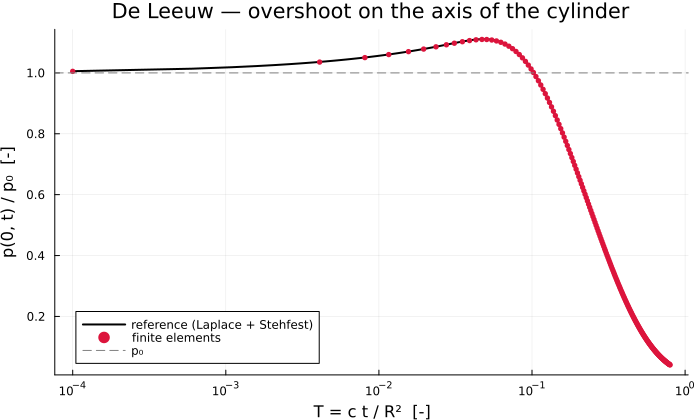
Error against the reference
println("      T     |  L2 error  |  L∞ error [Pa]")
println("-"^44)
errors = Float64[]
for (T, pn) in zip(T_probe, p_num)
    ref = [deleeuw_pressure(model, max(r / R_CYL, 1.0e-8), T) for r in rr]
    e2 = norm(pn .- ref) / norm(ref)
    push!(errors, e2)
    @printf("  %8.4f  |  %.3e |  %10.1f\n", T, e2, maximum(abs.(pn .- ref)))
end
println("-"^44)
@printf("worst relative L2 error: %.3e\n", maximum(errors))
T | L2 error | L∞ error [Pa]
--------------------------------------------
0.0100 | 2.552e-03 | 4552.2
0.0300 | 1.305e-03 | 1565.1
0.0500 | 1.095e-03 | 956.3
0.1000 | 6.380e-04 | 480.8
0.3000 | 1.689e-03 | 523.5
0.8000 | 4.475e-03 | 121.4
--------------------------------------------
worst relative L2 error: 4.475e-03Convergence
function worst_error(; nel, dT)
    mm, rrr, Tp, pn, _, _ = run_deleeuw(; nel = nel, dT = dT)
    return maximum(
        let ref = [deleeuw_pressure(mm, max(r / R_CYL, 1.0e-8), T) for r in rrr]
            norm(p .- ref) / norm(ref)
        end for (T, p) in zip(Tp, pn)
    )
end

println("  ΔT        |  worst L2 error |  ratio")
println("-"^42)
prev = NaN
for dT in (4.0e-3, 2.0e-3, 1.0e-3, 5.0e-4)
    e = worst_error(; nel = 80, dT = dT)
    @printf("  %.2e  |    %.3e    |  %s\n", dT, e, isnan(prev) ? "—" : @sprintf("%.2f", prev / e))
    global prev = e
end
ΔT | worst L2 error | ratio
------------------------------------------
4.00e-03 | 3.517e-02 | —
2.00e-03 | 1.770e-02 | 1.99
1.00e-03 | 8.878e-03 | 1.99
5.00e-04 | 4.475e-03 | 1.98Radial profiles
plt = plot(;
    xlabel = "r / R  [-]", ylabel = "p / p₀  [-]",
    title = "De Leeuw — radial pressure profiles",
    legend = :bottomleft, size = (700, 440),
)
rfine = range(0.001, 0.999; length = 200)
palette = cgrad(:viridis, max(length(T_probe), 2); categorical = true)
for (i, (T, pn)) in enumerate(zip(T_probe, p_num))
    plot!(
        plt, rfine, [deleeuw_pressure(model, r, T) / p0 for r in rfine];
        color = palette[i], lw = 2, label = "T = $T",
    )
    plot!(
        plt, rr ./ R_CYL, pn ./ p0;
        color = palette[i], seriestype = :scatter, ms = 2, mswidth = 0, label = "",
    )
end
plt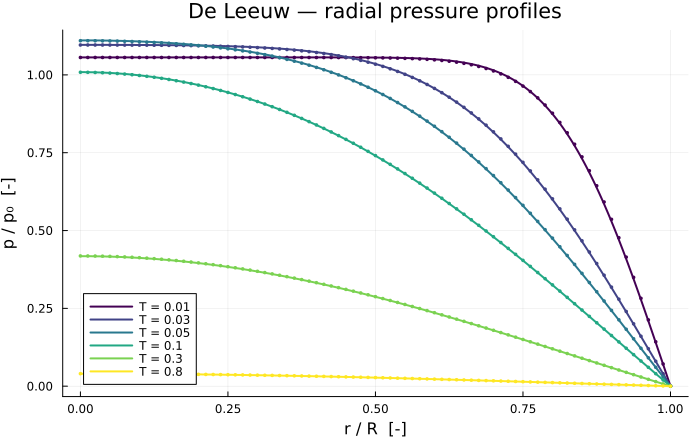
Notes
A different undrained limit is what makes this an independent check rather than a rerun of Cryer's. Plane strain gives
, and the initial value theorem returns it on materials with very different couplings. One parameter separates the geometries. The same
radial_element_matrices!serves both, withnhoop = 1here and2for the sphere.Bessel functions force
Float64for the transform, unlike Cryer's elementary one. Only the Stehfest weights needBigFloat, andN = 10,14,16agree to five digits.