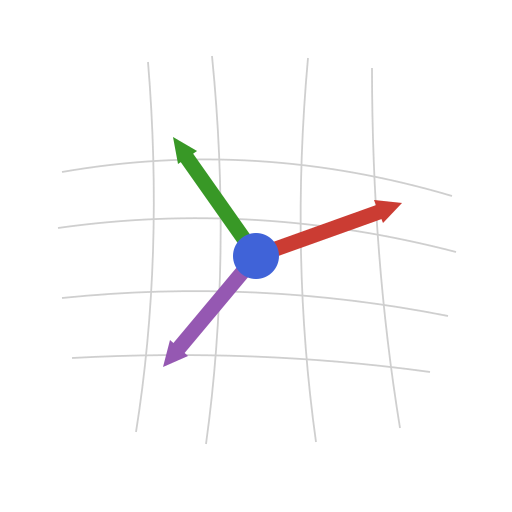
Bases and variance
This is the one chapter with no counterpart in the Echoes manual, which works exclusively in an orthonormal frame and states outright that "introducing the notion of tensor variance is useless here". TensND does not make that assumption: a tensor carries a basis, which may be arbitrary, and a variance tuple saying how each of its indices transforms. Everything below is derived from the definitions and matches src/bases.jl.
Dual basis and metric
Let
The two metric matrices are the Gram matrices of each basis,
so that
Variance of components
A vector has two equally legitimate sets of components,
:cont, the default in TensND) and :cov). An order-
related by the metric, TensND the conversion is components(t, var), or change_tens(t, ℬ, var) when the basis changes too.
Why an identity looks like a metric
Storing the covariant metric Tens docstring and the cheapest sanity check on a basis.
Change of basis
If
This contravariance/covariance split is exactly what the words name, and it is what makes the distinction vanish for an orthonormal basis, where
The four matrices of a Basis
TensND stores all four objects rather than recomputing them, because every component conversion needs one of them:
| Stored matrix | Symbol | Meaning |
|---|---|---|
vecbasis(ℬ, :cov) | columns = basis vectors in the canonical basis | |
vecbasis(ℬ, :cont) | columns = dual basis vectors | |
metric(ℬ, :cov) | covariant metric | |
metric(ℬ, :cont) | contravariant metric, |
The basis hierarchy
The more structure a basis has, the less of the above needs to be computed — so the type of the basis fixes the cost of every operation on tensors expressed in it, and the constructor Basis automatically returns the most specific type that applies.
| Type | Metric | Dual basis | Variance matters? |
|---|---|---|---|
CanonicalBasis | itself | no | |
RotatedBasis | itself | no | |
OrthogonalBasis | yes, but diagonally | ||
Basis | full | yes |
RotatedBasis is built from one angle in 2-D or three Euler angles in 3-D (see Rotations); OrthogonalBasis from an orthonormal basis and a tuple of scaling factors
Correspondingly, a tensor's type follows its basis' type: Tens, TensOrthogonal, TensRotated, TensCanonical. Only the first two carry a variance tuple.
Normalization
Dividing each vector of a basis by its norm produces an orthogonal basis with unit vectors, i.e. an orthonormal one if the original was orthogonal. This is LinearAlgebra.normalize``(ℬ) and it is what relates the natural basis of a coordinate system to its normalized basis — the distinction that makes
For a general (non-orthogonal) basis, normalizing removes the scaling but not the obliquity: the metric becomes a correlation matrix with unit diagonal, and variance still matters.