
A CEM I from its clinker phases
This page starts where a cement data sheet stops: four anhydrous phases and a sulfate carrier, a water/cement ratio, and nothing else. Everything after that — how fast each phase reacts, which hydrates appear and in what amounts, how the pore space closes, how the paste dries itself, how much heat it releases — is computed.
It is meant to be read as the entry point to the cement material in this documentation. The w/c example asks what the equilibrium assemblage is at a given degree of hydration; Self-desiccation asks where hydration stops. Here the question is simpler and comes first: what does a paste do, over ninety days, starting from its clinker.
1. Three clinkers, one controlled difference
The reference composition is the CEM I of (Baroghel-Bouny et al., 1999), Table 2. The other two are constructed from it rather than measured: they trade alite for belite at constant total silicate, which isolates the one effect this page is about. They are not three commercial cements, and nothing here should be read as a claim about any.
using ChemistryLab
using OrdinaryDiffEq
using DynamicQuantities
using OrderedCollections
using Plots
using Printf

# mass fractions of the anhydrous cement. C3S + C2S is held at 0.8126.
CLINKERS = OrderedDict(
    "measured (Baroghel-Bouny CO)" =>
        (C3S = 0.5728, C2S = 0.2398, C3A = 0.0303, C4AF = 0.0759, Gp = 0.0439),
    "alite-rich (constructed)" =>
        (C3S = 0.7126, C2S = 0.1000, C3A = 0.0303, C4AF = 0.0759, Gp = 0.0439),
    "belite-rich (constructed)" =>
        (C3S = 0.4128, C2S = 0.3998, C3A = 0.0303, C4AF = 0.0759, Gp = 0.0439),
)
WC = 0.45          # enough water that the arrest is not the subject here

for (name, c) in CLINKERS
    @printf("  %-30s C3S %.4f  C2S %.4f  C3A %.4f  C4AF %.4f  Gp %.4f\n",
            name, c.C3S, c.C2S, c.C3A, c.C4AF, c.Gp)
end
measured (Baroghel-Bouny CO) C3S 0.5728 C2S 0.2398 C3A 0.0303 C4AF 0.0759 Gp 0.0439
alite-rich (constructed) C3S 0.7126 C2S 0.1000 C3A 0.0303 C4AF 0.0759 Gp 0.0439
belite-rich (constructed) C3S 0.4128 C2S 0.3998 C3A 0.0303 C4AF 0.0759 Gp 0.04392. The chemical system
The species list is the clinker, the sulfate carrier and the hydrates they can form. Nothing else is admitted, and that closed list is an assumption worth stating: a phase absent from it cannot appear however stable it would be.
substances = build_species(datapath("cemdata18-thermofun.json"); verbose = false)
selection = split(
    "C3S C2S C3A C4AF Gp Portlandite Jennite ettringite monosulphate12 " *
        "C3AH6 C3FH6 H2O@"
)
cs = ChemicalSystem(
    speciation(substances, selection; aggregate_state = [AS_AQUEOUS]), CEMDATA_PRIMARIES
)
sp(n) = cs[n]
println("$(length(cs.species)) species in the system")
┌───────────────────────────────────────────────────┐
│ Loading database: data/cemdata18-thermofun.json │
└───────────────────────────────────────────────────┘
┌────────────────────┐
│ Building species │
└────────────────────┘
Progress: 83%|█████████████████████████████████████████████████████████████████████████████████████████████████████████████████████████████████████▌ | ETA: 0:00:00[K
Progress: 100%|█████████████████████████████████████████████████████████████████████████████████████████████████████████████████████████████████████████████████████████████████| Time: 0:00:00[K
52 species in the system3. The reactions, and the rate law each one carries
Four hydration reactions, each with a Parrot-Killoh rate in its Avrami form. The water ceiling is computed rather than assumed — powers_alpha_max returns exactly 1 at w/c = 0.45, because above 0.42 there is enough water for complete hydration and nothing about water is limiting. Below it the same call would return a real ceiling, and the w/c example is where that is the subject. Here the arrest, if any, is left to the humidity coupling of §7.
law = VanGenuchten(; a = 37.5479e6, m = 1 / 2.1684)   # Baroghel-Bouny, mix CO

function build(compo; humidity = true, tend = 90 * 86400.0)
    st = ChemicalState(cs)
    for (name, frac) in pairs(compo)
        set_quantity!(st, string(name), frac * u"kg")
    end
    set_quantity!(st, "H2O@", WC * sum(values(compo)) * u"kg")
    h = humidity ? PoreHumidity(law, cs; reference = st) : nothing

    specs = (
        ("C3S", PK84_PARAMS_C3S,
         OrderedDict(sp("C3S") => 1.0, sp("H2O@") => 103 / 30),
         OrderedDict(sp("Jennite") => 1.0, sp("Portlandite") => 4 / 3)),
        ("C2S", PK84_PARAMS_C2S,
         OrderedDict(sp("C2S") => 1.0, sp("H2O@") => 73 / 30),
         OrderedDict(sp("Jennite") => 1.0, sp("Portlandite") => 1 / 3)),
        # No gypsum in this one, deliberately — see §9.
        ("C3A", PK84_PARAMS_C3A,
         OrderedDict(sp("C3A") => 1.0, sp("H2O@") => 6.0),
         OrderedDict(sp("C3AH6") => 1.0)),
        ("C4AF", PK84_PARAMS_C4AF,
         OrderedDict(sp("C4AF") => 1.0, sp("Portlandite") => 2.0, sp("H2O@") => 10.0),
         OrderedDict(sp("C3AH6") => 1.0, sp("C3FH6") => 1.0)),
    )
    rxns = AbstractReaction[]
    for (nm, pk, reac, prod) in specs
        rx = Reaction(reac, prod; symbol = nm)
        rx[:rate] = parrot_killoh_avrami(
            pk, nm; α_max = powers_alpha_max(WC), blaine = 380.0u"m^2/kg",
            humidity = h
        )
        push!(rxns, rx)
    end
    kp = KineticsProblem(cs, rxns, st, (0.0, tend))
    ks = KineticsSolver(; ode_solver = Rodas5P(), reltol = 1.0e-6, abstol = 1.0e-10)
    return kp, integrate(kp, ks), st, h
end

runs = OrderedDict(name => build(c) for (name, c) in CLINKERS)
println("integrated: ", join(keys(runs), ", "))
┌ Warning: Using arrays or dicts to store parameters of different types can hurt performance.
│ Consider using tuples instead.
└ @ SciMLBase ~/.julia/packages/SciMLBase/1DcFZ/src/performance_warnings.jl:33
integrated: measured (Baroghel-Bouny CO), alite-rich (constructed), belite-rich (constructed)4. How fast each phase reacts
The four clinker phases have very different kinetics, and the shape of the early heat curve of a cement is mostly the aluminate's doing while its strength is mostly the alite's.
kp, sol, st0, h = runs["measured (Baroghel-Bouny CO)"]
ts = exp10.(range(log10(3600.0), log10(90 * 86400.0); length = 120))
dh = degrees_of_hydration(sol, kp; times = ts)
days = ts ./ 86400

p1 = plot(; xscale = :log10, xlabel = "time (days)", ylabel = "degree of hydration α",
    title = "Clinker phases, measured composition", legend = :topleft, ylims = (0, 1))
for (nm, col) in (("C3S", :steelblue), ("C2S", :seagreen),
                  ("C3A", :firebrick), ("C4AF", :darkorange))
    plot!(p1, days, dh[nm]; label = nm, linewidth = 2, color = col)
end
plot(p1; size = (720, 430), left_margin = 8Plots.mm, bottom_margin = 8Plots.mm)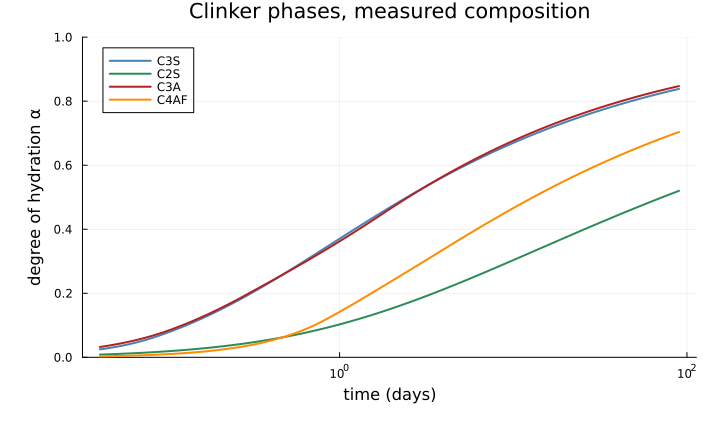
Alite and the aluminate move together early — both near 0.36 at one day — and the ferrite and belite lag well behind, at 0.14 and 0.10. By twenty-eight days alite is at 0.75 and belite has reached only 0.39; at ninety days they are 0.83 and 0.50. Belite is not so much a slow phase as a late one, and that separation is why a cement keeps gaining strength for months rather than days.
5. What changing the clinker does
p2 = plot(; xscale = :log10, xlabel = "time (days)",
    ylabel = "silicate degree of hydration",
    title = "Alite/belite balance, at constant total silicate",
    legend = :topleft, ylims = (0, 1))
for ((name, (kpi, soli, _, _)), col) in zip(runs, (:black, :firebrick, :seagreen))
    d = degrees_of_hydration(soli, kpi; times = ts)
    c = CLINKERS[name]
    blend = (c.C3S .* d["C3S"] .+ c.C2S .* d["C2S"]) ./ (c.C3S + c.C2S)
    plot!(p2, days, blend; label = name, linewidth = 2, color = col)
end
plot(p2; size = (760, 430), left_margin = 8Plots.mm, bottom_margin = 8Plots.mm)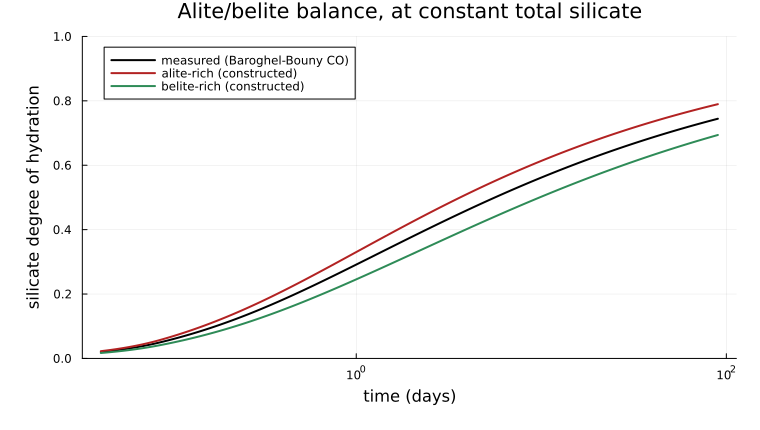
Trading alite for belite at constant silicate content separates the three curves by about 0.08 in degree of hydration at one day (0.244 to 0.328) — and that absolute spread does not close: it is still 0.096 at ninety days (0.694 to 0.790). What closes is the spread relative to how far the reaction has gone, from 29 % of the mean at one day to 13 % at ninety.
So the alite-rich cement is ahead at every age and is never overtaken. The familiar statement that a belite cement "catches up" is a statement about the relative gap, not the absolute one, and the two are worth keeping apart.
6. The hydrates that appear
states = [state_at(sol, kp, t) for t in ts]
amount(name) = [ustrip(us"mol", s.n[findfirst(x -> symbol(x) == name, cs.species)])
                for s in states]

p3 = plot(; xscale = :log10, xlabel = "time (days)", ylabel = "amount (mol)",
    title = "Hydrate assemblage, measured composition", legend = :topleft)
for (nm, lbl, col) in (("Portlandite", "portlandite CH", :steelblue),
                       ("Jennite", "C-S-H (Jennite)", :seagreen),
                       ("C3AH6", "hydrogarnet C3AH6", :firebrick),
                       ("C3FH6", "ferrite hydrogarnet", :darkorange))
    plot!(p3, days, amount(nm); label = lbl, linewidth = 2, color = col)
end
plot(p3; size = (720, 430), left_margin = 8Plots.mm, bottom_margin = 8Plots.mm)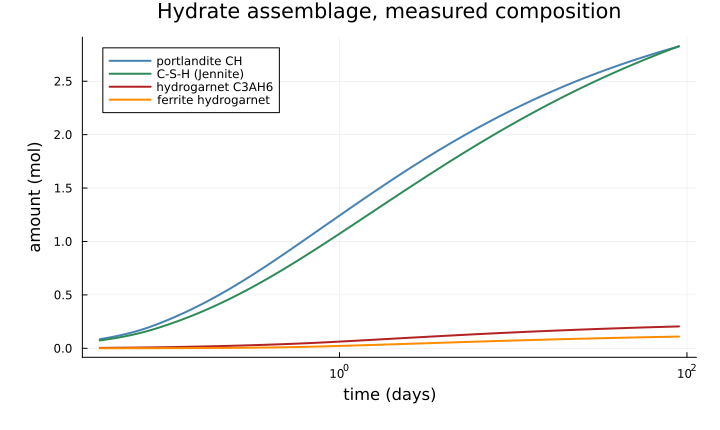
The two silicate hydrates — portlandite and C-S-H — keep growing for the whole ninety days, which is §4's alite and belite curves seen from the product side. The aluminate hydrogarnet is nearly complete by a few days, following its own clinker phase. No ettringite appears at all, and the gypsum in the mix is never touched: §9 is about why.
7. The pore space closes, and the paste dries itself
Hydrates occupy less than the water and clinker they were made from, so voids open even as the solids grow: that is chemical shrinkage, and it is what empties the pores of a sealed paste.
V0 = volume(st0)
poro = [porosity(s, st0).total for s in states]
# m³ → cm³ by hand: `us"cm^3"` is a symbolic unit and does not convert a
# quantity carried in SI dimensions.
shrink = [1.0e6 * ustrip(us"m^3", V0.total - volume(s).total) for s in states]
rh = [h(ustrip.(us"mol", s.n)) for s in states]

p4 = plot(days, 100 .* poro; xscale = :log10, xlabel = "time (days)",
    ylabel = "total porosity (%)", label = "porosity", linewidth = 2,
    color = :steelblue, title = "Pore space and self-desiccation", legend = :left)
p4b = twinx(p4)
plot!(p4b, days, rh; xscale = :log10, ylabel = "internal relative humidity",
    label = "internal RH", linewidth = 2, color = :firebrick, legend = :right,
    ylims = (0.75, 1.01))
hline!(p4b, [0.80]; label = "humidity_factor cut", linestyle = :dash, color = :gray)
plot(p4; size = (760, 430), left_margin = 10Plots.mm, right_margin = 12Plots.mm,
    bottom_margin = 8Plots.mm)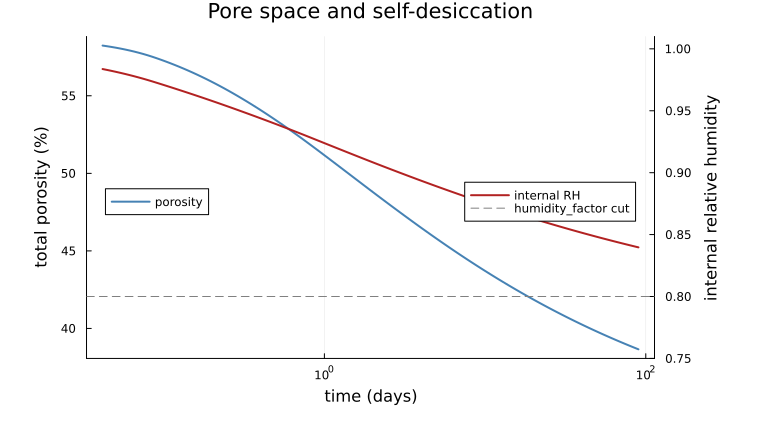
p5 = plot(days, shrink; xscale = :log10, xlabel = "time (days)",
    ylabel = "volume lost (cm³)", label = "chemical shrinkage", linewidth = 2,
    color = :seagreen, title = "Chemical shrinkage", legend = :topleft)
plot(p5; size = (720, 400), left_margin = 10Plots.mm, bottom_margin = 8Plots.mm)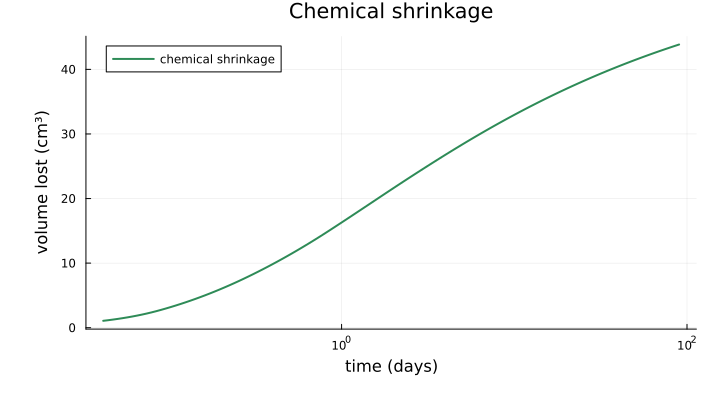
At w/c = 0.45 the internal humidity falls but does not reach the cut, so this paste is not arrested by self-desiccation within ninety days. Self-desiccation in time runs the drier mixes where it is.
8. Why the aluminate reaction here has no gypsum in it
A real cement's aluminate does not go to hydrogarnet: while sulfate lasts it makes ettringite, and once the sulfate is exhausted the ettringite converts to monosulfate. Writing that first stage as a fixed-stoichiometry kinetic reaction is tempting,
C3A + 3 Gp + 26 H2O → ettringite # do not do this with a PK rateand it is wrong for a reason worth showing rather than asserting. A Parrot-Killoh rate depends on the degree of reaction of its own clinker phase and on nothing else. It does not watch the gypsum. Running exactly that reaction on this cement — as a variant, not on this page, since it is the thing to avoid — gives:
| quantity | value |
|---|---|
| gypsum present at | 0.25499 mol |
| C₃A consumed by 90 days | 0.09388 mol |
| gypsum the extent demands ( | 0.28164 mol |
| gypsum actually consumed | 0.25499 mol, and it stops at exactly zero |
The extent kept advancing after the gypsum ran out. The amount of gypsum is floored at zero rather than going negative, so the shortfall — 0.027 mol of sulfate — is simply created. Nothing in the package objects: extent_residual measures the drift between the integrated species and the integrated extents, which is unaffected, and the feasibility machinery guards the element balance of an equilibrium sub-solve, which is not running here.
So a fixed-stoichiometry kinetic reaction is only safe when its co-reactants cannot run out. Two ways round it, and this page takes the first:
write the reaction without the limiting co-reactant, as here and as Cement clinker hydration kinetics does. The aluminate then goes to hydrogarnet, the sulfate stays untouched, and the page does not pretend to model the AFt/AFm sequence;
let the assemblage be a result: attach an equilibrium solver, so the kinetics supplies element budgets and the products are whatever minimizes the Gibbs energy at each step, ettringite while sulfate lasts and monosulfate afterwards. That is The hydrating paste, end to end, and it is the honest route to a sulfate-bearing aluminate.
9. What this page assumed
a closed species list — the hydrates admitted in §2 and no others;
stoichiometric reactions written by hand, one per clinker phase, rather than an equilibrium assemblage. The hydrating paste, end to end attaches an equilibrium solver instead, and then which hydrates appear becomes a result;
Parrot-Killoh parameters as published, with a Blaine correction and no fitting to any measurement on this page;
two constructed clinkers, which exist to isolate one variable and are not cements anyone has made.
See also: Cement clinker hydration kinetics for the same machinery on one composition with calorimetry, the w/c example for the equilibrium view, and the water budget for what the arrest is and is not.