
A composite binder: two glasses at once
A CEM V carries both a blastfurnace slag and a pozzolana, each between 18 % and 30 % for a CEM V/A, leaving 40 % to 64 % clinker. It is the binder in which every difficulty of the preceding pages arrives together:
two constituents with no formula, so the budget comes from two oxide analyses rather than from phases (the CEM III page);
magnesium, from the slag, which makes hydrotalcite and nothing else;
aluminum in excess of what the aluminate phases can hold, from the fly ash, which is why the C-S-H has to be the one that carries it (the CEM IV page);
sulfur at two oxidation states, S(-II) from the slag against S(+VI) from the clinker's calcium sulfate, which is what makes charge a conserved quantity of its own (the redox chapter).
None of these is new here. What is new is that they must hold simultaneously, and the point of the page is that the same element budget answers all four.
0. Why two constituents are not one constituent twice
A natural first reaction to a composite binder is that 24 % slag plus 24 % fly ash should behave like 48 % of "something in between". It does not, and the reason is worth stating because it is the reason the family exists.
The two glasses differ where it matters most — in calcium:
| CaO | SiO₂ | Al₂O₃ | MgO | |
|---|---|---|---|---|
| blastfurnace slag | ~41 % | ~36 % | ~11 % | ~8 % |
| siliceous fly ash | ~4 % | ~53 % | ~26 % | ~2 % |
A slag is latently hydraulic: it carries nearly as much calcium as it needs and mostly wants an alkaline trigger. A fly ash is pozzolanic: it carries almost none, so it must take calcium from the paste — which means consuming the portlandite the clinker makes.
Put them together and the slag's calcium partly feeds the ash's appetite, so the portlandite lasts further than it would with the same mass of ash alone. That is why a CEM V reaches a replacement level a CEM IV cannot, and it is visible in the budget table of section 3: read the Ca+2 row across the three columns.
The aluminum goes the other way. Both glasses bring it, the ash twice as much per gram, and there are only so many aluminate hydrates to hold it — which is what makes the C-A-S-H model the load-bearing choice here rather than a refinement.
Nothing here reacts completely, and the page says how much does
A Gibbs minimization reacts whatever it is given. What it is given is therefore a modeling decision, not a detail: hand it the whole binder and it answers what this paste becomes if everything reacts, which no paste does — not the glasses, and not the clinker either. Section 1 fixes a reacted fraction for each constituent, from the water available and from published 28-day measurements, and section 6 sweeps it.
using ChemistryLab
using DynamicQuantities
using OptimaSolver
using OrderedCollections
using Printf
using Plots
default(framestyle = :box, grid = false)

# The ZEOLITE-EXTENDED database, and that is not a detail of convenience.
# [The CEM IV page](@ref ex-cem4-pozzolanic) establishes why: past roughly a
# third replacement the aluminum and the alkalis the pozzolana brings exceed what
# the C-A-S-H and the aluminate hydrates can hold, and with no phase left to
# receive them the minimization has no admissible assemblage at all. A CEM V/A at
# the midpoint of its range is 48 % replaced, well inside that regime.
substances = build_species(datapath("cemdata18-zeolites.json"); verbose = false)
byname = Dict(symbol(s) => s for s in substances)
molar_mass(n) = ustrip(us"g/mol", byname[n][:M])

# Only the zeolites this binder could form. Two of the twenty-eight are a
# chloride and a nitrate sodalite, and this paste carries neither element:
# declaring them would pull every aqueous chloride and nitrate species into the
# system on a budget of exactly zero.
base = build_species(datapath("cemdata18-thermofun.json"); verbose = false)
carries(sp, el) = haskey(atoms(sp), Symbol(el))
ZEOLITES = [z for z in sort(collect(setdiff(Set(symbol.(substances)),
                                            Set(symbol.(base)))))
            if !carries(byname[z], "Cl") && !carries(byname[z], "N")]
┌──────────────────────────────────────────────────┐
│ Loading database: data/cemdata18-zeolites.json │
└──────────────────────────────────────────────────┘
┌────────────────────┐
│ Building species │
└────────────────────┘
Progress: 73%|█████████████████████████████████████████████████████████████████████████████████████████████████████████████████████ | ETA: 0:00:00[K
Progress: 100%|█████████████████████████████████████████████████████████████████████████████████████████████████████████████████████████████████████████████████████████████████| Time: 0:00:00[K
┌───────────────────────────────────────────────────┐
│ Loading database: data/cemdata18-thermofun.json │
└───────────────────────────────────────────────────┘
┌────────────────────┐
│ Building species │
└────────────────────┘
Progress: 86%|███████████████████████████████████████████████████████████████████████████████████████████████████████████████████████████████████████████▏ | ETA: 0:00:00[K
Progress: 100%|█████████████████████████████████████████████████████████████████████████████████████████████████████████████████████████████████████████████████████████████████| Time: 0:00:00[K1. The record, and the three numbers in it
rec = joinpath(datapath("experimental"),
               "smilauer2025-200-cemV-A-S-V-32.5R-prachovice.csv")
for line in eachline(rec)
    startswith(line, "#") || break
    occursin(r"cement:|blaine:|wb:|temperature:", line) && println(line)
end
# cement: CEM V-A (S-V) 32.5 R Prachovice
# blaine: 444 m2/kg
# wb: 0.40
# temperature: 20C(S-V) in the designation is the composition: S for blastfurnace slag, V for siliceous fly ash. The deposit gives the fineness, the water/binder ratio and the calorimetry. It gives neither the clinker composition nor the two replacement levels, so those are assumed at the midpoint of the EN 197-1 range and labeled:
# ASSUMED: a Bogue composition representative of a CEM I clinker.
CLINKER = OrderedDict("C3S" => 0.65, "C2S" => 0.11, "C3A" => 0.11, "C4AF" => 0.08)

# ASSUMED: midpoint of the EN 197-1 CEM V/A range, which is 40-64 % clinker
# with 18-30 % slag and 18-30 % pozzolana.
SLAG_FRACTION = 0.24
ASH_FRACTION = 0.24
GYPSUM = 0.046

# ASSUMED: the same two analyses used on the CEM III and CEM IV pages, so that
# the three calculations differ in their proportions and not in their inputs.
SLAG = OrderedDict("CaO" => 0.41, "SiO2" => 0.36, "Al2O3" => 0.11,
                   "MgO" => 0.08, "SO3" => 0.02)
FLYASH = OrderedDict("SiO2" => 0.53, "Al2O3" => 0.26, "Fe2O3" => 0.07,
                     "CaO" => 0.04, "MgO" => 0.02, "K2O" => 0.025,
                     "Na2O" => 0.008, "SO3" => 0.005)

# THE CLINKER'S OWN ALKALIS, which Bogue does not account for -- minor oxides
# outside the four-phase decomposition, and in a paste what fixes the pH: they
# dissolve almost completely and stay in solution, while the calcium is held down
# by portlandite at 12.5. ASSUMED at a usual industrial level, as a fraction of
# the CLINKER mass. The fly ash brings alkalis of its own, and section 3's table
# shows which constituent brought what. [The CEM III page](@ref cem3-alkali)
# sweeps this input over the industrial range: it, and almost nothing else, is
# what moves the pH.
ALKALIS = OrderedDict("K2O" => 0.008, "Na2O" => 0.002)

WB = 0.40            # MEASURED, from the record above
BINDER_G = 100.0

# HOW MUCH OF EACH CONSTITUENT HAS REACTED. Two ceilings, and the reacted
# fraction is the lower of them.
#
# THE WATER CEILING is the same for every constituent, because it is a property
# of the pore space and not of the grain. Powers (1948): a gram of cement needs
# about 0.42 g of water to hydrate completely -- 0.23 g written into the hydrate
# formulae, and 0.19 g held in the gel pores those hydrates create. Below that
# the paste desiccates itself and stops WITH WATER STILL IN IT, the remaining
# water being in pores too fine to reach an unhydrated grain at a scale orders
# of magnitude larger. Nothing about that argument mentions clinker, so it
# applies to a slag particle and an ash sphere exactly as it does to an alite
# grain. Under water curing the ceiling moves to 0.36, the volume emptied by
# chemical shrinkage being refilled from the bath -- `curing = :saturated`.
CURING = :sealed                                   # ASSUMED: the record is silent
ALPHA_WATER = powers_alpha_max(WB; curing = CURING)

# THE KINETIC CEILING is each constituent's own dissolution rate at the age
# considered, and for the two glasses it is far the lower of the two. The RILEM
# TC 238-SCM round robin [Durdzinski2017](@cite) measured exactly this geometry
# -- Portland cement blended with slag and with a siliceous fly ash, w/b 0.40 --
# in seven laboratories. Its Table 4 at 28 days, by SEM image analysis, the one
# technique the study found consistent: 38 % and 48 % for one slag, 45 % and
# 49 % for the other, 20 % for the siliceous fly ash. The study's own verdict on
# the precision is worth carrying: "at best +/- 5 %".
#
# ASSUMED from that table, and [section 6](@ref cem5-dor) sweeps both.
ALPHA_SLAG = min(0.45, ALPHA_WATER)
ALPHA_ASH = min(0.20, ALPHA_WATER)

# The clinker is taken AT its water ceiling. At 28 days it has not quite got
# there, so the assemblage below is an upper bound on what the clinker
# contributes; section 6 moves it too.
ALPHA_CLINKER = ALPHA_WATER

@printf("water ceiling (%s, w/b = %.2f) : %.3f\n", CURING, WB, ALPHA_WATER)
@printf("reacted: clinker %.0f %%, slag %.0f %%, fly ash %.0f %%\n",
        100ALPHA_CLINKER, 100ALPHA_SLAG, 100ALPHA_ASH)
water ceiling (sealed, w/b = 0.40) : 0.952
reacted: clinker 95 %, slag 45 %, fly ash 20 %2. The system: C-A-S-H, hydrotalcite and the sulfur ladder
pure = split(
    "C3S C2S C3A C4AF Gp Anh Cal Portlandite ettringite monosulphate12 " *
    "monocarbonate hemicarbonate C4AH13 C3AH6 C3FH6 straetlingite " *
    "hydrotalcite Mg2AlC0.5OH Brc FeOOHmic AlOHmic Amor-Sl Mgs " *
    # Aluminum sinks that CEMDATA18 documents and an earlier version of this
    # list simply did not declare. The siliceous hydrogarnet `C3AS0.84H4.32`
    # is the one that matters most here: it is the ALUMINUM end-member of the
    # family whose iron end-member was already present, and a blended binder
    # puts a great deal of aluminum into it. Leaving it out does not make the
    # calculation conservative -- it makes it insoluble, because the element
    # has to go somewhere.
    "C3AS0.84H4.32 C3AS0.41H5.18 straetlingite7 Gbs AlOHam " *
    "M4A-OH-LDH M6A-OH-LDH M8A-OH-LDH C2AH7.5 C4AH11 C4AH19 " *
    "Tro Py Sulfur K2SO4 syngenite Na2SO4"
)
pure = vcat(String.(pure), ZEOLITES)
gel = ["T2C-CNASHss", "T5C-CNASHss", "TobH-CNASHss",
       "5CA", "5CNA", "INFCA", "INFCN", "INFCNA"]
    # THE DECLARED SOLID SOLUTION CANNOT REACH AN ALUMINUM-RICH COMPOSITION,
    # so the aluminum end-member is declared beside it. The siliceous
    # hydrogarnet is a substitution of Al and Fe(III) on TWO sites:
    #
    #   C3AS0.84H4.32   (AlAlO3)[...]       x(Al) = 1.0
    #   C3AFS0.84H4.32  (AlFe|3|O3)[...]    x(Al) = 0.5
    #   C3FS0.84H4.32   (Fe|3|Fe|3|O3)[...] x(Al) = 0.0
    #
    # CEMDATA18 declares the binary between the middle and the iron end
    # (`data/solid_solutions.toml`, source Lothenbach2019), which spans
    # x(Al) from 0.5 down to 0. A CEM I is iron-rich through its ferrite
    # phase and never needs more. A binder whose pozzolana brings twice as
    # much aluminum as iron does, and the declared phase cannot go there.
    #
    # Declaring the aluminum end-member as a separate pure phase is how that
    # half of the series is reachable at all. It is an approximation, and the
    # approximation is named: as a pure phase it carries no mixing entropy,
    # where a site-fraction model over x(Al) in [0,1] would. Extending the
    # solid solution to three end-members would be WORSE, not better --
    # three compositions of a two-site substitution are not three independent
    # end-members, and an ideal ternary over them gets the configurational
    # entropy wrong.
feal = ["C3AFS0.84H4.32", "C3FS0.84H4.32"]
redox_species = ["HS-", "H2S@", "SO4-2", "SO3-2", "S2O3-2", "O2@", "H2@", "CO2@"]

species = speciation(substances, vcat(pure, gel, feal, redox_species);
                     aggregate_state = [AS_AQUEOUS])
ss = [SolidSolutionPhase("CNASH_ss", [byname[m] for m in gel]),
      SolidSolutionPhase("C3(AF)S0.84H", [byname[m] for m in feal])]
cs = ChemicalSystem(species, CEMDATA_PRIMARIES; solid_solutions = ss)
model = HKFActivityModel(å = 0.0, Ḃ = 0.097637, Kₙ = 0.0)

components = String.(symbol.(cs.SM.primaries))
@printf("%d species, %d components: %s\n",
        length(cs.species), length(components), join(components, " "))
@printf("charge (`Zz`) kept as a conservation component: %s\n",
        "Zz" in components ? "yes" : "no")
139 species, 12 components: H2O@ SiO2@ Ca+2 H+ K+ Mg+2 Na+ SO4-2 AlO2- CO3-2 FeO2- Zz
charge (`Zz`) kept as a conservation component: yes3. The budget is additive
Three contributions, and the only reason they can be added is that they are expressed on the same components: the clinker through its phases, each glass through oxide_budget.
clinker_frac = 1 - SLAG_FRACTION - ASH_FRACTION - GYPSUM

"""
    paste(α_slag, α_ash; α_clinker) -> (; state, clinker, slag, ash, total)

The fresh state and the three element contributions, at given reacted fractions.

The state carries ONLY what reacts. What does not is still in the specimen --
unhydrated clinker cores and undissolved glass, both of them measurable -- but it
is no part of the minimization, and putting it in would be a different and false
statement: that an unreacted grain is at equilibrium with the pore solution it is
sitting in.

Two things carry no ceiling. The calcium sulfate is soluble and is gone within
hours, ceiling or no ceiling. And ALL of the mixing water enters: the ceiling
limits how far the reaction can go, not how much water was poured in -- the water
that cannot reach a grain is still in the specimen, and still in the balance.
"""
function paste(α_slag, α_ash; α_clinker = ALPHA_CLINKER)
    st = ChemicalState(cs)
    for (phase, frac) in CLINKER
        set_quantity!(st, phase,
            α_clinker * BINDER_G * clinker_frac * frac / molar_mass(phase) * u"mol")
    end
    set_quantity!(st, "Gp", BINDER_G * GYPSUM / molar_mass("Gp") * u"mol")
    set_quantity!(st, "H2O@", BINDER_G * WB / molar_mass("H2O@") * u"mol")

    clinker = Float64.(cs.SM.A) * ustrip.(us"mol", st.n)
    # The alkalis leave the grain as it dissolves: same fraction as the clinker.
    clinker .+= oxide_budget(ALKALIS, cs.SM.primaries;
                             mass = BINDER_G * clinker_frac * α_clinker * u"g")
    slag = oxide_budget(SLAG, cs.SM.primaries;
                        mass = BINDER_G * SLAG_FRACTION * α_slag * u"g")
    ash = oxide_budget(FLYASH, cs.SM.primaries;
                       mass = BINDER_G * ASH_FRACTION * α_ash * u"g")
    return (; state = st, clinker, slag, ash, total = clinker .+ slag .+ ash)
end

"""
    solve_paste(α_slag, α_ash; start) -> (state, certificate)

The certified equilibrium of the paste at given reacted fractions.

`start` is where the search begins. A cement equilibrium is **hard to start
cold** -- 135 species, an assemblage that is not known in advance, and a pore
solution four orders of magnitude more dilute than the solids -- and the standard
remedy is to walk to it from a state that is easier. Here the walk is in the
reacted fraction itself: a younger paste has released less of everything, so it
is a smaller perturbation of pure water, and its answer is a good start for an
older one.

That is safe here for a reason that is **checked rather than assumed**. Both
solid solutions of section 2 carry the default ideal mixing model, and
`SolidSolutionPhase` refuses a model whose mixing energy has a spinodal — so the
Gibbs function is convex, its minimum is unique, and a continuation **cannot
change what is found**, only whether the search finds it.

Waive that refusal with `check_convexity = false` and none of it holds: inside a
spinodal the minimum is two coexisting compositions rather than one, the
certificate loses the sufficiency that rests on convexity, and the starting point
would then decide which branch the answer lands on — which is exactly the
path-dependence [the miscibility gap page](@ref ex-miscibility-gap) is about. The
certificate decides at every step here, and a start is reused only after it has
been certified.
"""
function solve_paste(α_slag, α_ash; start = nothing)
    pa = paste(α_slag, α_ash)
    return equilibrate_certified(something(start, pa.state); model = model, b = pa.total)
end

p28 = paste(ALPHA_SLAG, ALPHA_ASH)
state, b = p28.state, p28.total

@printf("of 100 g of binder: clinker %.1f g, slag %.1f g, fly ash %.1f g, gypsum %.1f g\n",
        100clinker_frac, 100SLAG_FRACTION, 100ASH_FRACTION, 100GYPSUM)
@printf("of which reacted   : clinker %.1f g, slag %.1f g, fly ash %.1f g, gypsum %.1f g\n\n",
        100clinker_frac * ALPHA_CLINKER, 100SLAG_FRACTION * ALPHA_SLAG,
        100ASH_FRACTION * ALPHA_ASH, 100GYPSUM)
@printf("%-8s %10s %10s %10s %10s\n", "", "clinker", "slag", "fly ash", "total")
for (i, c) in enumerate(components)
    abs(b[i]) > 1.0e-6 &&
        @printf("%-8s %10.5f %10.5f %10.5f %10.5f\n",
                c, p28.clinker[i], p28.slag[i], p28.ash[i], b[i])
end
of 100 g of binder: clinker 47.4 g, slag 24.0 g, fly ash 24.0 g, gypsum 4.6 g
of which reacted : clinker 45.1 g, slag 10.8 g, fly ash 4.8 g, gypsum 4.6 g
clinker slag fly ash total
H2O@ 2.77394 0.08605 -0.00694 2.85305
SiO2@ 0.15735 0.06471 0.04234 0.26440
Ca+2 0.55480 0.07896 0.00342 0.63719
H+ -1.00026 -0.17210 0.01389 -1.15847
K+ 0.00767 0.00000 0.00255 0.01022
Mg+2 0.00000 0.02144 0.00238 0.02382
Na+ 0.00291 0.00000 0.00124 0.00415
SO4-2 0.02672 0.00270 0.00030 0.02972
AlO2- 0.05162 0.02330 0.02448 0.09940
FeO2- 0.01486 -0.00000 0.00421 0.01907That table is the page in one object. The aluminum comes mostly from the ash, the magnesium only from the slag, the sulfur from all three at two different oxidation states, the alkalis from the clinker and the ash together — and the calcium overwhelmingly from the clinker even at 48 % replacement.
Read the K+ and Na+ rows in particular. They are a few hundredths of a mole against nearly a mole of calcium, and they are what sets the pH: the calcium is buffered by portlandite at 12.5 and cannot rise, while the alkalis dissolve almost entirely and stay in solution. A budget that leaves them out — and a Bogue calculation leaves them out, since they sit outside the four-phase decomposition — returns a portlandite floor and calls it a pore solution.
4. The equilibrium
# Continued from a seven-day paste rather than started cold -- see `solve_paste`
# above for why, and section 6 for the ages this walk passes through.
eq_early, cert_early = solve_paste(0.35, 0.10)
eq, cert = solve_paste(ALPHA_SLAG, ALPHA_ASH;
                       start = cert_early.optimal ? eq_early : nothing)

@printf("started from a 7-day paste: certified %s\n", cert_early.optimal)
@printf("certificate: optimal=%s  worst SI=%.2e  element balance=%.1e\n",
        cert.optimal, cert.worst_supersaturation, cert.balance)
# The volume is that of the REACTED system and its pore solution. The
# unhydrated clinker and the undissolved glass occupy volume too; the clinker's
# is computable from its phases, the glass's would need a density this page has
# not been given, so neither is added rather than one of them being.
@printf("pH = %.3f   volume of the reacted system = %.2f cm3\n",
        pH(eq, model), ustrip(uconvert(us"cm^3", volume(eq).total)))
┌ Warning: Verbosity toggle: missing_second_order_ad
│ The selected optimization algorithm requires second order derivatives, but `SecondOrder` ADtype was not provided. So a `SecondOrder` with AutoForwardDiff() for both inner and outer will be created, this can be suboptimal and not work in some cases so an explicit `SecondOrder` ADtype is recommended.
└ @ OptimizationBase ~/.julia/packages/OptimizationBase/TvAnm/src/cache.jl:116
┌ Warning: Verbosity toggle: missing_second_order_ad
│ The selected optimization algorithm requires second order derivatives, but `SecondOrder` ADtype was not provided. So a `SecondOrder` with AutoForwardDiff() for both inner and outer will be created, this can be suboptimal and not work in some cases so an explicit `SecondOrder` ADtype is recommended.
└ @ OptimizationBase ~/.julia/packages/OptimizationBase/TvAnm/src/cache.jl:116
┌ Warning: Verbosity toggle: missing_second_order_ad
│ The selected optimization algorithm requires second order derivatives, but `SecondOrder` ADtype was not provided. So a `SecondOrder` with AutoForwardDiff() for both inner and outer will be created, this can be suboptimal and not work in some cases so an explicit `SecondOrder` ADtype is recommended.
└ @ OptimizationBase ~/.julia/packages/OptimizationBase/TvAnm/src/cache.jl:116
┌ Warning: Verbosity toggle: missing_second_order_ad
│ The selected optimization algorithm requires second order derivatives, but `SecondOrder` ADtype was not provided. So a `SecondOrder` with AutoForwardDiff() for both inner and outer will be created, this can be suboptimal and not work in some cases so an explicit `SecondOrder` ADtype is recommended.
└ @ OptimizationBase ~/.julia/packages/OptimizationBase/TvAnm/src/cache.jl:116
┌ Warning: Verbosity toggle: missing_second_order_ad
│ The selected optimization algorithm requires second order derivatives, but `SecondOrder` ADtype was not provided. So a `SecondOrder` with AutoForwardDiff() for both inner and outer will be created, this can be suboptimal and not work in some cases so an explicit `SecondOrder` ADtype is recommended.
└ @ OptimizationBase ~/.julia/packages/OptimizationBase/TvAnm/src/cache.jl:116
┌ Warning: Verbosity toggle: missing_second_order_ad
│ The selected optimization algorithm requires second order derivatives, but `SecondOrder` ADtype was not provided. So a `SecondOrder` with AutoForwardDiff() for both inner and outer will be created, this can be suboptimal and not work in some cases so an explicit `SecondOrder` ADtype is recommended.
└ @ OptimizationBase ~/.julia/packages/OptimizationBase/TvAnm/src/cache.jl:116
┌ Warning: Verbosity toggle: missing_second_order_ad
│ The selected optimization algorithm requires second order derivatives, but `SecondOrder` ADtype was not provided. So a `SecondOrder` with AutoForwardDiff() for both inner and outer will be created, this can be suboptimal and not work in some cases so an explicit `SecondOrder` ADtype is recommended.
└ @ OptimizationBase ~/.julia/packages/OptimizationBase/TvAnm/src/cache.jl:116
┌ Warning: Verbosity toggle: missing_second_order_ad
│ The selected optimization algorithm requires second order derivatives, but `SecondOrder` ADtype was not provided. So a `SecondOrder` with AutoForwardDiff() for both inner and outer will be created, this can be suboptimal and not work in some cases so an explicit `SecondOrder` ADtype is recommended.
└ @ OptimizationBase ~/.julia/packages/OptimizationBase/TvAnm/src/cache.jl:116
┌ Warning: Verbosity toggle: missing_second_order_ad
│ The selected optimization algorithm requires second order derivatives, but `SecondOrder` ADtype was not provided. So a `SecondOrder` with AutoForwardDiff() for both inner and outer will be created, this can be suboptimal and not work in some cases so an explicit `SecondOrder` ADtype is recommended.
└ @ OptimizationBase ~/.julia/packages/OptimizationBase/TvAnm/src/cache.jl:116
┌ Warning: Verbosity toggle: missing_second_order_ad
│ The selected optimization algorithm requires second order derivatives, but `SecondOrder` ADtype was not provided. So a `SecondOrder` with AutoForwardDiff() for both inner and outer will be created, this can be suboptimal and not work in some cases so an explicit `SecondOrder` ADtype is recommended.
└ @ OptimizationBase ~/.julia/packages/OptimizationBase/TvAnm/src/cache.jl:116
┌ Warning: Verbosity toggle: missing_second_order_ad
│ The selected optimization algorithm requires second order derivatives, but `SecondOrder` ADtype was not provided. So a `SecondOrder` with AutoForwardDiff() for both inner and outer will be created, this can be suboptimal and not work in some cases so an explicit `SecondOrder` ADtype is recommended.
└ @ OptimizationBase ~/.julia/packages/OptimizationBase/TvAnm/src/cache.jl:116
┌ Warning: Verbosity toggle: missing_second_order_ad
│ The selected optimization algorithm requires second order derivatives, but `SecondOrder` ADtype was not provided. So a `SecondOrder` with AutoForwardDiff() for both inner and outer will be created, this can be suboptimal and not work in some cases so an explicit `SecondOrder` ADtype is recommended.
└ @ OptimizationBase ~/.julia/packages/OptimizationBase/TvAnm/src/cache.jl:116
┌ Warning: Verbosity toggle: missing_second_order_ad
│ The selected optimization algorithm requires second order derivatives, but `SecondOrder` ADtype was not provided. So a `SecondOrder` with AutoForwardDiff() for both inner and outer will be created, this can be suboptimal and not work in some cases so an explicit `SecondOrder` ADtype is recommended.
└ @ OptimizationBase ~/.julia/packages/OptimizationBase/TvAnm/src/cache.jl:116
started from a 7-day paste: certified true
certificate: optimal=true worst SI=1.01e-10 element balance=2.5e-13
pH = 13.386 volume of the reacted system = 54.74 cm3n = ustrip.(us"mol", eq.n)
present = sort([(symbol(cs.species[i]), n[i])
for i in cs.idx_crystal if n[i] > 1.0e-4]; by = last, rev = true)
for (name, amount) in present
@printf(" %-18s %9.5f mol\n", name, amount)
end T2C-CNASHss 0.15338 mol
Portlandite 0.13831 mol
5CA 0.04845 mol
T5C-CNASHss 0.02519 mol
C3AS0.41H5.18 0.02086 mol
C3AFS0.84H4.32 0.01322 mol
ettringite 0.00973 mol
hydrotalcite 0.00595 mol
INFCN 0.00330 mol
C3FS0.84H4.32 0.00292 mol
5CNA 0.00158 mol
INFCA 0.00140 mol
INFCNA 0.00048 mol
TobH-CNASHss 0.00014 molWhere each element ends up is the more useful reading, since the C-A-S-H holds several of them at once:
"""Moles of one conservation component held by each solid phase, largest first."""
function component_in_solids(component; tol = 1.0e-4)
    row = findfirst(==(component), String.(symbol.(cs.SM.primaries)))
    row === nothing && error("$component is not a component of this system")
    A = Float64.(cs.SM.A)
    out = [(symbol(cs.species[i]), A[row, i] * n[i]) for i in cs.idx_crystal]
    return sort(filter(p -> last(p) > tol, out); by = last, rev = true)
end

# The primary species carry one atom of their element each, so these rows count
# aluminum, magnesium and sulfur however the species that hold them are written.
for (component, element) in ("AlO2-" => "Al", "Mg+2" => "Mg", "SO4-2" => "S")
    println(element, ":")
    for (name, amount) in component_in_solids(component)
        @printf("  %-18s %9.5f mol %s\n", name, amount, element)
    end
    println()
end
Al:
C3AS0.41H5.18 0.04171 mol Al
ettringite 0.01946 mol Al
C3AFS0.84H4.32 0.01322 mol Al
5CA 0.01211 mol Al
hydrotalcite 0.01191 mol Al
INFCA 0.00044 mol Al
5CNA 0.00039 mol Al
INFCNA 0.00015 mol Al
Mg:
hydrotalcite 0.02382 mol Mg
S:
ettringite 0.02919 mol S5. The oxidation state
r = half_reaction(eq, "SO4-2", "HS-")
println("half-reaction : ", r.equation)
@printf("log K at 25 C : %.2f\n", r.logK⁰(T = 298.15))
@printf("pe            : %+.2f\n", pe(eq, model))
@printf("Eh            : %+.3f V\n", Eh(eq, model))
@printf("aqueous S(VI)  : %.3e mol\naqueous S(-II) : %.3e mol\n",
        ustrip(us"mol", moles(eq, "SO4-2")), ustrip(us"mol", moles(eq, "HS-")))
half-reaction : SO₄²⁻ + 9H⁺ + 8e⁻ = 4H₂O@ + HS⁻
log K at 25 C : 33.69
┌ Warning: `HS-` is at 9.85967654375977e-305 mol, at or near the solver floor, so the SO4-2/HS- couple does not buffer anything here: the `pe` returned is set by the floor `ϵ`, not by the chemistry. Read it as a bound, or choose a couple whose members are both present.
└ @ ChemistryLab ~/work/ChemistryLab.jl/ChemistryLab.jl/src/equilibrium/aqueous_properties.jl:660
pe : -9.41
┌ Warning: `HS-` is at 9.85967654375977e-305 mol, at or near the solver floor, so the SO4-2/HS- couple does not buffer anything here: the `pe` returned is set by the floor `ϵ`, not by the chemistry. Read it as a bound, or choose a couple whose members are both present.
└ @ ChemistryLab ~/work/ChemistryLab.jl/ChemistryLab.jl/src/equilibrium/aqueous_properties.jl:660
Eh : -0.557 V
aqueous S(VI) : 4.745e-04 mol
aqueous S(-II) : 9.860e-305 molThe caution of the CEM III page applies unchanged, and for the same reason: a couple buffers a potential only while both members are in solution, and a cement paste puts nearly all of its sulfur into solids. The number is a bound on the reducing power the slag brings, not a measurement of the paste's redox state — and even a buffered value would be the mutual equilibrium of every couple, which sulfate reduction is far too slow to reach during hydration.
6. What the reacted fractions are worth
The three fractions of section 1 are the page's only real assumption, so the page is obliged to say what turns on them. The round robin gives the answer its own way: it reports the same two glasses at 7, 28 and 90 days, so sweeping the age rather than an abstract parameter keeps every point on measured ground. The pairs below are read off its Table 4, SEM image analysis, rounded to the two laboratories' agreement.
AGES = [(" 7 days", 0.35, 0.10), ("28 days", ALPHA_SLAG, ALPHA_ASH),
        ("90 days", 0.52, 0.25)]

@printf("%-9s %7s %7s   %-9s %9s %7s %9s\n",
        "age", "slag", "ash", "certified", "balance", "pH", "portlandite")
i_portlandite = findfirst(sp -> symbol(sp) == "Portlandite", cs.species)

# `let` rather than a bare loop: a top-level `for` that assigns to a name of the
# enclosing scope makes a NEW LOCAL, so `prev` would be read before it is ever
# written. Wrapping the sweep gives it a scope of its own.
let prev = nothing
    for (label, a_sl, a_as) in AGES
        # Ordered by age and continued, for the reason `solve_paste` gives: each
        # answer is the next one's start. The certificate decides every point.
        e, c = solve_paste(a_sl, a_as; start = prev)
        c.optimal && (prev = e)
        nn = ustrip.(us"mol", e.n)
        @printf("%-9s %6.0f %% %6.0f %%   %-9s %9.1e %7.3f %9.5f\n",
                label, 100a_sl, 100a_as, c.optimal, c.balance, pH(e, model),
                nn[i_portlandite])
    end
end
age slag ash certified balance pH portlandite
┌ Warning: Verbosity toggle: missing_second_order_ad
│ The selected optimization algorithm requires second order derivatives, but `SecondOrder` ADtype was not provided. So a `SecondOrder` with AutoForwardDiff() for both inner and outer will be created, this can be suboptimal and not work in some cases so an explicit `SecondOrder` ADtype is recommended.
└ @ OptimizationBase ~/.julia/packages/OptimizationBase/TvAnm/src/cache.jl:116
┌ Warning: Verbosity toggle: missing_second_order_ad
│ The selected optimization algorithm requires second order derivatives, but `SecondOrder` ADtype was not provided. So a `SecondOrder` with AutoForwardDiff() for both inner and outer will be created, this can be suboptimal and not work in some cases so an explicit `SecondOrder` ADtype is recommended.
└ @ OptimizationBase ~/.julia/packages/OptimizationBase/TvAnm/src/cache.jl:116
┌ Warning: Verbosity toggle: missing_second_order_ad
│ The selected optimization algorithm requires second order derivatives, but `SecondOrder` ADtype was not provided. So a `SecondOrder` with AutoForwardDiff() for both inner and outer will be created, this can be suboptimal and not work in some cases so an explicit `SecondOrder` ADtype is recommended.
└ @ OptimizationBase ~/.julia/packages/OptimizationBase/TvAnm/src/cache.jl:116
┌ Warning: Verbosity toggle: missing_second_order_ad
│ The selected optimization algorithm requires second order derivatives, but `SecondOrder` ADtype was not provided. So a `SecondOrder` with AutoForwardDiff() for both inner and outer will be created, this can be suboptimal and not work in some cases so an explicit `SecondOrder` ADtype is recommended.
└ @ OptimizationBase ~/.julia/packages/OptimizationBase/TvAnm/src/cache.jl:116
┌ Warning: Verbosity toggle: missing_second_order_ad
│ The selected optimization algorithm requires second order derivatives, but `SecondOrder` ADtype was not provided. So a `SecondOrder` with AutoForwardDiff() for both inner and outer will be created, this can be suboptimal and not work in some cases so an explicit `SecondOrder` ADtype is recommended.
└ @ OptimizationBase ~/.julia/packages/OptimizationBase/TvAnm/src/cache.jl:116
┌ Warning: Verbosity toggle: missing_second_order_ad
│ The selected optimization algorithm requires second order derivatives, but `SecondOrder` ADtype was not provided. So a `SecondOrder` with AutoForwardDiff() for both inner and outer will be created, this can be suboptimal and not work in some cases so an explicit `SecondOrder` ADtype is recommended.
└ @ OptimizationBase ~/.julia/packages/OptimizationBase/TvAnm/src/cache.jl:116
┌ Warning: Verbosity toggle: missing_second_order_ad
│ The selected optimization algorithm requires second order derivatives, but `SecondOrder` ADtype was not provided. So a `SecondOrder` with AutoForwardDiff() for both inner and outer will be created, this can be suboptimal and not work in some cases so an explicit `SecondOrder` ADtype is recommended.
└ @ OptimizationBase ~/.julia/packages/OptimizationBase/TvAnm/src/cache.jl:116
┌ Warning: Verbosity toggle: missing_second_order_ad
│ The selected optimization algorithm requires second order derivatives, but `SecondOrder` ADtype was not provided. So a `SecondOrder` with AutoForwardDiff() for both inner and outer will be created, this can be suboptimal and not work in some cases so an explicit `SecondOrder` ADtype is recommended.
└ @ OptimizationBase ~/.julia/packages/OptimizationBase/TvAnm/src/cache.jl:116
┌ Warning: Verbosity toggle: missing_second_order_ad
│ The selected optimization algorithm requires second order derivatives, but `SecondOrder` ADtype was not provided. So a `SecondOrder` with AutoForwardDiff() for both inner and outer will be created, this can be suboptimal and not work in some cases so an explicit `SecondOrder` ADtype is recommended.
└ @ OptimizationBase ~/.julia/packages/OptimizationBase/TvAnm/src/cache.jl:116
┌ Warning: Verbosity toggle: missing_second_order_ad
│ The selected optimization algorithm requires second order derivatives, but `SecondOrder` ADtype was not provided. So a `SecondOrder` with AutoForwardDiff() for both inner and outer will be created, this can be suboptimal and not work in some cases so an explicit `SecondOrder` ADtype is recommended.
└ @ OptimizationBase ~/.julia/packages/OptimizationBase/TvAnm/src/cache.jl:116
┌ Warning: Verbosity toggle: missing_second_order_ad
│ The selected optimization algorithm requires second order derivatives, but `SecondOrder` ADtype was not provided. So a `SecondOrder` with AutoForwardDiff() for both inner and outer will be created, this can be suboptimal and not work in some cases so an explicit `SecondOrder` ADtype is recommended.
└ @ OptimizationBase ~/.julia/packages/OptimizationBase/TvAnm/src/cache.jl:116
┌ Warning: Verbosity toggle: missing_second_order_ad
│ The selected optimization algorithm requires second order derivatives, but `SecondOrder` ADtype was not provided. So a `SecondOrder` with AutoForwardDiff() for both inner and outer will be created, this can be suboptimal and not work in some cases so an explicit `SecondOrder` ADtype is recommended.
└ @ OptimizationBase ~/.julia/packages/OptimizationBase/TvAnm/src/cache.jl:116
7 days 35 % 10 % true 7.1e-15 13.342 0.18482
┌ Warning: Verbosity toggle: missing_second_order_ad
│ The selected optimization algorithm requires second order derivatives, but `SecondOrder` ADtype was not provided. So a `SecondOrder` with AutoForwardDiff() for both inner and outer will be created, this can be suboptimal and not work in some cases so an explicit `SecondOrder` ADtype is recommended.
└ @ OptimizationBase ~/.julia/packages/OptimizationBase/TvAnm/src/cache.jl:116
28 days 45 % 20 % true 2.5e-13 13.386 0.13831
┌ Warning: Verbosity toggle: missing_second_order_ad
│ The selected optimization algorithm requires second order derivatives, but `SecondOrder` ADtype was not provided. So a `SecondOrder` with AutoForwardDiff() for both inner and outer will be created, this can be suboptimal and not work in some cases so an explicit `SecondOrder` ADtype is recommended.
└ @ OptimizationBase ~/.julia/packages/OptimizationBase/TvAnm/src/cache.jl:116
90 days 52 % 25 % true 2.0e-13 13.405 0.11405The package's own kinetics would answer this differently, and the disagreement is worth knowing about: the Waller sigmoid shipped for a slag and a fly ash gives 0.29 and 0.32 at 28 days where the round robin measures 0.38–0.49 and 0.20. Both are fits to particular materials, and "a slag" is not a substance — the rate law chapter sets the two side by side.
Read the columns against each other. The portlandite falls by nearly 40 % across the three ages — that is the pozzolanic reaction, and the reason the family exists. The pH moves the other way and by almost nothing, six hundredths of a unit, because it is the alkalis that set it and the glasses release them only slowly; the calcium hydroxide is a floor beneath, not a lever. And every one of the three certifies, with element balances of 2.6·10⁻¹², 8.2·10⁻¹⁴ and 1.1·10⁻¹³.
That is the useful conclusion, and it is worth stating as a limit on what the page claims: between 7 and 90 days the slag's reacted fraction changes by half again, and the assemblage's character does not. The answer is sensitive to the reacted fraction in its amounts and robust in its identity — so a reader who disagrees with the fractions assumed here can move them and keep the qualitative reading, while a reader who wants the amounts must supply a measured degree of reaction for their own materials.
Where this stops being true
Push the fractions to 1 — every grain of slag and every ash sphere fully dissolved — and the calculation stops having an answer at all: the minimization reports supersaturated hydrotalcite and layered double hydroxides it has no room to precipitate, an element balance off by 3·10⁻¹, and a pH of 14.4 that no cement paste has ever had. That is not a solver failure and not a gap in CEMDATA18. It is the formulation being asked an unphysical question: a 48 %-replaced binder whose glasses have entirely dissolved would have to place alkalis and aluminum that a real paste never releases, and no assemblage the database can form will hold them. The remedy is not a better minimizer. It is the reacted fraction.
7. Where a CEM V sits among the others
function final_heat(file)
    t, Q = 0.0, 0.0
    for line in eachline(joinpath(datapath("experimental"), file))
        (startswith(line, "#") || startswith(line, "time")) && continue
        f = split(line, ',')
        t, Q = parse(Float64, f[1]), parse(Float64, f[3])
    end
    return t, Q
end

records = [
    ("smilauer2025-122-cemI-52.5R-cizkovice.csv", "CEM I 52.5 R", 0.0),
    ("smilauer2025-165-cemII-A-LL-42.5R-hranice.csv", "CEM II/A-LL", 0.13),
    ("smilauer2025-149-cemII-B-S-32.5R-mokra.csv", "CEM II/B-S", 0.28),
    ("smilauer2025-184-cemIII-A-42.5N-hranice.csv", "CEM III/A", 0.50),
    ("smilauer2025-200-cemV-A-S-V-32.5R-prachovice.csv", "CEM V/A (S-V)", 0.48),
    ("smilauer2025-121-cemIII-B-32.5N-mokra.csv", "CEM III/B", 0.73),
]
labels = String[]
heats = Float64[]
repl = Float64[]
for (file, label, r) in records
    _, Q = final_heat(file)
    push!(labels, label); push!(heats, Q); push!(repl, 100r)
    @printf("  %-16s replacement %4.0f %% (assumed)   Q = %6.1f J/g\n", label, 100r, Q)
end
CEM I 52.5 R replacement 0 % (assumed) Q = 376.0 J/g
CEM II/A-LL replacement 13 % (assumed) Q = 329.3 J/g
CEM II/B-S replacement 28 % (assumed) Q = 295.6 J/g
CEM III/A replacement 50 % (assumed) Q = 261.2 J/g
CEM V/A (S-V) replacement 48 % (assumed) Q = 258.7 J/g
CEM III/B replacement 73 % (assumed) Q = 234.4 J/gfig = scatter(repl, heats; legend = false, markersize = 7, color = :seagreen,
xlabel = "clinker replaced (%, assumed at the EN 197-1 midpoint)",
ylabel = "measured heat at ~28 days (J/g of binder)",
title = "Every joule comes from the clinker",
size = (780, 420),
bottom_margin = 10Plots.mm, left_margin = 10Plots.mm)
for (x, y, l) in zip(repl, heats, labels)
annotate!(fig, x, y + 8, text(l, 8, :left, :bottom))
end
plot!(fig; xlims = (-8, 85), ylims = (200, 410))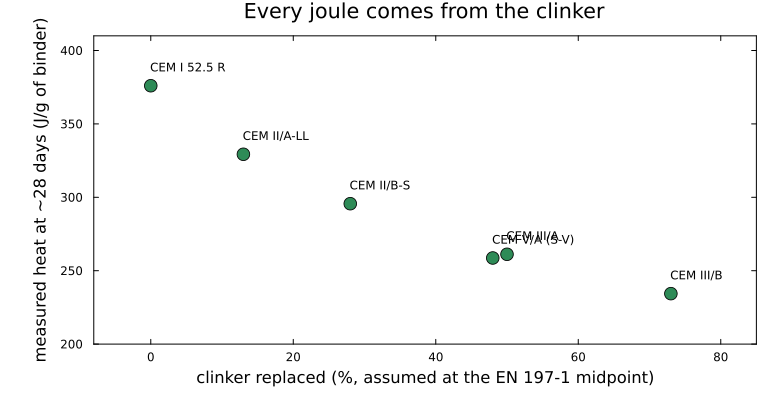
The abscissa is assumed, the ordinate is measured
The heats are measured on one instrument at 20 °C. The replacement levels are not in the deposit — each is the midpoint of the EN 197-1 range for its designation, the same assumption every page here makes. So the figure shows a real trend read against an estimated axis, and the scatter about it is as much the spread of the ranges as it is chemistry. What it does establish is the ordering and the magnitude: half the clinker removed costs roughly a third of the heat.
The CEM V/A and the CEM III/A sit almost on top of each other, at comparable replacement and comparable heat, which is what makes the family interesting: the same reduction in heat and clinker, reached with two different constituents, and therefore with a different assemblage, a different aluminum balance and a different long-term reactivity. The equilibrium calculation above distinguishes them where the calorimeter does not.