
A pozzolanic binder, and the C-S-H that has to carry the aluminum
A CEM IV replaces 11 % to 55 % of the clinker with a pozzolana — siliceous fly ash, natural or calcined pozzolana, silica fume, or a mixture of them. The replacement is not a filler: a pozzolana consumes portlandite and makes more C-S-H out of it, which is why a pozzolanic binder is specified where the paste must be denser and less alkaline.
Two things follow for the calculation, and this page is about both.
The aluminum has somewhere to go, and the model must let it. Fly ash brings almost as much Al as Si. In a real paste most of that aluminum ends up inside the calcium silicate hydrate, as C-A-S-H.
CSHQ, the C-S-H model the CEM I pages use, has no aluminum end-member at all, so a calculation that keeps it forces every atom of aluminum into the AFm and AFt phases.CNASH_ssis the model that can take it.Portlandite becomes the limiting reagent. Past a certain replacement it runs out, and what the paste can do afterwards changes.
0. What a pozzolana actually does
A pozzolana is not a binder on its own. Mix siliceous fly ash with water and nothing happens. What makes it work is that a Portland clinker, while hydrating, produces a large amount of portlandite — calcium hydroxide,
Roughly a fifth of a hydrated CEM I paste is portlandite, and it contributes little strength while being the phase most easily leached. The pozzolanic reaction puts it to work: the ash's amorphous silica consumes it and makes more of the phase that does carry the strength, the calcium silicate hydrate.
So a pozzolanic binder trades a weak, soluble phase for a strong one, at the cost of a slower reaction. Section 6 measures exactly that trade, by sweeping the replacement level and watching the portlandite go.
But the ash brings something else that the equation above ignores, and it is what the rest of the page is about: aluminum, almost as much as silicon. Where it goes decides the answer, and it depends entirely on which C-S-H model the calculation is given.
using ChemistryLab
using DynamicQuantities
using OptimaSolver
using OrderedCollections
using Printf
using Plots
default(framestyle = :box, grid = false)

substances = build_species(datapath("cemdata18-thermofun.json"); verbose = false)
byname = Dict(symbol(s) => s for s in substances)
molar_mass(n) = ustrip(us"g/mol", byname[n][:M])
┌───────────────────────────────────────────────────┐
│ Loading database: data/cemdata18-thermofun.json │
└───────────────────────────────────────────────────┘
┌────────────────────┐
│ Building species │
└────────────────────┘
Progress: 81%|██████████████████████████████████████████████████████████████████████████████████████████████████████████████████████████████████▋ | ETA: 0:00:00[K
Progress: 100%|█████████████████████████████████████████████████████████████████████████████████████████████████████████████████████████████████████████████████████████████████| Time: 0:00:00[K1. What is assumed here, and why all of it is
This page has no measured specimen behind it
The calorimetry deposit this package ships (Šmilauer and Reiterman, 2025) carries CEM I, CEM II, CEM III and CEM V records, and no CEM IV. So unlike the CEM III page and the CEM II page, nothing below is anchored to a specimen. It is a model study of a family, run on a composition chosen inside the EN 197-1 range, and the numbers describe what a pozzolanic binder of that composition does — not what any particular cement contains.
That distinction is worth keeping, because the aluminum question this page is about does not depend on the exact analysis, while the assemblage does.
# ASSUMED: a Bogue composition representative of a CEM I clinker.
CLINKER = OrderedDict("C3S" => 0.65, "C2S" => 0.11, "C3A" => 0.11, "C4AF" => 0.08)

# ASSUMED: a siliceous (class V) fly ash analysis of the kind European standards
# admit — low calcium, high silica and alumina, and the alkalis that make the
# aluminum question interesting.
FLYASH = OrderedDict("SiO2" => 0.53, "Al2O3" => 0.26, "Fe2O3" => 0.07,
                     "CaO" => 0.04, "MgO" => 0.02, "K2O" => 0.025,
                     "Na2O" => 0.008, "SO3" => 0.005)

# THE CLINKER'S OWN ALKALIS, which Bogue does not account for. They are minor
# oxides outside the four-phase decomposition, and in a paste they are what fixes
# the pH: they dissolve almost completely and stay in solution while the calcium
# is held down by portlandite at 12.5. On this page they matter twice over, since
# the whole question of section 6 is what the pozzolana does to the alkalis.
# ASSUMED at a usual industrial level, as a fraction of the CLINKER mass.
# [The CEM III page](@ref cem3-alkali) sweeps this over the industrial range and
# shows that it, and almost nothing else, is what moves the pH.
ALKALIS = OrderedDict("K2O" => 0.008, "Na2O" => 0.002)

# ASSUMED: the midpoint of the EN 197-1 range for a CEM IV/A, which is 65-89 %
# clinker and 11-35 % pozzolana. Section 7 goes to a CEM IV/B, and shows what
# has to be added to the phase list before that is a question with an answer.
ASH_FRACTION = 0.23
ASH_FRACTION_B = 0.45
GYPSUM = 0.046
WB = 0.50
BINDER_G = 100.0

# HOW MUCH REACTS. Two ceilings, and the reacted fraction is the lower.
#
# The WATER ceiling is Powers (1948): about 0.42 g of water per gram of cement
# is needed for complete hydration, 0.23 g written into the hydrates and 0.19 g
# held in gel pores too fine to feed a grain. It is a property of the pore space
# rather than of the grain, so it caps every constituent alike. At w/b = 0.50
# it does not bind at all -- water is abundant here, and the function correctly
# returns 1. It binds on [the CEM V page](@ref ex-cem5-composite), mixed at 0.40.
ALPHA_WATER = powers_alpha_max(WB)              # 1.0 at w/b = 0.50

# The KINETIC ceiling is what actually limits a fly ash, and by a long way. Only
# the glassy fraction reacts at all -- the crystalline mullite and quartz do not
# dissolve on any relevant time scale -- and the glass itself is slow. The RILEM
# TC 238-SCM round robin [Durdzinski2017](@cite) measured a siliceous fly ash at
# 30 % replacement and w/b 0.40 in seven laboratories; its Table 4 at 28 days
# gives 20 % by SEM image analysis, the technique the study found most
# consistent, with XRD-PONKCS between 19 % and 23 %. The study's verdict on the
# precision of any of these: "at best +/- 5 %".
#
# ASSUMED from that table. Section 7 drives it to 1 and shows what changes.
ALPHA_ASH = min(0.20, ALPHA_WATER)
ALPHA_CLINKER = ALPHA_WATER

@printf("water ceiling at w/b = %.2f : %.3f\n", WB, ALPHA_WATER)
@printf("reacted: clinker %.0f %%, fly ash %.0f %%\n",
        100ALPHA_CLINKER, 100ALPHA_ASH)
water ceiling at w/b = 0.50 : 1.000
reacted: clinker 100 %, fly ash 20 %An equilibrium calculation cannot tell glass from mullite, and it cannot tell a dissolved grain from an intact one: it reacts whatever budget it is handed. So the reacted fraction is not a refinement to be added later — it is part of posing the problem, and a page that leaves it at 1 has quietly asked what the paste becomes after every ash sphere has dissolved, which is a question about geological time, not about a specimen at 28 days.
2. Two species lists, differing in one phase
Everything is held fixed between the two systems except the C-S-H model. That is what makes the comparison mean something:
pure = split(
    "C3S C2S C3A C4AF Gp Anh Cal Portlandite ettringite monosulphate12 " *
    "monocarbonate hemicarbonate C4AH13 C3AH6 C3FH6 straetlingite " *
    "hydrotalcite Brc FeOOHmic AlOHmic Amor-Sl Mgs " *
    # Aluminum sinks that CEMDATA18 documents and an earlier version of this
    # list simply did not declare. The siliceous hydrogarnet `C3AS0.84H4.32`
    # is the one that matters most here: it is the ALUMINUM end-member of the
    # family whose iron end-member was already present, and a blended binder
    # puts a great deal of aluminum into it. Leaving it out does not make the
    # calculation conservative -- it makes it insoluble, because the element
    # has to go somewhere.
    "C3AS0.84H4.32 C3AS0.41H5.18 straetlingite7 Gbs AlOHam " *
    "M4A-OH-LDH M6A-OH-LDH M8A-OH-LDH C2AH7.5 C4AH11 C4AH19 " *
    "K2SO4 syngenite Na2SO4"
)
aqueous = ["SO4-2", "CO2@", "O2@"]

CSHQ = ["CSHQ-JenD", "CSHQ-JenH", "CSHQ-TobD", "CSHQ-TobH", "KSiOH", "NaSiOH"]
CNASH = ["T2C-CNASHss", "T5C-CNASHss", "TobH-CNASHss",
         "5CA", "5CNA", "INFCA", "INFCN", "INFCNA"]
    # THE DECLARED SOLID SOLUTION CANNOT REACH AN ALUMINUM-RICH COMPOSITION,
    # so the aluminum end-member is declared beside it. The siliceous
    # hydrogarnet is a substitution of Al and Fe(III) on TWO sites:
    #
    #   C3AS0.84H4.32   (AlAlO3)[...]       x(Al) = 1.0
    #   C3AFS0.84H4.32  (AlFe|3|O3)[...]    x(Al) = 0.5
    #   C3FS0.84H4.32   (Fe|3|Fe|3|O3)[...] x(Al) = 0.0
    #
    # CEMDATA18 declares the binary between the middle and the iron end
    # (`data/solid_solutions.toml`, source Lothenbach2019), which spans
    # x(Al) from 0.5 down to 0. A CEM I is iron-rich through its ferrite
    # phase and never needs more. A binder whose pozzolana brings twice as
    # much aluminum as iron does, and the declared phase cannot go there.
    #
    # Declaring the aluminum end-member as a separate pure phase is how that
    # half of the series is reachable at all. It is an approximation, and the
    # approximation is named: as a pure phase it carries no mixing entropy,
    # where a site-fraction model over x(Al) in [0,1] would. Extending the
    # solid solution to three end-members would be WORSE, not better --
    # three compositions of a two-site substitution are not three independent
    # end-members, and an ideal ternary over them gets the configurational
    # entropy wrong.
FEAL = ["C3AFS0.84H4.32", "C3FS0.84H4.32"]

function system(gel_name, gel_members)
    sp = speciation(substances, vcat(pure, gel_members, FEAL, aqueous);
                    aggregate_state = [AS_AQUEOUS])
    ss = [SolidSolutionPhase(gel_name, [byname[m] for m in gel_members]),
          SolidSolutionPhase("C3(AF)S0.84H", [byname[m] for m in FEAL])]
    return ChemicalSystem(sp, CEMDATA_PRIMARIES; solid_solutions = ss)
end

cs_q = system("CSHQ", CSHQ)
cs_n = system("CNASH_ss", CNASH)
model = HKFActivityModel(å = 0.0, Ḃ = 0.097637, Kₙ = 0.0)

@printf("CSHQ system     : %d species\n", length(cs_q.species))
@printf("CNASH_ss system : %d species\n", length(cs_n.species))
CSHQ system : 107 species
CNASH_ss system : 109 speciesNever both at once
CSHQ, CNASH_ss and the ECSH family are three models of one gel, not three phases. Declaring two of them counts the same calcium silicate hydrate twice, and ChemicalSystem refuses the pair by name. The two systems above are alternatives, built separately and compared, which is the only correct way to use them.
3. The budget
# `α_ash` is a keyword rather than a constant so that section 7 can drive it,
# and the state carries only the reacted clinker: what has not reacted is still
# in the specimen but is not at equilibrium with the pore solution.
function budget(cs; ash, wb = WB, α_ash = ALPHA_ASH, α_clinker = ALPHA_CLINKER)
    clinker_frac = 1 - ash - GYPSUM
    state = ChemicalState(cs)
    for (phase, frac) in CLINKER
        set_quantity!(state, phase,
            α_clinker * BINDER_G * clinker_frac * frac / molar_mass(phase) * u"mol")
    end
    # The calcium sulfate is soluble and carries no ceiling, and all of the
    # mixing water enters: the ceiling limits how far the reaction goes, not how
    # much water was poured in.
    set_quantity!(state, "Gp", BINDER_G * GYPSUM / molar_mass("Gp") * u"mol")
    set_quantity!(state, "H2O@", BINDER_G * wb / molar_mass("H2O@") * u"mol")
    b = Float64.(cs.SM.A) * ustrip.(us"mol", state.n)
    # The alkalis leave the grain as it dissolves: same fraction as the clinker.
    b .+= oxide_budget(ALKALIS, cs.SM.primaries;
                       mass = BINDER_G * clinker_frac * α_clinker * u"g")
    ash > 0 && (b .+= oxide_budget(FLYASH, cs.SM.primaries;
                                   mass = BINDER_G * ash * α_ash * u"g"))
    return state, b
end

st_q, b_q = budget(cs_q; ash = ASH_FRACTION)
st_n, b_n = budget(cs_n; ash = ASH_FRACTION)

comps = String.(symbol.(cs_n.SM.primaries))
for (c, v) in zip(comps, b_n)
    abs(v) > 1.0e-6 && @printf("  %-8s %10.5f mol\n", c, v)
end
H2O@ 3.62436 mol
SiO2@ 0.29294 mol
Ca+2 0.87694 mol
H+ -1.59091 mol
K+ 0.01474 mol
Mg+2 0.00228 mol
Na+ 0.00586 mol
SO4-2 0.02701 mol
AlO2- 0.10625 mol
FeO2- 0.02787 molThe silicon-to-aluminum ratio of that budget is the whole issue. A CEM I paste has roughly seven times more Si than Al; this one has under three.
4. The same paste, two C-S-H models
eq_q, c_q = equilibrate_certified(st_q; model = model, b = b_q)
eq_n, c_n = equilibrate_certified(st_n; model = model, b = b_n)

for (label, cs, eq, c) in (("CSHQ", cs_q, eq_q, c_q),
                           ("CNASH_ss", cs_n, eq_n, c_n))
    @printf("%-10s optimal=%-5s  worst SI=%+.2e  balance=%.1e  pH=%.3f  V=%.2f cm3\n",
            label, c.optimal, c.worst_supersaturation, c.balance,
            pH(eq, model), ustrip(uconvert(us"cm^3", volume(eq).total)))
end
┌ Warning: Verbosity toggle: missing_second_order_ad
│ The selected optimization algorithm requires second order derivatives, but `SecondOrder` ADtype was not provided. So a `SecondOrder` with AutoForwardDiff() for both inner and outer will be created, this can be suboptimal and not work in some cases so an explicit `SecondOrder` ADtype is recommended.
└ @ OptimizationBase ~/.julia/packages/OptimizationBase/TvAnm/src/cache.jl:116
┌ Warning: Verbosity toggle: missing_second_order_ad
│ The selected optimization algorithm requires second order derivatives, but `SecondOrder` ADtype was not provided. So a `SecondOrder` with AutoForwardDiff() for both inner and outer will be created, this can be suboptimal and not work in some cases so an explicit `SecondOrder` ADtype is recommended.
└ @ OptimizationBase ~/.julia/packages/OptimizationBase/TvAnm/src/cache.jl:116
┌ Warning: Verbosity toggle: missing_second_order_ad
│ The selected optimization algorithm requires second order derivatives, but `SecondOrder` ADtype was not provided. So a `SecondOrder` with AutoForwardDiff() for both inner and outer will be created, this can be suboptimal and not work in some cases so an explicit `SecondOrder` ADtype is recommended.
└ @ OptimizationBase ~/.julia/packages/OptimizationBase/TvAnm/src/cache.jl:116
┌ Warning: Verbosity toggle: missing_second_order_ad
│ The selected optimization algorithm requires second order derivatives, but `SecondOrder` ADtype was not provided. So a `SecondOrder` with AutoForwardDiff() for both inner and outer will be created, this can be suboptimal and not work in some cases so an explicit `SecondOrder` ADtype is recommended.
└ @ OptimizationBase ~/.julia/packages/OptimizationBase/TvAnm/src/cache.jl:116
┌ Warning: Verbosity toggle: missing_second_order_ad
│ The selected optimization algorithm requires second order derivatives, but `SecondOrder` ADtype was not provided. So a `SecondOrder` with AutoForwardDiff() for both inner and outer will be created, this can be suboptimal and not work in some cases so an explicit `SecondOrder` ADtype is recommended.
└ @ OptimizationBase ~/.julia/packages/OptimizationBase/TvAnm/src/cache.jl:116
┌ Warning: Verbosity toggle: missing_second_order_ad
│ The selected optimization algorithm requires second order derivatives, but `SecondOrder` ADtype was not provided. So a `SecondOrder` with AutoForwardDiff() for both inner and outer will be created, this can be suboptimal and not work in some cases so an explicit `SecondOrder` ADtype is recommended.
└ @ OptimizationBase ~/.julia/packages/OptimizationBase/TvAnm/src/cache.jl:116
┌ Warning: Verbosity toggle: missing_second_order_ad
│ The selected optimization algorithm requires second order derivatives, but `SecondOrder` ADtype was not provided. So a `SecondOrder` with AutoForwardDiff() for both inner and outer will be created, this can be suboptimal and not work in some cases so an explicit `SecondOrder` ADtype is recommended.
└ @ OptimizationBase ~/.julia/packages/OptimizationBase/TvAnm/src/cache.jl:116
┌ Warning: Verbosity toggle: missing_second_order_ad
│ The selected optimization algorithm requires second order derivatives, but `SecondOrder` ADtype was not provided. So a `SecondOrder` with AutoForwardDiff() for both inner and outer will be created, this can be suboptimal and not work in some cases so an explicit `SecondOrder` ADtype is recommended.
└ @ OptimizationBase ~/.julia/packages/OptimizationBase/TvAnm/src/cache.jl:116
┌ Warning: Verbosity toggle: missing_second_order_ad
│ The selected optimization algorithm requires second order derivatives, but `SecondOrder` ADtype was not provided. So a `SecondOrder` with AutoForwardDiff() for both inner and outer will be created, this can be suboptimal and not work in some cases so an explicit `SecondOrder` ADtype is recommended.
└ @ OptimizationBase ~/.julia/packages/OptimizationBase/TvAnm/src/cache.jl:116
┌ Warning: Verbosity toggle: missing_second_order_ad
│ The selected optimization algorithm requires second order derivatives, but `SecondOrder` ADtype was not provided. So a `SecondOrder` with AutoForwardDiff() for both inner and outer will be created, this can be suboptimal and not work in some cases so an explicit `SecondOrder` ADtype is recommended.
└ @ OptimizationBase ~/.julia/packages/OptimizationBase/TvAnm/src/cache.jl:116
┌ Warning: Verbosity toggle: missing_second_order_ad
│ The selected optimization algorithm requires second order derivatives, but `SecondOrder` ADtype was not provided. So a `SecondOrder` with AutoForwardDiff() for both inner and outer will be created, this can be suboptimal and not work in some cases so an explicit `SecondOrder` ADtype is recommended.
└ @ OptimizationBase ~/.julia/packages/OptimizationBase/TvAnm/src/cache.jl:116
┌ Warning: Verbosity toggle: missing_second_order_ad
│ The selected optimization algorithm requires second order derivatives, but `SecondOrder` ADtype was not provided. So a `SecondOrder` with AutoForwardDiff() for both inner and outer will be created, this can be suboptimal and not work in some cases so an explicit `SecondOrder` ADtype is recommended.
└ @ OptimizationBase ~/.julia/packages/OptimizationBase/TvAnm/src/cache.jl:116
┌ Warning: Verbosity toggle: missing_second_order_ad
│ The selected optimization algorithm requires second order derivatives, but `SecondOrder` ADtype was not provided. So a `SecondOrder` with AutoForwardDiff() for both inner and outer will be created, this can be suboptimal and not work in some cases so an explicit `SecondOrder` ADtype is recommended.
└ @ OptimizationBase ~/.julia/packages/OptimizationBase/TvAnm/src/cache.jl:116
┌ Warning: Verbosity toggle: missing_second_order_ad
│ The selected optimization algorithm requires second order derivatives, but `SecondOrder` ADtype was not provided. So a `SecondOrder` with AutoForwardDiff() for both inner and outer will be created, this can be suboptimal and not work in some cases so an explicit `SecondOrder` ADtype is recommended.
└ @ OptimizationBase ~/.julia/packages/OptimizationBase/TvAnm/src/cache.jl:116
CSHQ optimal=true worst SI=+1.00e-10 balance=1.3e-14 pH=13.239 V=69.12 cm3
CNASH_ss optimal=true worst SI=+1.00e-10 balance=2.7e-13 pH=13.404 V=68.58 cm3Where does the aluminum end up? The conservation matrix already answers it. The row of the primary species AlO2- counts one unit per aluminum atom, so multiplying that row by the amounts distributes the element over the phases that hold it:
"""Moles of one conservation component held by each solid phase, largest first."""
function component_in_solids(cs, eq, component; tol = 1.0e-4)
    n = ustrip.(us"mol", eq.n)
    row = findfirst(==(component), String.(symbol.(cs.SM.primaries)))
    row === nothing && error("$component is not a component of this system")
    A = Float64.(cs.SM.A)
    out = [(symbol(cs.species[i]), A[row, i] * n[i]) for i in cs.idx_crystal]
    return sort(filter(p -> last(p) > tol, out); by = last, rev = true)
end

for (label, cs, eq) in (("CSHQ", cs_q, eq_q), ("CNASH_ss", cs_n, eq_n))
    println(label, " — where the aluminum is:")
    for (name, al) in component_in_solids(cs, eq, "AlO2-")
        @printf("  %-18s %9.5f mol Al\n", name, al)
    end
    println()
end
CSHQ — where the aluminum is:
C3AS0.41H5.18 0.06800 mol Al
C3AFS0.84H4.32 0.01919 mol Al
ettringite 0.01791 mol Al
hydrotalcite 0.00114 mol Al
CNASH_ss — where the aluminum is:
C3AS0.41H5.18 0.05419 mol Al
C3AFS0.84H4.32 0.01932 mol Al
ettringite 0.01739 mol Al
5CA 0.01304 mol Al
hydrotalcite 0.00114 mol Al
5CNA 0.00050 mol Al
INFCA 0.00047 mol Al
INFCNA 0.00020 mol Al5. The assemblages, side by side
function assemblage(cs, eq; tol = 1.0e-4)
    n = ustrip.(us"mol", eq.n)
    sort([(symbol(cs.species[i]), n[i]) for i in cs.idx_crystal if n[i] > tol];
         by = last, rev = true)
end

for (label, cs, eq) in (("CSHQ", cs_q, eq_q), ("CNASH_ss", cs_n, eq_n))
    println(label, ":")
    for (name, amount) in assemblage(cs, eq)
        @printf("  %-18s %9.5f mol\n", name, amount)
    end
    println()
end
CSHQ:
Portlandite 0.23623 mol
CSHQ-JenD 0.13807 mol
CSHQ-TobD 0.10586 mol
CSHQ-JenH 0.08703 mol
C3AS0.41H5.18 0.03400 mol
C3AFS0.84H4.32 0.01919 mol
KSiOH 0.01669 mol
NaSiOH 0.00935 mol
ettringite 0.00896 mol
CSHQ-TobH 0.00437 mol
C3FS0.84H4.32 0.00434 mol
hydrotalcite 0.00057 mol
CNASH_ss:
Portlandite 0.31723 mol
T2C-CNASHss 0.16486 mol
5CA 0.05214 mol
C3AS0.41H5.18 0.02710 mol
T5C-CNASHss 0.02704 mol
C3AFS0.84H4.32 0.01932 mol
ettringite 0.00869 mol
INFCN 0.00428 mol
C3FS0.84H4.32 0.00427 mol
5CNA 0.00198 mol
INFCA 0.00151 mol
INFCNA 0.00064 mol
hydrotalcite 0.00057 mol
TobH-CNASHss 0.00015 molRead the C-A-S-H as a total, not as eight numbers
The eight CNASH_ss end-members span a space of rank 5: Myers' model carries site-occupancy constraints that an ideal eight-component mixture does not reproduce (Myers et al., 2014). The feasible set stays bounded and the solve is well posed, but the individual end-member amounts are not determined by the element balance alone — only their combinations are. The total, the Ca/Si and the Al/Si are the quantities to read.
6. Portlandite is the limiting reagent
The pozzolanic reaction consumes calcium hydroxide, so sweeping the replacement level says how much of it survives. The sweep is run twice — at the reacted fraction of section 1, and in the limit where the ash has entirely dissolved — because the two answer different questions and are routinely confused:
fractions = 0.0:0.10:0.30
curves = Dict{Float64, Tuple{Vector{Float64}, Vector{Float64}, Vector{Bool}}}()
i_ch = findfirst(s -> symbol(s) == "Portlandite", cs_n.species)
for α in (ALPHA_ASH, 1.0)
    ch, phs, ok = Float64[], Float64[], Bool[]
    prev = nothing
    refused = false          # set once this branch has run out; see below
    for f in fractions
        st, b = budget(cs_n; ash = f, α_ash = α)
        # CONTINUATION along the sweep: each point starts from its neighbor's
        # answer rather than from a fresh paste.
        #
        # That is safe here for a reason that is CHECKED rather than assumed.
        # Both solid solutions above are declared with the default ideal mixing
        # model, and `SolidSolutionPhase` refuses a model whose mixing energy has
        # a spinodal -- so the Gibbs function is convex, its minimum is unique,
        # and a continuation cannot change WHAT is found, only whether the search
        # finds it, which on a 109-species cement is the whole difficulty. Waive
        # that refusal with `check_convexity = false` and none of it holds: inside
        # a spinodal the minimum is two compositions, the certificate loses the
        # sufficiency that rests on convexity, and the start would then decide
        # which branch you land on. The certificate still decides every point
        # here, and a start is reused only once it has been certified.
        # The cascade is declined only AFTER this branch has already refused
        # once, and that condition is exact rather than cautious.
        #
        # Measured: this block cost 654 s, of which about 600 were the two
        # points of the α = 1 branch that refuse — a refusal pays every back
        # end, then the ideal pre-solve, then the homotopy, before returning the
        # same verdict. Past the composition where a branch first runs out, the
        # cascade has been shown on this very branch not to change the verdict,
        # so paying it again buys nothing.
        #
        # Declining it from the START of the branch was tried and REJECTED: the
        # two points of that branch that do certify (0 % and 10 % ash) stop
        # certifying without it, their balances going from 1e-15 and 7e-13 to
        # 1.8e-02 and 3.9e-07. That trades two proved answers for two hollow
        # markers of the page's own making, which is a downgrade dressed as a
        # saving.
        eq, c = equilibrate_certified(
            something(prev, st); model = model, b = b, autostart = !refused,
        )
        c.optimal ? (prev = eq) : (refused = true)
        n = ustrip.(us"mol", eq.n)
        push!(ch, n[i_ch])
        push!(phs, pH(eq, model))
        push!(ok, c.optimal)
        # The certificate is carried through to the figure, not just printed. A
        # point that does not certify is a point whose portlandite and pH mean
        # nothing, and a sweep that hides one draws a curve through a number the
        # solver never stood behind.
        @printf("  ash reacted %3.0f %% of %3.0f %%   certified %-5s   balance %8.1e   portlandite %8.5f mol   pH %.3f\n",
                100α, 100f, c.optimal, c.balance, n[i_ch], phs[end])
    end
    curves[α] = (ch, phs, ok)
end
┌ Warning: Verbosity toggle: missing_second_order_ad
│ The selected optimization algorithm requires second order derivatives, but `SecondOrder` ADtype was not provided. So a `SecondOrder` with AutoForwardDiff() for both inner and outer will be created, this can be suboptimal and not work in some cases so an explicit `SecondOrder` ADtype is recommended.
└ @ OptimizationBase ~/.julia/packages/OptimizationBase/TvAnm/src/cache.jl:116
┌ Warning: Verbosity toggle: missing_second_order_ad
│ The selected optimization algorithm requires second order derivatives, but `SecondOrder` ADtype was not provided. So a `SecondOrder` with AutoForwardDiff() for both inner and outer will be created, this can be suboptimal and not work in some cases so an explicit `SecondOrder` ADtype is recommended.
└ @ OptimizationBase ~/.julia/packages/OptimizationBase/TvAnm/src/cache.jl:116
┌ Warning: Verbosity toggle: missing_second_order_ad
│ The selected optimization algorithm requires second order derivatives, but `SecondOrder` ADtype was not provided. So a `SecondOrder` with AutoForwardDiff() for both inner and outer will be created, this can be suboptimal and not work in some cases so an explicit `SecondOrder` ADtype is recommended.
└ @ OptimizationBase ~/.julia/packages/OptimizationBase/TvAnm/src/cache.jl:116
┌ Warning: Verbosity toggle: missing_second_order_ad
│ The selected optimization algorithm requires second order derivatives, but `SecondOrder` ADtype was not provided. So a `SecondOrder` with AutoForwardDiff() for both inner and outer will be created, this can be suboptimal and not work in some cases so an explicit `SecondOrder` ADtype is recommended.
└ @ OptimizationBase ~/.julia/packages/OptimizationBase/TvAnm/src/cache.jl:116
┌ Warning: Verbosity toggle: missing_second_order_ad
│ The selected optimization algorithm requires second order derivatives, but `SecondOrder` ADtype was not provided. So a `SecondOrder` with AutoForwardDiff() for both inner and outer will be created, this can be suboptimal and not work in some cases so an explicit `SecondOrder` ADtype is recommended.
└ @ OptimizationBase ~/.julia/packages/OptimizationBase/TvAnm/src/cache.jl:116
┌ Warning: Verbosity toggle: missing_second_order_ad
│ The selected optimization algorithm requires second order derivatives, but `SecondOrder` ADtype was not provided. So a `SecondOrder` with AutoForwardDiff() for both inner and outer will be created, this can be suboptimal and not work in some cases so an explicit `SecondOrder` ADtype is recommended.
└ @ OptimizationBase ~/.julia/packages/OptimizationBase/TvAnm/src/cache.jl:116
┌ Warning: Verbosity toggle: missing_second_order_ad
│ The selected optimization algorithm requires second order derivatives, but `SecondOrder` ADtype was not provided. So a `SecondOrder` with AutoForwardDiff() for both inner and outer will be created, this can be suboptimal and not work in some cases so an explicit `SecondOrder` ADtype is recommended.
└ @ OptimizationBase ~/.julia/packages/OptimizationBase/TvAnm/src/cache.jl:116
┌ Warning: Verbosity toggle: missing_second_order_ad
│ The selected optimization algorithm requires second order derivatives, but `SecondOrder` ADtype was not provided. So a `SecondOrder` with AutoForwardDiff() for both inner and outer will be created, this can be suboptimal and not work in some cases so an explicit `SecondOrder` ADtype is recommended.
└ @ OptimizationBase ~/.julia/packages/OptimizationBase/TvAnm/src/cache.jl:116
┌ Warning: Verbosity toggle: missing_second_order_ad
│ The selected optimization algorithm requires second order derivatives, but `SecondOrder` ADtype was not provided. So a `SecondOrder` with AutoForwardDiff() for both inner and outer will be created, this can be suboptimal and not work in some cases so an explicit `SecondOrder` ADtype is recommended.
└ @ OptimizationBase ~/.julia/packages/OptimizationBase/TvAnm/src/cache.jl:116
┌ Warning: Verbosity toggle: missing_second_order_ad
│ The selected optimization algorithm requires second order derivatives, but `SecondOrder` ADtype was not provided. So a `SecondOrder` with AutoForwardDiff() for both inner and outer will be created, this can be suboptimal and not work in some cases so an explicit `SecondOrder` ADtype is recommended.
└ @ OptimizationBase ~/.julia/packages/OptimizationBase/TvAnm/src/cache.jl:116
┌ Warning: Verbosity toggle: missing_second_order_ad
│ The selected optimization algorithm requires second order derivatives, but `SecondOrder` ADtype was not provided. So a `SecondOrder` with AutoForwardDiff() for both inner and outer will be created, this can be suboptimal and not work in some cases so an explicit `SecondOrder` ADtype is recommended.
└ @ OptimizationBase ~/.julia/packages/OptimizationBase/TvAnm/src/cache.jl:116
┌ Warning: Verbosity toggle: missing_second_order_ad
│ The selected optimization algorithm requires second order derivatives, but `SecondOrder` ADtype was not provided. So a `SecondOrder` with AutoForwardDiff() for both inner and outer will be created, this can be suboptimal and not work in some cases so an explicit `SecondOrder` ADtype is recommended.
└ @ OptimizationBase ~/.julia/packages/OptimizationBase/TvAnm/src/cache.jl:116
┌ Warning: Verbosity toggle: missing_second_order_ad
│ The selected optimization algorithm requires second order derivatives, but `SecondOrder` ADtype was not provided. So a `SecondOrder` with AutoForwardDiff() for both inner and outer will be created, this can be suboptimal and not work in some cases so an explicit `SecondOrder` ADtype is recommended.
└ @ OptimizationBase ~/.julia/packages/OptimizationBase/TvAnm/src/cache.jl:116
ash reacted 20 % of 0 % certified true balance 2.9e-13 portlandite 0.52565 mol pH 13.444
┌ Warning: Verbosity toggle: missing_second_order_ad
│ The selected optimization algorithm requires second order derivatives, but `SecondOrder` ADtype was not provided. So a `SecondOrder` with AutoForwardDiff() for both inner and outer will be created, this can be suboptimal and not work in some cases so an explicit `SecondOrder` ADtype is recommended.
└ @ OptimizationBase ~/.julia/packages/OptimizationBase/TvAnm/src/cache.jl:116
ash reacted 20 % of 10 % certified true balance 2.2e-13 portlandite 0.43496 mol pH 13.430
┌ Warning: Verbosity toggle: missing_second_order_ad
│ The selected optimization algorithm requires second order derivatives, but `SecondOrder` ADtype was not provided. So a `SecondOrder` with AutoForwardDiff() for both inner and outer will be created, this can be suboptimal and not work in some cases so an explicit `SecondOrder` ADtype is recommended.
└ @ OptimizationBase ~/.julia/packages/OptimizationBase/TvAnm/src/cache.jl:116
ash reacted 20 % of 20 % certified true balance 4.4e-13 portlandite 0.34438 mol pH 13.411
┌ Warning: Verbosity toggle: missing_second_order_ad
│ The selected optimization algorithm requires second order derivatives, but `SecondOrder` ADtype was not provided. So a `SecondOrder` with AutoForwardDiff() for both inner and outer will be created, this can be suboptimal and not work in some cases so an explicit `SecondOrder` ADtype is recommended.
└ @ OptimizationBase ~/.julia/packages/OptimizationBase/TvAnm/src/cache.jl:116
ash reacted 20 % of 30 % certified true balance 4.0e-13 portlandite 0.25388 mol pH 13.388
┌ Warning: Verbosity toggle: missing_second_order_ad
│ The selected optimization algorithm requires second order derivatives, but `SecondOrder` ADtype was not provided. So a `SecondOrder` with AutoForwardDiff() for both inner and outer will be created, this can be suboptimal and not work in some cases so an explicit `SecondOrder` ADtype is recommended.
└ @ OptimizationBase ~/.julia/packages/OptimizationBase/TvAnm/src/cache.jl:116
┌ Warning: Verbosity toggle: missing_second_order_ad
│ The selected optimization algorithm requires second order derivatives, but `SecondOrder` ADtype was not provided. So a `SecondOrder` with AutoForwardDiff() for both inner and outer will be created, this can be suboptimal and not work in some cases so an explicit `SecondOrder` ADtype is recommended.
└ @ OptimizationBase ~/.julia/packages/OptimizationBase/TvAnm/src/cache.jl:116
┌ Warning: Verbosity toggle: missing_second_order_ad
│ The selected optimization algorithm requires second order derivatives, but `SecondOrder` ADtype was not provided. So a `SecondOrder` with AutoForwardDiff() for both inner and outer will be created, this can be suboptimal and not work in some cases so an explicit `SecondOrder` ADtype is recommended.
└ @ OptimizationBase ~/.julia/packages/OptimizationBase/TvAnm/src/cache.jl:116
┌ Warning: Verbosity toggle: missing_second_order_ad
│ The selected optimization algorithm requires second order derivatives, but `SecondOrder` ADtype was not provided. So a `SecondOrder` with AutoForwardDiff() for both inner and outer will be created, this can be suboptimal and not work in some cases so an explicit `SecondOrder` ADtype is recommended.
└ @ OptimizationBase ~/.julia/packages/OptimizationBase/TvAnm/src/cache.jl:116
┌ Warning: Verbosity toggle: missing_second_order_ad
│ The selected optimization algorithm requires second order derivatives, but `SecondOrder` ADtype was not provided. So a `SecondOrder` with AutoForwardDiff() for both inner and outer will be created, this can be suboptimal and not work in some cases so an explicit `SecondOrder` ADtype is recommended.
└ @ OptimizationBase ~/.julia/packages/OptimizationBase/TvAnm/src/cache.jl:116
┌ Warning: Verbosity toggle: missing_second_order_ad
│ The selected optimization algorithm requires second order derivatives, but `SecondOrder` ADtype was not provided. So a `SecondOrder` with AutoForwardDiff() for both inner and outer will be created, this can be suboptimal and not work in some cases so an explicit `SecondOrder` ADtype is recommended.
└ @ OptimizationBase ~/.julia/packages/OptimizationBase/TvAnm/src/cache.jl:116
┌ Warning: Verbosity toggle: missing_second_order_ad
│ The selected optimization algorithm requires second order derivatives, but `SecondOrder` ADtype was not provided. So a `SecondOrder` with AutoForwardDiff() for both inner and outer will be created, this can be suboptimal and not work in some cases so an explicit `SecondOrder` ADtype is recommended.
└ @ OptimizationBase ~/.julia/packages/OptimizationBase/TvAnm/src/cache.jl:116
┌ Warning: Verbosity toggle: missing_second_order_ad
│ The selected optimization algorithm requires second order derivatives, but `SecondOrder` ADtype was not provided. So a `SecondOrder` with AutoForwardDiff() for both inner and outer will be created, this can be suboptimal and not work in some cases so an explicit `SecondOrder` ADtype is recommended.
└ @ OptimizationBase ~/.julia/packages/OptimizationBase/TvAnm/src/cache.jl:116
┌ Warning: Verbosity toggle: missing_second_order_ad
│ The selected optimization algorithm requires second order derivatives, but `SecondOrder` ADtype was not provided. So a `SecondOrder` with AutoForwardDiff() for both inner and outer will be created, this can be suboptimal and not work in some cases so an explicit `SecondOrder` ADtype is recommended.
└ @ OptimizationBase ~/.julia/packages/OptimizationBase/TvAnm/src/cache.jl:116
┌ Warning: Verbosity toggle: missing_second_order_ad
│ The selected optimization algorithm requires second order derivatives, but `SecondOrder` ADtype was not provided. So a `SecondOrder` with AutoForwardDiff() for both inner and outer will be created, this can be suboptimal and not work in some cases so an explicit `SecondOrder` ADtype is recommended.
└ @ OptimizationBase ~/.julia/packages/OptimizationBase/TvAnm/src/cache.jl:116
┌ Warning: Verbosity toggle: missing_second_order_ad
│ The selected optimization algorithm requires second order derivatives, but `SecondOrder` ADtype was not provided. So a `SecondOrder` with AutoForwardDiff() for both inner and outer will be created, this can be suboptimal and not work in some cases so an explicit `SecondOrder` ADtype is recommended.
└ @ OptimizationBase ~/.julia/packages/OptimizationBase/TvAnm/src/cache.jl:116
┌ Warning: Verbosity toggle: missing_second_order_ad
│ The selected optimization algorithm requires second order derivatives, but `SecondOrder` ADtype was not provided. So a `SecondOrder` with AutoForwardDiff() for both inner and outer will be created, this can be suboptimal and not work in some cases so an explicit `SecondOrder` ADtype is recommended.
└ @ OptimizationBase ~/.julia/packages/OptimizationBase/TvAnm/src/cache.jl:116
┌ Warning: Verbosity toggle: missing_second_order_ad
│ The selected optimization algorithm requires second order derivatives, but `SecondOrder` ADtype was not provided. So a `SecondOrder` with AutoForwardDiff() for both inner and outer will be created, this can be suboptimal and not work in some cases so an explicit `SecondOrder` ADtype is recommended.
└ @ OptimizationBase ~/.julia/packages/OptimizationBase/TvAnm/src/cache.jl:116
ash reacted 100 % of 0 % certified true balance 2.9e-13 portlandite 0.52565 mol pH 13.444
┌ Warning: Verbosity toggle: missing_second_order_ad
│ The selected optimization algorithm requires second order derivatives, but `SecondOrder` ADtype was not provided. So a `SecondOrder` with AutoForwardDiff() for both inner and outer will be created, this can be suboptimal and not work in some cases so an explicit `SecondOrder` ADtype is recommended.
└ @ OptimizationBase ~/.julia/packages/OptimizationBase/TvAnm/src/cache.jl:116
ash reacted 100 % of 10 % certified true balance 4.7e-14 portlandite 0.29866 mol pH 13.450
┌ Warning: Verbosity toggle: missing_second_order_ad
│ The selected optimization algorithm requires second order derivatives, but `SecondOrder` ADtype was not provided. So a `SecondOrder` with AutoForwardDiff() for both inner and outer will be created, this can be suboptimal and not work in some cases so an explicit `SecondOrder` ADtype is recommended.
└ @ OptimizationBase ~/.julia/packages/OptimizationBase/TvAnm/src/cache.jl:116
┌ Warning: Verbosity toggle: missing_second_order_ad
│ The selected optimization algorithm requires second order derivatives, but `SecondOrder` ADtype was not provided. So a `SecondOrder` with AutoForwardDiff() for both inner and outer will be created, this can be suboptimal and not work in some cases so an explicit `SecondOrder` ADtype is recommended.
└ @ OptimizationBase ~/.julia/packages/OptimizationBase/TvAnm/src/cache.jl:116
┌ Warning: Verbosity toggle: missing_second_order_ad
│ The selected optimization algorithm requires second order derivatives, but `SecondOrder` ADtype was not provided. So a `SecondOrder` with AutoForwardDiff() for both inner and outer will be created, this can be suboptimal and not work in some cases so an explicit `SecondOrder` ADtype is recommended.
└ @ OptimizationBase ~/.julia/packages/OptimizationBase/TvAnm/src/cache.jl:116
┌ Warning: Verbosity toggle: missing_second_order_ad
│ The selected optimization algorithm requires second order derivatives, but `SecondOrder` ADtype was not provided. So a `SecondOrder` with AutoForwardDiff() for both inner and outer will be created, this can be suboptimal and not work in some cases so an explicit `SecondOrder` ADtype is recommended.
└ @ OptimizationBase ~/.julia/packages/OptimizationBase/TvAnm/src/cache.jl:116
┌ Warning: Verbosity toggle: missing_second_order_ad
│ The selected optimization algorithm requires second order derivatives, but `SecondOrder` ADtype was not provided. So a `SecondOrder` with AutoForwardDiff() for both inner and outer will be created, this can be suboptimal and not work in some cases so an explicit `SecondOrder` ADtype is recommended.
└ @ OptimizationBase ~/.julia/packages/OptimizationBase/TvAnm/src/cache.jl:116
┌ Warning: Verbosity toggle: missing_second_order_ad
│ The selected optimization algorithm requires second order derivatives, but `SecondOrder` ADtype was not provided. So a `SecondOrder` with AutoForwardDiff() for both inner and outer will be created, this can be suboptimal and not work in some cases so an explicit `SecondOrder` ADtype is recommended.
└ @ OptimizationBase ~/.julia/packages/OptimizationBase/TvAnm/src/cache.jl:116
┌ Warning: Verbosity toggle: missing_second_order_ad
│ The selected optimization algorithm requires second order derivatives, but `SecondOrder` ADtype was not provided. So a `SecondOrder` with AutoForwardDiff() for both inner and outer will be created, this can be suboptimal and not work in some cases so an explicit `SecondOrder` ADtype is recommended.
└ @ OptimizationBase ~/.julia/packages/OptimizationBase/TvAnm/src/cache.jl:116
┌ Warning: Verbosity toggle: missing_second_order_ad
│ The selected optimization algorithm requires second order derivatives, but `SecondOrder` ADtype was not provided. So a `SecondOrder` with AutoForwardDiff() for both inner and outer will be created, this can be suboptimal and not work in some cases so an explicit `SecondOrder` ADtype is recommended.
└ @ OptimizationBase ~/.julia/packages/OptimizationBase/TvAnm/src/cache.jl:116
┌ Warning: Verbosity toggle: missing_second_order_ad
│ The selected optimization algorithm requires second order derivatives, but `SecondOrder` ADtype was not provided. So a `SecondOrder` with AutoForwardDiff() for both inner and outer will be created, this can be suboptimal and not work in some cases so an explicit `SecondOrder` ADtype is recommended.
└ @ OptimizationBase ~/.julia/packages/OptimizationBase/TvAnm/src/cache.jl:116
┌ Warning: Verbosity toggle: missing_second_order_ad
│ The selected optimization algorithm requires second order derivatives, but `SecondOrder` ADtype was not provided. So a `SecondOrder` with AutoForwardDiff() for both inner and outer will be created, this can be suboptimal and not work in some cases so an explicit `SecondOrder` ADtype is recommended.
└ @ OptimizationBase ~/.julia/packages/OptimizationBase/TvAnm/src/cache.jl:116
┌ Warning: Verbosity toggle: missing_second_order_ad
│ The selected optimization algorithm requires second order derivatives, but `SecondOrder` ADtype was not provided. So a `SecondOrder` with AutoForwardDiff() for both inner and outer will be created, this can be suboptimal and not work in some cases so an explicit `SecondOrder` ADtype is recommended.
└ @ OptimizationBase ~/.julia/packages/OptimizationBase/TvAnm/src/cache.jl:116
┌ Warning: Verbosity toggle: missing_second_order_ad
│ The selected optimization algorithm requires second order derivatives, but `SecondOrder` ADtype was not provided. So a `SecondOrder` with AutoForwardDiff() for both inner and outer will be created, this can be suboptimal and not work in some cases so an explicit `SecondOrder` ADtype is recommended.
└ @ OptimizationBase ~/.julia/packages/OptimizationBase/TvAnm/src/cache.jl:116
┌ Warning: Verbosity toggle: missing_second_order_ad
│ The selected optimization algorithm requires second order derivatives, but `SecondOrder` ADtype was not provided. So a `SecondOrder` with AutoForwardDiff() for both inner and outer will be created, this can be suboptimal and not work in some cases so an explicit `SecondOrder` ADtype is recommended.
└ @ OptimizationBase ~/.julia/packages/OptimizationBase/TvAnm/src/cache.jl:116
┌ Warning: Verbosity toggle: missing_second_order_ad
│ The selected optimization algorithm requires second order derivatives, but `SecondOrder` ADtype was not provided. So a `SecondOrder` with AutoForwardDiff() for both inner and outer will be created, this can be suboptimal and not work in some cases so an explicit `SecondOrder` ADtype is recommended.
└ @ OptimizationBase ~/.julia/packages/OptimizationBase/TvAnm/src/cache.jl:116
┌ Warning: Verbosity toggle: missing_second_order_ad
│ The selected optimization algorithm requires second order derivatives, but `SecondOrder` ADtype was not provided. So a `SecondOrder` with AutoForwardDiff() for both inner and outer will be created, this can be suboptimal and not work in some cases so an explicit `SecondOrder` ADtype is recommended.
└ @ OptimizationBase ~/.julia/packages/OptimizationBase/TvAnm/src/cache.jl:116
┌ Warning: no route produced a certifiable equilibrium: stationarity 2.032916133988067e-5, element balance 0.0001101858619025238, worst supersaturation -0.0017858223992248123. Automatic initial approximation: the continuation ran and its answer was no better than 0.00020306339006015417, so it was discarded; returning the answer with the smallest KKT error — audit it with `optimality_certificate`
└ @ ChemistryLab ~/work/ChemistryLab.jl/ChemistryLab.jl/src/equilibrium/certified.jl:845
ash reacted 100 % of 20 % certified false balance 1.1e-04 portlandite 0.07188 mol pH 14.784
┌ Warning: Verbosity toggle: missing_second_order_ad
│ The selected optimization algorithm requires second order derivatives, but `SecondOrder` ADtype was not provided. So a `SecondOrder` with AutoForwardDiff() for both inner and outer will be created, this can be suboptimal and not work in some cases so an explicit `SecondOrder` ADtype is recommended.
└ @ OptimizationBase ~/.julia/packages/OptimizationBase/TvAnm/src/cache.jl:116
ash reacted 100 % of 30 % certified false balance 7.7e-02 portlandite 0.00000 mol pH 12.798x = 100 .* collect(fractions)
p1 = plot(; xlabel = "fly ash (% of binder)", ylabel = "portlandite (mol / 100 g)",
title = "Calcium hydroxide consumed", legend = :bottomleft)
p2 = plot(; xlabel = "fly ash (% of binder)", ylabel = "pH",
title = "Pore solution pH", legend = false)
for (α, color, lab) in ((ALPHA_ASH, :seagreen, "ash reacted 20 % (28 days)"),
(1.0, :indianred, "ash reacted 100 % (the limit)"))
ch, phs, ok = curves[α]
plot!(p1, x, ch; marker = :circle, color, label = lab)
plot!(p2, x, phs; marker = :circle, color, label = lab)
# A point the certificate refused is drawn hollow and black, so that a
# reader sees the gap in the evidence rather than a smooth curve through it.
bad = .!ok
if any(bad)
scatter!(p1, x[bad], ch[bad]; marker = :circle, markersize = 8,
markercolor = :white, markerstrokecolor = :black,
label = "not certified")
scatter!(p2, x[bad], phs[bad]; marker = :circle, markersize = 8,
markercolor = :white, markerstrokecolor = :black, label = "")
end
end
fig = plot(p1, p2; layout = (1, 2), size = (900, 380),
bottom_margin = 10Plots.mm, left_margin = 10Plots.mm)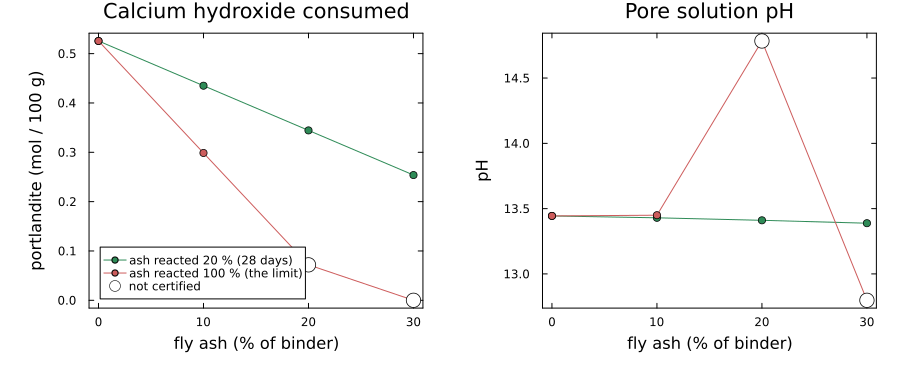
Three things are visible, and they are worth separating — plus one honest gap, marked hollow wherever the certificate refused a point. A refused point is not a result: its portlandite and its pH are whatever the iteration stopped at, and a pH of exactly 6.999 is the signature of a solve that fell back to neutral water. They are drawn rather than dropped, because dropping them would put a smooth curve where the evidence has a hole.
The portlandite falls because the ash's silica turns it into more C-S-H — that is the pozzolanic reaction, and it is the property the family is specified for. How far it falls is entirely a matter of how much ash has reacted: in the limit a CEM IV/A exhausts its portlandite inside the EN 197-1 range — and the last points of that branch stop certifying as it goes, which is what the hollow markers are — while at 28 days the same binder still has about half of it. Reporting the first as though it described a specimen is the single easiest mistake to make with an equilibrium code, and it is not a small one — portlandite is what buffers the pH and what protects the reinforcement.
The pH moves much less than the portlandite, because in a cement paste it is the alkalis that set it, not the calcium hydroxide; portlandite only fixes a floor around 12.5 at 25 °C. A pozzolanic binder lowers the pH mainly by binding alkalis into the C-A-S-H, and that is a mechanism only the CNASH_ss model can express at all.
7. A CEM IV/B, and the limit where the phase list runs out
Everything so far was a CEM IV/A, 23 % ash. Take it to a CEM IV/B — the midpoint of 36–55 % — and ask the same question twice: once at the reacted fraction a specimen has at 28 days, and once in the limit where every ash sphere has dissolved.
How to read optimal = false, because it is not one thing
The certificate reports three residuals, and which one is too large says what went wrong. A novice reading only the optimal flag will mistake a solver difficulty for a statement about chemistry — this page did, for two releases.
| the residual that is large | what it means | what to do |
|---|---|---|
| worst supersaturation, clearly positive | a phase the system could form is not in your species list | declare it |
| element balance | the answer does not conserve matter — it is not an answer at all | start somewhere else |
| stationarity alone, the other two small | a genuinely hard point | nothing simple; report it as unresolved |
A supersaturation of +3e+02 names a missing phase. One of +5e-02 beside a broken balance names a failed solve. Read them, not the flag.
eq_b, c_b = nothing, nothing          # the full-reaction case, kept below

# CONTINUATION, not a cold start, at the 28-day fraction.
#
# A 45 % ash binder is a hard landing. Started from a fresh paste, `CSHQ` stops
# with the element balance off by 7.8e-02 -- 0.078 mol of matter that does not
# conserve -- while its supersaturation is only +5.3e-02. By the table above that
# is a failed solve, not a missing phase, and an earlier version of this page
# read it as chemistry. Walking the ash fraction up to 45 % instead certifies
# every point, `CSHQ` included.
ramp = collect(range(0.15, ASH_FRACTION_B; length = 5))

for (label, cs) in ("CSHQ" => cs_q, "CNASH_ss" => cs_n)
    budgets = [budget(cs; ash = f, α_ash = ALPHA_ASH)[2] for f in ramp]
    st0, _ = budget(cs; ash = first(ramp), α_ash = ALPHA_ASH)
    states, certs = equilibrate_path(st0, budgets; model = model)
    eq, c = states[end], certs[end]
    @printf("%2.0f %% ash reacted %3.0f %%  %-10s optimal=%-5s balance=%.1e  pH=%.3f\n",
            100ASH_FRACTION_B, 100ALPHA_ASH, label, c.optimal, c.balance, pH(eq, model))
end
┌ Warning: Verbosity toggle: missing_second_order_ad
│ The selected optimization algorithm requires second order derivatives, but `SecondOrder` ADtype was not provided. So a `SecondOrder` with AutoForwardDiff() for both inner and outer will be created, this can be suboptimal and not work in some cases so an explicit `SecondOrder` ADtype is recommended.
└ @ OptimizationBase ~/.julia/packages/OptimizationBase/TvAnm/src/cache.jl:116
┌ Warning: Verbosity toggle: missing_second_order_ad
│ The selected optimization algorithm requires second order derivatives, but `SecondOrder` ADtype was not provided. So a `SecondOrder` with AutoForwardDiff() for both inner and outer will be created, this can be suboptimal and not work in some cases so an explicit `SecondOrder` ADtype is recommended.
└ @ OptimizationBase ~/.julia/packages/OptimizationBase/TvAnm/src/cache.jl:116
┌ Warning: Verbosity toggle: missing_second_order_ad
│ The selected optimization algorithm requires second order derivatives, but `SecondOrder` ADtype was not provided. So a `SecondOrder` with AutoForwardDiff() for both inner and outer will be created, this can be suboptimal and not work in some cases so an explicit `SecondOrder` ADtype is recommended.
└ @ OptimizationBase ~/.julia/packages/OptimizationBase/TvAnm/src/cache.jl:116
┌ Warning: Verbosity toggle: missing_second_order_ad
│ The selected optimization algorithm requires second order derivatives, but `SecondOrder` ADtype was not provided. So a `SecondOrder` with AutoForwardDiff() for both inner and outer will be created, this can be suboptimal and not work in some cases so an explicit `SecondOrder` ADtype is recommended.
└ @ OptimizationBase ~/.julia/packages/OptimizationBase/TvAnm/src/cache.jl:116
┌ Warning: Verbosity toggle: missing_second_order_ad
│ The selected optimization algorithm requires second order derivatives, but `SecondOrder` ADtype was not provided. So a `SecondOrder` with AutoForwardDiff() for both inner and outer will be created, this can be suboptimal and not work in some cases so an explicit `SecondOrder` ADtype is recommended.
└ @ OptimizationBase ~/.julia/packages/OptimizationBase/TvAnm/src/cache.jl:116
45 % ash reacted 20 % CSHQ optimal=true balance=2.5e-15 pH=13.206
┌ Warning: Verbosity toggle: missing_second_order_ad
│ The selected optimization algorithm requires second order derivatives, but `SecondOrder` ADtype was not provided. So a `SecondOrder` with AutoForwardDiff() for both inner and outer will be created, this can be suboptimal and not work in some cases so an explicit `SecondOrder` ADtype is recommended.
└ @ OptimizationBase ~/.julia/packages/OptimizationBase/TvAnm/src/cache.jl:116
┌ Warning: Verbosity toggle: missing_second_order_ad
│ The selected optimization algorithm requires second order derivatives, but `SecondOrder` ADtype was not provided. So a `SecondOrder` with AutoForwardDiff() for both inner and outer will be created, this can be suboptimal and not work in some cases so an explicit `SecondOrder` ADtype is recommended.
└ @ OptimizationBase ~/.julia/packages/OptimizationBase/TvAnm/src/cache.jl:116
┌ Warning: Verbosity toggle: missing_second_order_ad
│ The selected optimization algorithm requires second order derivatives, but `SecondOrder` ADtype was not provided. So a `SecondOrder` with AutoForwardDiff() for both inner and outer will be created, this can be suboptimal and not work in some cases so an explicit `SecondOrder` ADtype is recommended.
└ @ OptimizationBase ~/.julia/packages/OptimizationBase/TvAnm/src/cache.jl:116
┌ Warning: Verbosity toggle: missing_second_order_ad
│ The selected optimization algorithm requires second order derivatives, but `SecondOrder` ADtype was not provided. So a `SecondOrder` with AutoForwardDiff() for both inner and outer will be created, this can be suboptimal and not work in some cases so an explicit `SecondOrder` ADtype is recommended.
└ @ OptimizationBase ~/.julia/packages/OptimizationBase/TvAnm/src/cache.jl:116
┌ Warning: Verbosity toggle: missing_second_order_ad
│ The selected optimization algorithm requires second order derivatives, but `SecondOrder` ADtype was not provided. So a `SecondOrder` with AutoForwardDiff() for both inner and outer will be created, this can be suboptimal and not work in some cases so an explicit `SecondOrder` ADtype is recommended.
└ @ OptimizationBase ~/.julia/packages/OptimizationBase/TvAnm/src/cache.jl:116
┌ Warning: Verbosity toggle: missing_second_order_ad
│ The selected optimization algorithm requires second order derivatives, but `SecondOrder` ADtype was not provided. So a `SecondOrder` with AutoForwardDiff() for both inner and outer will be created, this can be suboptimal and not work in some cases so an explicit `SecondOrder` ADtype is recommended.
└ @ OptimizationBase ~/.julia/packages/OptimizationBase/TvAnm/src/cache.jl:116
┌ Warning: Verbosity toggle: missing_second_order_ad
│ The selected optimization algorithm requires second order derivatives, but `SecondOrder` ADtype was not provided. So a `SecondOrder` with AutoForwardDiff() for both inner and outer will be created, this can be suboptimal and not work in some cases so an explicit `SecondOrder` ADtype is recommended.
└ @ OptimizationBase ~/.julia/packages/OptimizationBase/TvAnm/src/cache.jl:116
┌ Warning: Verbosity toggle: missing_second_order_ad
│ The selected optimization algorithm requires second order derivatives, but `SecondOrder` ADtype was not provided. So a `SecondOrder` with AutoForwardDiff() for both inner and outer will be created, this can be suboptimal and not work in some cases so an explicit `SecondOrder` ADtype is recommended.
└ @ OptimizationBase ~/.julia/packages/OptimizationBase/TvAnm/src/cache.jl:116
┌ Warning: Verbosity toggle: missing_second_order_ad
│ The selected optimization algorithm requires second order derivatives, but `SecondOrder` ADtype was not provided. So a `SecondOrder` with AutoForwardDiff() for both inner and outer will be created, this can be suboptimal and not work in some cases so an explicit `SecondOrder` ADtype is recommended.
└ @ OptimizationBase ~/.julia/packages/OptimizationBase/TvAnm/src/cache.jl:116
┌ Warning: Verbosity toggle: missing_second_order_ad
│ The selected optimization algorithm requires second order derivatives, but `SecondOrder` ADtype was not provided. So a `SecondOrder` with AutoForwardDiff() for both inner and outer will be created, this can be suboptimal and not work in some cases so an explicit `SecondOrder` ADtype is recommended.
└ @ OptimizationBase ~/.julia/packages/OptimizationBase/TvAnm/src/cache.jl:116
┌ Warning: Verbosity toggle: missing_second_order_ad
│ The selected optimization algorithm requires second order derivatives, but `SecondOrder` ADtype was not provided. So a `SecondOrder` with AutoForwardDiff() for both inner and outer will be created, this can be suboptimal and not work in some cases so an explicit `SecondOrder` ADtype is recommended.
└ @ OptimizationBase ~/.julia/packages/OptimizationBase/TvAnm/src/cache.jl:116
┌ Warning: Verbosity toggle: missing_second_order_ad
│ The selected optimization algorithm requires second order derivatives, but `SecondOrder` ADtype was not provided. So a `SecondOrder` with AutoForwardDiff() for both inner and outer will be created, this can be suboptimal and not work in some cases so an explicit `SecondOrder` ADtype is recommended.
└ @ OptimizationBase ~/.julia/packages/OptimizationBase/TvAnm/src/cache.jl:116
┌ Warning: Verbosity toggle: missing_second_order_ad
│ The selected optimization algorithm requires second order derivatives, but `SecondOrder` ADtype was not provided. So a `SecondOrder` with AutoForwardDiff() for both inner and outer will be created, this can be suboptimal and not work in some cases so an explicit `SecondOrder` ADtype is recommended.
└ @ OptimizationBase ~/.julia/packages/OptimizationBase/TvAnm/src/cache.jl:116
┌ Warning: Verbosity toggle: missing_second_order_ad
│ The selected optimization algorithm requires second order derivatives, but `SecondOrder` ADtype was not provided. So a `SecondOrder` with AutoForwardDiff() for both inner and outer will be created, this can be suboptimal and not work in some cases so an explicit `SecondOrder` ADtype is recommended.
└ @ OptimizationBase ~/.julia/packages/OptimizationBase/TvAnm/src/cache.jl:116
┌ Warning: Verbosity toggle: missing_second_order_ad
│ The selected optimization algorithm requires second order derivatives, but `SecondOrder` ADtype was not provided. So a `SecondOrder` with AutoForwardDiff() for both inner and outer will be created, this can be suboptimal and not work in some cases so an explicit `SecondOrder` ADtype is recommended.
└ @ OptimizationBase ~/.julia/packages/OptimizationBase/TvAnm/src/cache.jl:116
┌ Warning: Verbosity toggle: missing_second_order_ad
│ The selected optimization algorithm requires second order derivatives, but `SecondOrder` ADtype was not provided. So a `SecondOrder` with AutoForwardDiff() for both inner and outer will be created, this can be suboptimal and not work in some cases so an explicit `SecondOrder` ADtype is recommended.
└ @ OptimizationBase ~/.julia/packages/OptimizationBase/TvAnm/src/cache.jl:116
┌ Warning: Verbosity toggle: missing_second_order_ad
│ The selected optimization algorithm requires second order derivatives, but `SecondOrder` ADtype was not provided. So a `SecondOrder` with AutoForwardDiff() for both inner and outer will be created, this can be suboptimal and not work in some cases so an explicit `SecondOrder` ADtype is recommended.
└ @ OptimizationBase ~/.julia/packages/OptimizationBase/TvAnm/src/cache.jl:116
45 % ash reacted 20 % CNASH_ss optimal=true balance=2.2e-13 pH=13.352Both models certify, and they disagree — which is the whole point of the section and is now a comparison of two proved answers rather than of a success against a failure.
# The full-reaction limit. The cascade is declined because nothing helps here:
# the continuation above was run on this branch too and refuses as well, so the
# verdict is the same and the cascade spends about nine minutes reaching it.
for (label, cs) in ("CSHQ" => cs_q, "CNASH_ss" => cs_n)
    st, b = budget(cs; ash = ASH_FRACTION_B, α_ash = 1.0)
    eq, c = equilibrate_certified(st; model = model, b = b, autostart = false)
    (label == "CNASH_ss") && (global eq_b, c_b = eq, c)
    @printf("%2.0f %% ash reacted 100 %%  %-10s optimal=%-5s balance=%.1e\n",
            100ASH_FRACTION_B, label, c.optimal, c.balance)
end
┌ Warning: Verbosity toggle: missing_second_order_ad
│ The selected optimization algorithm requires second order derivatives, but `SecondOrder` ADtype was not provided. So a `SecondOrder` with AutoForwardDiff() for both inner and outer will be created, this can be suboptimal and not work in some cases so an explicit `SecondOrder` ADtype is recommended.
└ @ OptimizationBase ~/.julia/packages/OptimizationBase/TvAnm/src/cache.jl:116
┌ Warning: no route produced a certifiable equilibrium: stationarity 0.006069338759374457, element balance 0.3457630670211035, worst supersaturation 30.200054745894704. Automatic initial approximation: declined (autostart = false); returning the answer with the smallest KKT error — audit it with `optimality_certificate`
└ @ ChemistryLab ~/work/ChemistryLab.jl/ChemistryLab.jl/src/equilibrium/certified.jl:845
45 % ash reacted 100 % CSHQ optimal=false balance=3.5e-01
┌ Warning: Verbosity toggle: missing_second_order_ad
│ The selected optimization algorithm requires second order derivatives, but `SecondOrder` ADtype was not provided. So a `SecondOrder` with AutoForwardDiff() for both inner and outer will be created, this can be suboptimal and not work in some cases so an explicit `SecondOrder` ADtype is recommended.
└ @ OptimizationBase ~/.julia/packages/OptimizationBase/TvAnm/src/cache.jl:116
45 % ash reacted 100 % CNASH_ss optimal=false balance=1.0e+00At 28 days a CEM IV/B is an ordinary calculation for both models: what the ash has released by then fits in the phases the paste can form, and both answers certify. They differ by about 0.15 unit of pH, and that difference — not a refusal — is what says the aluminum matters.
In the limit neither certifies, and it is worth being precise about why, because the obvious reading is wrong.
The block above declines the cascade, so its balances are whatever the single solve stopped at — for CSHQ, 9.8 mol, which is not a number to interpret at all. The diagnosis below comes from the continuation, the best route available on this branch, and that is what makes it a diagnosis rather than a symptom:
| model, walked up by continuation | element balance | worst supersaturation | reading |
|---|---|---|---|
CSHQ | 3.2e-14 | −2.5e-01 | matter conserves, and nothing is missing — the negative sign says every absent phase is undersaturated. What fails is stationarity alone. |
CNASH_ss | 4.3e-01 | +1.9e-01 | matter does not conserve: this is not an answer to read. |
The continuation is not run in the page because it costs about nine minutes to reach the same verdict, and the verdict is what the section needs. The numbers above are measured, not asserted; the route that produced them is named so that they can be reproduced.
So the limit is a hard point for the solver, not a demonstration that the phase list is too short. An earlier version of this page said the opposite — that "the minimization is looking for an assemblage the declared phase list cannot form" — and a supersaturation of −0.25 refutes it: if a phase were missing, that number would be positive.
What remains true, and is the reason the next section exists, is that the limit is where a real alkaline aluminosilicate forms phases this species list does not contain. That is a claim about chemistry, and the way to test it is to add the phases and see whether the calculation then closes — not to read a refusal as evidence for it.
That limit is not an idle question. It is where a pozzolanic binder is heading over years, and it is the regime an alkali-activated system is in from the start. A real alkaline aluminosilicate does have an answer there, because it precipitates zeolites — and CEMDATA18 carries five, none of the families this binder needs. That is exactly what the zeolite extension was built for.
zeo_db = build_species(datapath("cemdata18-zeolites.json"); verbose = false)
zeo_byname = Dict(symbol(s) => s for s in zeo_db)
added = sort(collect(setdiff(Set(keys(zeo_byname)), Set(keys(byname)))))

# Only the ones this paste could form. Two of the twenty-eight are a chloride
# and a nitrate sodalite, and this binder carries neither element: declaring them
# would widen the species list to every aqueous chloride and nitrate species in
# the database, all of them on a budget of exactly zero, for no phase that can
# form. Dropping them is not a modeling choice, it is arithmetic.
carries(sp, el) = haskey(atoms(sp), Symbol(el))
zeolites = [z for z in added
            if !carries(zeo_byname[z], "Cl") && !carries(zeo_byname[z], "N")]

@printf("%d phases added by the extension, %d of them usable here\n",
        length(added), length(zeolites))
println("left out (no Cl and no N in this binder): ",
        join(setdiff(added, zeolites), ", "))
for z in zeolites
    print(z, "  ")
end
┌──────────────────────────────────────────────────┐
│ Loading database: data/cemdata18-zeolites.json │
└──────────────────────────────────────────────────┘
┌────────────────────┐
│ Building species │
└────────────────────┘
Progress: 73%|█████████████████████████████████████████████████████████████████████████████████████████████████████████████████████▋ | ETA: 0:00:00[K
Progress: 100%|█████████████████████████████████████████████████████████████████████████████████████████████████████████████████████████████████████████████████████████████████| Time: 0:00:01[K
28 phases added by the extension, 26 of them usable here
left out (no Cl and no N in this binder): CAN-NO3-Na, SOD-Cl-Na
ANA-Na CHA-K CHA-Na CLI-K FAU-X-K FAU-X-Na FAU-Y-K FAU-Y-Na GIS-LSP-K GIS-LSP-Na GIS-P1-K HEU-K LEU-K LTA-4A-Na LTA-K LTA-Na MOR-K MOR-Na NAT-K NAT-Na NAT-tetra-K PHI-K PHI-Na PHI-NaK SOD-OH-Na STI-Kpure_z = vcat(String.(pure), zeolites)
sp_z = speciation(zeo_db, vcat(pure_z, CNASH, FEAL, aqueous);
aggregate_state = [AS_AQUEOUS])
ss_z = [SolidSolutionPhase("CNASH_ss", [zeo_byname[m] for m in CNASH]),
SolidSolutionPhase("C3(AF)S0.84H", [zeo_byname[m] for m in FEAL])]
cs_z = ChemicalSystem(sp_z, CEMDATA_PRIMARIES; solid_solutions = ss_z)
st_z = ChemicalState(cs_z)
for (phase, frac) in CLINKER
set_quantity!(st_z, phase,
BINDER_G * (1 - ASH_FRACTION_B - GYPSUM) * frac / molar_mass(phase) * u"mol")
end
set_quantity!(st_z, "Gp", BINDER_G * GYPSUM / molar_mass("Gp") * u"mol")
set_quantity!(st_z, "H2O@", BINDER_G * WB / molar_mass("H2O@") * u"mol")
b_z = Float64.(cs_z.SM.A) * ustrip.(us"mol", st_z.n)
# The full-reaction limit, so that this is the same question `c_b` failed.
b_z .+= oxide_budget(FLYASH, cs_z.SM.primaries;
mass = BINDER_G * ASH_FRACTION_B * 1.0 * u"g")
eq_z, c_z = equilibrate_certified(st_z; model = model, b = b_z)
@printf("with zeolites: optimal=%-5s worst SI=%+.2e pH=%.3f
",
c_z.optimal, c_z.worst_supersaturation, pH(eq_z, model))
# WITHOUT the zeolites, nothing certifies -- so nothing from that point is
# quotable. Its pH is whatever the iteration stopped at (`6.999`, neutral water,
# the signature of a solve that fell back), and its supersaturation is read at a
# composition that does not conserve matter. The comparison here is between an
# answer and no answer, which is the strongest form it can take; an earlier
# version of this page quoted `+3.12e+02` from that point as if it measured how
# supersaturated the paste was, and it measured nothing.
@printf("without : optimal=%-5s (no residual from this point is a result)\n",
c_b.optimal)
nz = ustrip.(us"mol", eq_z.n)
formed = sort([(symbol(cs_z.species[i]), nz[i])
for i in cs_z.idx_crystal
if nz[i] > 1.0e-6 && symbol(cs_z.species[i]) in zeolites];
by = last, rev = true)
if isempty(formed)
println("
no zeolite is stable in this paste")
else
println("
zeolites formed:")
for (name, amount) in formed
@printf(" %-16s %9.5f mol
", name, amount)
end
end┌ Warning: Verbosity toggle: missing_second_order_ad
│ The selected optimization algorithm requires second order derivatives, but `SecondOrder` ADtype was not provided. So a `SecondOrder` with AutoForwardDiff() for both inner and outer will be created, this can be suboptimal and not work in some cases so an explicit `SecondOrder` ADtype is recommended.
└ @ OptimizationBase ~/.julia/packages/OptimizationBase/TvAnm/src/cache.jl:116
┌ Warning: Verbosity toggle: missing_second_order_ad
│ The selected optimization algorithm requires second order derivatives, but `SecondOrder` ADtype was not provided. So a `SecondOrder` with AutoForwardDiff() for both inner and outer will be created, this can be suboptimal and not work in some cases so an explicit `SecondOrder` ADtype is recommended.
└ @ OptimizationBase ~/.julia/packages/OptimizationBase/TvAnm/src/cache.jl:116
┌ Warning: Verbosity toggle: missing_second_order_ad
│ The selected optimization algorithm requires second order derivatives, but `SecondOrder` ADtype was not provided. So a `SecondOrder` with AutoForwardDiff() for both inner and outer will be created, this can be suboptimal and not work in some cases so an explicit `SecondOrder` ADtype is recommended.
└ @ OptimizationBase ~/.julia/packages/OptimizationBase/TvAnm/src/cache.jl:116
┌ Warning: Verbosity toggle: missing_second_order_ad
│ The selected optimization algorithm requires second order derivatives, but `SecondOrder` ADtype was not provided. So a `SecondOrder` with AutoForwardDiff() for both inner and outer will be created, this can be suboptimal and not work in some cases so an explicit `SecondOrder` ADtype is recommended.
└ @ OptimizationBase ~/.julia/packages/OptimizationBase/TvAnm/src/cache.jl:116
┌ Warning: Verbosity toggle: missing_second_order_ad
│ The selected optimization algorithm requires second order derivatives, but `SecondOrder` ADtype was not provided. So a `SecondOrder` with AutoForwardDiff() for both inner and outer will be created, this can be suboptimal and not work in some cases so an explicit `SecondOrder` ADtype is recommended.
└ @ OptimizationBase ~/.julia/packages/OptimizationBase/TvAnm/src/cache.jl:116
┌ Warning: Verbosity toggle: missing_second_order_ad
│ The selected optimization algorithm requires second order derivatives, but `SecondOrder` ADtype was not provided. So a `SecondOrder` with AutoForwardDiff() for both inner and outer will be created, this can be suboptimal and not work in some cases so an explicit `SecondOrder` ADtype is recommended.
└ @ OptimizationBase ~/.julia/packages/OptimizationBase/TvAnm/src/cache.jl:116
┌ Warning: Verbosity toggle: missing_second_order_ad
│ The selected optimization algorithm requires second order derivatives, but `SecondOrder` ADtype was not provided. So a `SecondOrder` with AutoForwardDiff() for both inner and outer will be created, this can be suboptimal and not work in some cases so an explicit `SecondOrder` ADtype is recommended.
└ @ OptimizationBase ~/.julia/packages/OptimizationBase/TvAnm/src/cache.jl:116
┌ Warning: Verbosity toggle: missing_second_order_ad
│ The selected optimization algorithm requires second order derivatives, but `SecondOrder` ADtype was not provided. So a `SecondOrder` with AutoForwardDiff() for both inner and outer will be created, this can be suboptimal and not work in some cases so an explicit `SecondOrder` ADtype is recommended.
└ @ OptimizationBase ~/.julia/packages/OptimizationBase/TvAnm/src/cache.jl:116
┌ Warning: Verbosity toggle: missing_second_order_ad
│ The selected optimization algorithm requires second order derivatives, but `SecondOrder` ADtype was not provided. So a `SecondOrder` with AutoForwardDiff() for both inner and outer will be created, this can be suboptimal and not work in some cases so an explicit `SecondOrder` ADtype is recommended.
└ @ OptimizationBase ~/.julia/packages/OptimizationBase/TvAnm/src/cache.jl:116
┌ Warning: Verbosity toggle: missing_second_order_ad
│ The selected optimization algorithm requires second order derivatives, but `SecondOrder` ADtype was not provided. So a `SecondOrder` with AutoForwardDiff() for both inner and outer will be created, this can be suboptimal and not work in some cases so an explicit `SecondOrder` ADtype is recommended.
└ @ OptimizationBase ~/.julia/packages/OptimizationBase/TvAnm/src/cache.jl:116
┌ Warning: Verbosity toggle: missing_second_order_ad
│ The selected optimization algorithm requires second order derivatives, but `SecondOrder` ADtype was not provided. So a `SecondOrder` with AutoForwardDiff() for both inner and outer will be created, this can be suboptimal and not work in some cases so an explicit `SecondOrder` ADtype is recommended.
└ @ OptimizationBase ~/.julia/packages/OptimizationBase/TvAnm/src/cache.jl:116
┌ Warning: Verbosity toggle: missing_second_order_ad
│ The selected optimization algorithm requires second order derivatives, but `SecondOrder` ADtype was not provided. So a `SecondOrder` with AutoForwardDiff() for both inner and outer will be created, this can be suboptimal and not work in some cases so an explicit `SecondOrder` ADtype is recommended.
└ @ OptimizationBase ~/.julia/packages/OptimizationBase/TvAnm/src/cache.jl:116
┌ Warning: Verbosity toggle: missing_second_order_ad
│ The selected optimization algorithm requires second order derivatives, but `SecondOrder` ADtype was not provided. So a `SecondOrder` with AutoForwardDiff() for both inner and outer will be created, this can be suboptimal and not work in some cases so an explicit `SecondOrder` ADtype is recommended.
└ @ OptimizationBase ~/.julia/packages/OptimizationBase/TvAnm/src/cache.jl:116
with zeolites: optimal=true worst SI=+1.00e-10 pH=12.086
without : optimal=false (no residual from this point is a result)
zeolites formed:
FAU-Y-K 0.01050 molWhichever way that comes out, the calculation is now able to answer the question, and before the extension it was not: a phase absent from the species list is not reported as undersaturated, it is not reported at all.
That is the shape of the evidence, and it is worth naming because it is the honest one available. With the zeolites the equilibrium certifies — the supersaturation is at tolerance, the balance at 1e-10, the pH is a result. Without them no route certifies, so that side contributes no number at all: not its pH, not its supersaturation. An argument built on comparing the two numbers would be built on one number that does not exist. An argument built on "one side answers and the other does not" is built on what was actually measured.
And it was measured twice, by two different routes, which is the check worth making on any answer that matters. The block above starts cold; walking the ash fraction up by continuation instead gives optimal = true with an element balance of 4.3e-14 and a pH of 12.104, against 12.086 cold — eighteen thousandths apart. A result that does not move when the route changes is a result. On the other side neither route certifies, so there is nothing there to compare against: not a number that differs, a number that does not exist.
An equilibrium at 55 % replacement is not a 28-day paste
Everything above is the state the paste tends to, with the whole ash taken as reactive. A real fly ash binder reaches a fraction of it in a month. The figure is a map of the family's limit, and the way to a date on the calendar is the coupled route of the kinetic pages, which needs a rate law for the ash — waller ships published parameters for fly ash, and that is the subject of the coupled runs rather than of this page.