
Two CEM II, and the two different things a replacement can do
A CEM II replaces between 6 % and 35 % of the clinker. What that does to the chemistry depends entirely on what the replacement is made of, and the two most common ones sit at opposite ends:
limestone (L, LL) is a crystalline phase with a formula. It enters the calculation as calcite, and it is very nearly inert as a filler — but the carbonate it carries is not inert at all. It rewrites the aluminate sequence.
blastfurnace slag (S) is a glass. It has no formula, so it enters as an oxide analysis, and it brings magnesium and reduced sulfur along with the calcium, silicon and aluminum.
This page runs both against measured records, and isolates the carbonate effect by removing the limestone from an otherwise identical paste.
0. Two words you need first: AFm and AFt
Everything below turns on where the aluminum and the sulfate of a cement end up, and the two families that hold them have names worth learning once.
They are both calcium aluminate hydrates built on the same idea: layers of
| family | full name | anion per Al | archetype | formula |
|---|---|---|---|---|
| AFt | alumino-ferrite-tri | 3 | ettringite | |
| AFm | alumino-ferrite-mono | 1 | monosulfate |
The AFm layer is not fussy about which single anion it holds: sulfate gives monosulfate, carbonate gives monocarbonate, hydroxide gives
A Portland cement is ground with 3–5 % gypsum, so its early hydration makes ettringite, which holds three sulfates per aluminum:
Once the gypsum runs out, the remaining
Unless there is carbonate. Calcite supplies an anion the AFm layer likes better, so the aluminate goes to monocarbonate instead — and the sulfate it did not consume has nowhere to go but back into ettringite:
That is why a few percent of ground limestone is not a filler. Ettringite carries 26 waters to monosulfate's 12, so keeping the sulfate in the AFt phase binds more water into solids and the paste occupies more volume — with less clinker.
Cement chemist notation
Nothing below assumes any of this. The calculation is a Gibbs energy minimization over an element budget: it is told which phases exist and how much of each element the paste contains, and it finds the assemblage of lowest energy. The reactions above are what the answer will turn out to mean, not what it was told.
using ChemistryLab
using DynamicQuantities
using OptimaSolver
using OrderedCollections
using Printf
using Plots
default(framestyle = :box, grid = false)

substances = build_species(datapath("cemdata18-thermofun.json"); verbose = false)
byname = Dict(symbol(s) => s for s in substances)
molar_mass(n) = ustrip(us"g/mol", byname[n][:M])
┌───────────────────────────────────────────────────┐
│ Loading database: data/cemdata18-thermofun.json │
└───────────────────────────────────────────────────┘
┌────────────────────┐
│ Building species │
└────────────────────┘
Progress: 84%|███████████████████████████████████████████████████████████████████████████████████████████████████████████████████████████████████████▋ | ETA: 0:00:00[K
Progress: 100%|█████████████████████████████████████████████████████████████████████████████████████████████████████████████████████████████████████████████████████████████████| Time: 0:00:00[K1. What is measured
Two records from the CC-BY-4.0 deposit of (Šmilauer and Reiterman, 2025), one of each family:
function header(file)
    for line in eachline(joinpath(datapath("experimental"), file))
        startswith(line, "#") || break
        occursin(r"cement:|blaine:|wb:|temperature:", line) && println(line)
    end
    println()
end

header("smilauer2025-165-cemII-A-LL-42.5R-hranice.csv")
header("smilauer2025-149-cemII-B-S-32.5R-mokra.csv")
# cement: CEM II/A-LL 42.5 R Hranice
# blaine: 423 m2/kg
# wb: 0.45
# temperature: 20C
# cement: CEM II/B-S 32.5 R-380 ID 848 883, Mokra
# blaine: 380 m2/kg
# wb: 0.40
# temperature: 20CThe fineness, the water/binder ratio and the calorimetry are measured. The clinker phase composition and the replacement level are not, for either record, and nothing in the deposit lets them be recovered. They are assumed below, at the midpoint of the EN 197-1 range for each family, and the assumption is stated where it is made rather than buried in a preamble.
# ASSUMED: a Bogue composition representative of a CEM I clinker. The deposit
# reports none.
CLINKER = OrderedDict("C3S" => 0.65, "C2S" => 0.11, "C3A" => 0.11, "C4AF" => 0.08)

# ASSUMED: midpoints of the EN 197-1 ranges. CEM II/A-LL is 80-94 % clinker
# with 6-20 % limestone; CEM II/B-S is 65-79 % clinker with 21-35 % slag.
LL_LIMESTONE = 0.13
BS_SLAG = 0.28

# ASSUMED: a European ground granulated blastfurnace slag analysis.
SLAG = OrderedDict("CaO" => 0.41, "SiO2" => 0.36, "Al2O3" => 0.11,
                   "MgO" => 0.08, "SO3" => 0.02)

# THE CLINKER'S ALKALIS, which Bogue does not account for and which set the pH.
# They are minor oxides, a fraction of a percent, sitting outside the four-phase
# decomposition -- and in a cement paste they are what fixes the pH, dissolving
# almost completely into the pore solution and staying there while the calcium is
# held down by portlandite at 12.5. Omitting them does not make the calculation
# conservative: it makes it report a portlandite floor as a pore solution.
# ASSUMED at a usual industrial level, as a fraction of the CLINKER mass.
# [The CEM III page](@ref cem3-alkali) sweeps this over the industrial range and
# shows that it, and almost nothing else, is what moves the pH.
ALKALIS = OrderedDict("K2O" => 0.008, "Na2O" => 0.002)

# The calcium sulfate ground in with every Portland clinker, as a mass fraction
# of the binder. ASSUMED at a usual industrial level.
GYPSUM = 0.046

BINDER_G = 100.0

# HOW MUCH REACTS, and it is not everything. Two ceilings; the reacted fraction
# is the lower of them.
#
# The WATER ceiling, Powers (1948): complete hydration needs about 0.42 g of
# water per gram of cement, 0.23 g written into the hydrates and 0.19 g held in
# the gel pores those hydrates create. Below that the paste stops with water
# still in it, in pores too fine to reach an unhydrated grain. It is a property
# of the pore space, so it caps the slag as it caps the clinker; and it depends
# on the mix, which is why the two pastes here do not get the same number --
# the limestone paste was mixed at w/b 0.45 and the slag paste at 0.40.
#
# The KINETIC ceiling, for the slag only: [Durdzinski2017](@cite), Table 4, a
# ground granulated slag at 28 days by SEM image analysis, 38-49 % across two
# slags and two laboratories, with a stated precision of "at best +/- 5 %".
# ASSUMED at 45 %. The limestone needs none: calcite is a declared phase, and
# the minimization dissolves exactly as much of it as is stable.
ALPHA_SLAG_KINETIC = 0.45
reacted(wb) = (clinker = powers_alpha_max(wb),
               slag = min(ALPHA_SLAG_KINETIC, powers_alpha_max(wb)))

for wb in (0.45, 0.40)
    r = reacted(wb)
    @printf("w/b = %.2f : water ceiling %.3f -> clinker %.0f %%, slag %.0f %%\n",
            wb, powers_alpha_max(wb), 100r.clinker, 100r.slag)
end
w/b = 0.45 : water ceiling 1.000 -> clinker 100 %, slag 45 %
w/b = 0.40 : water ceiling 0.952 -> clinker 95 %, slag 45 %2. One species list for all three pastes
The comparison is only honest if the three calculations are allowed to form the same phases. So the species list is built once, with the carbonate AFm phases, the sulfate AFm and AFt phases, hydrotalcite for the magnesium, and the sulfur ladder the slag needs:
pure = split(
    "C3S C2S C3A C4AF Gp Anh Cal Portlandite ettringite monosulphate12 " *
    "monocarbonate hemicarbonate monocarbonate9 hemicarbonat10.5 " *
    "C4AH13 C3AH6 C3FH6 straetlingite Femonocarbonate Fe-hemicarbonate " *
    "hydrotalcite Mg2AlC0.5OH Brc FeOOHmic AlOHmic Amor-Sl Tro Py Sulfur Mgs"
)
solutions = [
    "CSHQ" => ["CSHQ-JenD", "CSHQ-JenH", "CSHQ-TobD", "CSHQ-TobH", "KSiOH", "NaSiOH"],
    "C3(AF)S0.84H" => ["C3AFS0.84H4.32", "C3FS0.84H4.32"],
]
members = reduce(vcat, last.(solutions))
redox_species = ["HS-", "H2S@", "SO4-2", "SO3-2", "S2O3-2", "O2@", "H2@", "CO2@"]

species = speciation(substances, vcat(pure, members, redox_species);
                     aggregate_state = [AS_AQUEOUS])
ss = [SolidSolutionPhase(n, [byname[m] for m in ms]) for (n, ms) in solutions]
cs = ChemicalSystem(species, CEMDATA_PRIMARIES; solid_solutions = ss)
model = HKFActivityModel(å = 0.0, Ḃ = 0.097637, Kₙ = 0.0)

components = String.(symbol.(cs.SM.primaries))
@printf("%d species, %d conservation components: %s\n",
        length(cs.species), length(components), join(components, " "))
101 species, 12 conservation components: H2O@ SiO2@ Ca+2 H+ K+ Mg+2 Na+ SO4-2 AlO2- CO3-2 FeO2- ZzZz is in that list because the sulfur ladder is: with sulfur at more than one oxidation state, charge stops being a fixed combination of the element rows and becomes a conserved quantity of its own. That is explained in the redox chapter; here it simply means all three pastes are posed on the same components, so their budgets are comparable term by term.
3. The three budgets
Each paste is 100 g of binder. The clinker enters through its phases, the limestone as calcite — a species with a formula — and the slag through oxide_budget, which is what a glass needs:
"""Element budget of one paste, in moles per 100 g of binder."""
function budget(; clinker_frac, limestone = 0.0, slag = 0.0, wb)
    α = reacted(wb)
    state = ChemicalState(cs)
    # Only the reacted clinker is posed to the minimization; the unhydrated
    # cores are still in the specimen but are not at equilibrium with it.
    for (phase, frac) in CLINKER
        set_quantity!(state, phase,
            α.clinker * BINDER_G * clinker_frac * frac / molar_mass(phase) * u"mol")
    end
    # The calcium sulfate is soluble and the limestone is a declared phase, so
    # neither carries a ceiling. All of the mixing water enters: the ceiling
    # says how far the reaction goes, not how much water was poured in.
    set_quantity!(state, "Gp", BINDER_G * GYPSUM / molar_mass("Gp") * u"mol")
    limestone > 0 && set_quantity!(state, "Cal",
        BINDER_G * limestone / molar_mass("Cal") * u"mol")
    set_quantity!(state, "H2O@", BINDER_G * wb / molar_mass("H2O@") * u"mol")

    b = Float64.(cs.SM.A) * ustrip.(us"mol", state.n)
    # The alkalis leave the grain as it dissolves, so they follow the clinker and
    # its reacted fraction.
    b .+= oxide_budget(ALKALIS, cs.SM.primaries;
                       mass = BINDER_G * clinker_frac * α.clinker * u"g")
    slag > 0 && (b .+= oxide_budget(SLAG, cs.SM.primaries;
                                    mass = BINDER_G * slag * α.slag * u"g"))
    return state, b
end

# The clinker fraction is what is left once the replacement and the gypsum are
# taken out, so the three pastes really are 100 g of binder each.
st_ll, b_ll = budget(clinker_frac = 1 - LL_LIMESTONE - GYPSUM,
                     limestone = LL_LIMESTONE, wb = 0.45)
st_ref, b_ref = budget(clinker_frac = 1 - LL_LIMESTONE - GYPSUM, wb = 0.45)
st_bs, b_bs = budget(clinker_frac = 1 - BS_SLAG - GYPSUM,
                     slag = BS_SLAG, wb = 0.40)

@printf("%-10s %s\n", "", join((@sprintf("%8s", c) for c in components), ""))
for (label, b) in ("CEM II/A-LL" => b_ll, "no limestone" => b_ref,
                   "CEM II/B-S" => b_bs)
    @printf("%-12s%s\n", label, join((@sprintf("%8.3f", v) for v in b), ""))
end
H2O@ SiO2@ Ca+2 H+ K+ Mg+2 Na+ SO4-2 AlO2- CO3-2 FeO2- Zz
CEM II/A-LL 3.464 0.287 1.121 -1.826 0.014 0.000 0.005 0.027 0.094 0.130 0.027 0.000
no limestone 3.464 0.287 0.991 -1.826 0.014 0.000 0.005 0.027 0.094 0.000 0.027 0.000
CEM II/B-S 3.085 0.299 0.870 -1.623 0.011 0.025 0.004 0.030 0.101 0.000 0.021 0.000The middle row is not a cement anyone sells. It is the CEM II/A-LL with its 13 g of calcite removed and nothing put back — the control, which isolates what the carbonate does from what the dilution does.
4. The three equilibria
function solve(state, b)
    eq, cert = equilibrate_certified(state; model = model, b = b)
    return eq, cert
end

eq_ll, c_ll = solve(st_ll, b_ll)
eq_ref, c_ref = solve(st_ref, b_ref)
eq_bs, c_bs = solve(st_bs, b_bs)

for (label, eq, c) in (("CEM II/A-LL", eq_ll, c_ll),
                       ("no limestone", eq_ref, c_ref),
                       ("CEM II/B-S", eq_bs, c_bs))
    @printf("%-13s optimal=%-5s  worst SI=%+.2e  balance=%.1e  pH=%.3f  V=%.2f cm3\n",
            label, c.optimal, c.worst_supersaturation, c.balance,
            pH(eq, model), ustrip(uconvert(us"cm^3", volume(eq).total)))
end
┌ Warning: Verbosity toggle: missing_second_order_ad
│ The selected optimization algorithm requires second order derivatives, but `SecondOrder` ADtype was not provided. So a `SecondOrder` with AutoForwardDiff() for both inner and outer will be created, this can be suboptimal and not work in some cases so an explicit `SecondOrder` ADtype is recommended.
└ @ OptimizationBase ~/.julia/packages/OptimizationBase/TvAnm/src/cache.jl:116
┌ Warning: Verbosity toggle: missing_second_order_ad
│ The selected optimization algorithm requires second order derivatives, but `SecondOrder` ADtype was not provided. So a `SecondOrder` with AutoForwardDiff() for both inner and outer will be created, this can be suboptimal and not work in some cases so an explicit `SecondOrder` ADtype is recommended.
└ @ OptimizationBase ~/.julia/packages/OptimizationBase/TvAnm/src/cache.jl:116
┌ Warning: Verbosity toggle: missing_second_order_ad
│ The selected optimization algorithm requires second order derivatives, but `SecondOrder` ADtype was not provided. So a `SecondOrder` with AutoForwardDiff() for both inner and outer will be created, this can be suboptimal and not work in some cases so an explicit `SecondOrder` ADtype is recommended.
└ @ OptimizationBase ~/.julia/packages/OptimizationBase/TvAnm/src/cache.jl:116
┌ Warning: Verbosity toggle: missing_second_order_ad
│ The selected optimization algorithm requires second order derivatives, but `SecondOrder` ADtype was not provided. So a `SecondOrder` with AutoForwardDiff() for both inner and outer will be created, this can be suboptimal and not work in some cases so an explicit `SecondOrder` ADtype is recommended.
└ @ OptimizationBase ~/.julia/packages/OptimizationBase/TvAnm/src/cache.jl:116
┌ Warning: Verbosity toggle: missing_second_order_ad
│ The selected optimization algorithm requires second order derivatives, but `SecondOrder` ADtype was not provided. So a `SecondOrder` with AutoForwardDiff() for both inner and outer will be created, this can be suboptimal and not work in some cases so an explicit `SecondOrder` ADtype is recommended.
└ @ OptimizationBase ~/.julia/packages/OptimizationBase/TvAnm/src/cache.jl:116
┌ Warning: Verbosity toggle: missing_second_order_ad
│ The selected optimization algorithm requires second order derivatives, but `SecondOrder` ADtype was not provided. So a `SecondOrder` with AutoForwardDiff() for both inner and outer will be created, this can be suboptimal and not work in some cases so an explicit `SecondOrder` ADtype is recommended.
└ @ OptimizationBase ~/.julia/packages/OptimizationBase/TvAnm/src/cache.jl:116
┌ Warning: Verbosity toggle: missing_second_order_ad
│ The selected optimization algorithm requires second order derivatives, but `SecondOrder` ADtype was not provided. So a `SecondOrder` with AutoForwardDiff() for both inner and outer will be created, this can be suboptimal and not work in some cases so an explicit `SecondOrder` ADtype is recommended.
└ @ OptimizationBase ~/.julia/packages/OptimizationBase/TvAnm/src/cache.jl:116
┌ Warning: Verbosity toggle: missing_second_order_ad
│ The selected optimization algorithm requires second order derivatives, but `SecondOrder` ADtype was not provided. So a `SecondOrder` with AutoForwardDiff() for both inner and outer will be created, this can be suboptimal and not work in some cases so an explicit `SecondOrder` ADtype is recommended.
└ @ OptimizationBase ~/.julia/packages/OptimizationBase/TvAnm/src/cache.jl:116
┌ Warning: Verbosity toggle: missing_second_order_ad
│ The selected optimization algorithm requires second order derivatives, but `SecondOrder` ADtype was not provided. So a `SecondOrder` with AutoForwardDiff() for both inner and outer will be created, this can be suboptimal and not work in some cases so an explicit `SecondOrder` ADtype is recommended.
└ @ OptimizationBase ~/.julia/packages/OptimizationBase/TvAnm/src/cache.jl:116
┌ Warning: Verbosity toggle: missing_second_order_ad
│ The selected optimization algorithm requires second order derivatives, but `SecondOrder` ADtype was not provided. So a `SecondOrder` with AutoForwardDiff() for both inner and outer will be created, this can be suboptimal and not work in some cases so an explicit `SecondOrder` ADtype is recommended.
└ @ OptimizationBase ~/.julia/packages/OptimizationBase/TvAnm/src/cache.jl:116
┌ Warning: Verbosity toggle: missing_second_order_ad
│ The selected optimization algorithm requires second order derivatives, but `SecondOrder` ADtype was not provided. So a `SecondOrder` with AutoForwardDiff() for both inner and outer will be created, this can be suboptimal and not work in some cases so an explicit `SecondOrder` ADtype is recommended.
└ @ OptimizationBase ~/.julia/packages/OptimizationBase/TvAnm/src/cache.jl:116
┌ Warning: Verbosity toggle: missing_second_order_ad
│ The selected optimization algorithm requires second order derivatives, but `SecondOrder` ADtype was not provided. So a `SecondOrder` with AutoForwardDiff() for both inner and outer will be created, this can be suboptimal and not work in some cases so an explicit `SecondOrder` ADtype is recommended.
└ @ OptimizationBase ~/.julia/packages/OptimizationBase/TvAnm/src/cache.jl:116
┌ Warning: Verbosity toggle: missing_second_order_ad
│ The selected optimization algorithm requires second order derivatives, but `SecondOrder` ADtype was not provided. So a `SecondOrder` with AutoForwardDiff() for both inner and outer will be created, this can be suboptimal and not work in some cases so an explicit `SecondOrder` ADtype is recommended.
└ @ OptimizationBase ~/.julia/packages/OptimizationBase/TvAnm/src/cache.jl:116
┌ Warning: Verbosity toggle: missing_second_order_ad
│ The selected optimization algorithm requires second order derivatives, but `SecondOrder` ADtype was not provided. So a `SecondOrder` with AutoForwardDiff() for both inner and outer will be created, this can be suboptimal and not work in some cases so an explicit `SecondOrder` ADtype is recommended.
└ @ OptimizationBase ~/.julia/packages/OptimizationBase/TvAnm/src/cache.jl:116
┌ Warning: Verbosity toggle: missing_second_order_ad
│ The selected optimization algorithm requires second order derivatives, but `SecondOrder` ADtype was not provided. So a `SecondOrder` with AutoForwardDiff() for both inner and outer will be created, this can be suboptimal and not work in some cases so an explicit `SecondOrder` ADtype is recommended.
└ @ OptimizationBase ~/.julia/packages/OptimizationBase/TvAnm/src/cache.jl:116
┌ Warning: Verbosity toggle: missing_second_order_ad
│ The selected optimization algorithm requires second order derivatives, but `SecondOrder` ADtype was not provided. So a `SecondOrder` with AutoForwardDiff() for both inner and outer will be created, this can be suboptimal and not work in some cases so an explicit `SecondOrder` ADtype is recommended.
└ @ OptimizationBase ~/.julia/packages/OptimizationBase/TvAnm/src/cache.jl:116
┌ Warning: Verbosity toggle: missing_second_order_ad
│ The selected optimization algorithm requires second order derivatives, but `SecondOrder` ADtype was not provided. So a `SecondOrder` with AutoForwardDiff() for both inner and outer will be created, this can be suboptimal and not work in some cases so an explicit `SecondOrder` ADtype is recommended.
└ @ OptimizationBase ~/.julia/packages/OptimizationBase/TvAnm/src/cache.jl:116
┌ Warning: Verbosity toggle: missing_second_order_ad
│ The selected optimization algorithm requires second order derivatives, but `SecondOrder` ADtype was not provided. So a `SecondOrder` with AutoForwardDiff() for both inner and outer will be created, this can be suboptimal and not work in some cases so an explicit `SecondOrder` ADtype is recommended.
└ @ OptimizationBase ~/.julia/packages/OptimizationBase/TvAnm/src/cache.jl:116
┌ Warning: Verbosity toggle: missing_second_order_ad
│ The selected optimization algorithm requires second order derivatives, but `SecondOrder` ADtype was not provided. So a `SecondOrder` with AutoForwardDiff() for both inner and outer will be created, this can be suboptimal and not work in some cases so an explicit `SecondOrder` ADtype is recommended.
└ @ OptimizationBase ~/.julia/packages/OptimizationBase/TvAnm/src/cache.jl:116
┌ Warning: Verbosity toggle: missing_second_order_ad
│ The selected optimization algorithm requires second order derivatives, but `SecondOrder` ADtype was not provided. So a `SecondOrder` with AutoForwardDiff() for both inner and outer will be created, this can be suboptimal and not work in some cases so an explicit `SecondOrder` ADtype is recommended.
└ @ OptimizationBase ~/.julia/packages/OptimizationBase/TvAnm/src/cache.jl:116
┌ Warning: Verbosity toggle: missing_second_order_ad
│ The selected optimization algorithm requires second order derivatives, but `SecondOrder` ADtype was not provided. So a `SecondOrder` with AutoForwardDiff() for both inner and outer will be created, this can be suboptimal and not work in some cases so an explicit `SecondOrder` ADtype is recommended.
└ @ OptimizationBase ~/.julia/packages/OptimizationBase/TvAnm/src/cache.jl:116
┌ Warning: Verbosity toggle: missing_second_order_ad
│ The selected optimization algorithm requires second order derivatives, but `SecondOrder` ADtype was not provided. So a `SecondOrder` with AutoForwardDiff() for both inner and outer will be created, this can be suboptimal and not work in some cases so an explicit `SecondOrder` ADtype is recommended.
└ @ OptimizationBase ~/.julia/packages/OptimizationBase/TvAnm/src/cache.jl:116
┌ Warning: Verbosity toggle: missing_second_order_ad
│ The selected optimization algorithm requires second order derivatives, but `SecondOrder` ADtype was not provided. So a `SecondOrder` with AutoForwardDiff() for both inner and outer will be created, this can be suboptimal and not work in some cases so an explicit `SecondOrder` ADtype is recommended.
└ @ OptimizationBase ~/.julia/packages/OptimizationBase/TvAnm/src/cache.jl:116
┌ Warning: Verbosity toggle: missing_second_order_ad
│ The selected optimization algorithm requires second order derivatives, but `SecondOrder` ADtype was not provided. So a `SecondOrder` with AutoForwardDiff() for both inner and outer will be created, this can be suboptimal and not work in some cases so an explicit `SecondOrder` ADtype is recommended.
└ @ OptimizationBase ~/.julia/packages/OptimizationBase/TvAnm/src/cache.jl:116
┌ Warning: Verbosity toggle: missing_second_order_ad
│ The selected optimization algorithm requires second order derivatives, but `SecondOrder` ADtype was not provided. So a `SecondOrder` with AutoForwardDiff() for both inner and outer will be created, this can be suboptimal and not work in some cases so an explicit `SecondOrder` ADtype is recommended.
└ @ OptimizationBase ~/.julia/packages/OptimizationBase/TvAnm/src/cache.jl:116
┌ Warning: Verbosity toggle: missing_second_order_ad
│ The selected optimization algorithm requires second order derivatives, but `SecondOrder` ADtype was not provided. So a `SecondOrder` with AutoForwardDiff() for both inner and outer will be created, this can be suboptimal and not work in some cases so an explicit `SecondOrder` ADtype is recommended.
└ @ OptimizationBase ~/.julia/packages/OptimizationBase/TvAnm/src/cache.jl:116
┌ Warning: Verbosity toggle: missing_second_order_ad
│ The selected optimization algorithm requires second order derivatives, but `SecondOrder` ADtype was not provided. So a `SecondOrder` with AutoForwardDiff() for both inner and outer will be created, this can be suboptimal and not work in some cases so an explicit `SecondOrder` ADtype is recommended.
└ @ OptimizationBase ~/.julia/packages/OptimizationBase/TvAnm/src/cache.jl:116
┌ Warning: Verbosity toggle: missing_second_order_ad
│ The selected optimization algorithm requires second order derivatives, but `SecondOrder` ADtype was not provided. So a `SecondOrder` with AutoForwardDiff() for both inner and outer will be created, this can be suboptimal and not work in some cases so an explicit `SecondOrder` ADtype is recommended.
└ @ OptimizationBase ~/.julia/packages/OptimizationBase/TvAnm/src/cache.jl:116
CEM II/A-LL optimal=true worst SI=+9.83e-11 balance=4.1e-13 pH=13.280 V=69.97 cm3
no limestone optimal=true worst SI=+1.00e-10 balance=8.4e-11 pH=13.261 V=66.20 cm3
CEM II/B-S optimal=true worst SI=+1.00e-10 balance=4.9e-15 pH=13.182 V=59.86 cm35. What the carbonate does — the aluminate sequence
This is the reason a limestone addition is not a dilution. Put the two aluminate-bearing assemblages side by side:
function assemblage(eq; tol = 1.0e-4)
    n = ustrip.(us"mol", eq.n)
    sort([(symbol(cs.species[i]), n[i]) for i in cs.idx_crystal if n[i] > tol];
         by = last, rev = true)
end

for (label, eq) in ("CEM II/A-LL" => eq_ll, "no limestone" => eq_ref)
    println(label, ":")
    for (name, amount) in assemblage(eq)
        @printf("  %-18s %9.5f mol\n", name, amount)
    end
    println()
end
CEM II/A-LL:
Portlandite 0.35728 mol
CSHQ-JenD 0.14159 mol
CSHQ-TobD 0.10856 mol
Cal 0.10326 mol
CSHQ-JenH 0.08911 mol
monocarbonate 0.02662 mol
C3AFS0.84H4.32 0.02322 mol
KSiOH 0.01921 mol
NaSiOH 0.00940 mol
ettringite 0.00888 mol
CSHQ-TobH 0.00447 mol
C3FS0.84H4.32 0.00196 mol
no limestone:
Portlandite 0.35941 mol
CSHQ-JenD 0.14080 mol
CSHQ-TobD 0.10796 mol
CSHQ-JenH 0.08873 mol
C3AFS0.84H4.32 0.02711 mol
monosulphate12 0.02672 mol
KSiOH 0.01793 mol
NaSiOH 0.00911 mol
C3AH6 0.00683 mol
CSHQ-TobH 0.00445 molThe sulfate has nowhere else to go when there is no carbonate: it ends up in monosulphate12, the AFm phase. Add calcite and the carbonate takes the AFm site instead — monocarbonate, and hemicarbonate at lower carbonate availability — which leaves the sulfate to stay in ettringite. The paste therefore holds more ettringite, and ettringite is the most voluminous and most water-rich of the aluminate hydrates, so the solid volume goes up.
That mechanism is the one Lothenbach and co-workers established (Matschei et al., 2007); this calculation reproduces it from the element budget alone, with nothing fitted.
aluminates = ["ettringite", "monosulphate12", "monocarbonate", "hemicarbonate",
              "C4AH13", "straetlingite"]
n_ll = ustrip.(us"mol", eq_ll.n)
n_ref = ustrip.(us"mol", eq_ref.n)
idx = Dict(symbol(s) => i for (i, s) in enumerate(cs.species))
get_n(n, s) = haskey(idx, s) ? n[idx[s]] : 0.0

v_ref = [get_n(n_ref, s) for s in aluminates]
v_ll = [get_n(n_ll, s) for s in aluminates]
top = 1.1 * maximum(vcat(v_ref, v_ll))

p_ref = bar(aluminates, v_ref; legend = false, color = :steelblue, ylims = (0, top),
            ylabel = "mol per 100 g of binder", xrotation = 30,
            title = "no limestone")
p_ll = bar(aluminates, v_ll; legend = false, color = :seagreen, ylims = (0, top),
           xrotation = 30, title = "CEM II/A-LL, 13 % calcite")
fig = plot(p_ref, p_ll; layout = (1, 2), size = (900, 420),
           bottom_margin = 16Plots.mm, left_margin = 8Plots.mm,
           plot_title = "The carbonate moves the sulfate out of the AFm and into the AFt",
           plot_titlefontsize = 11)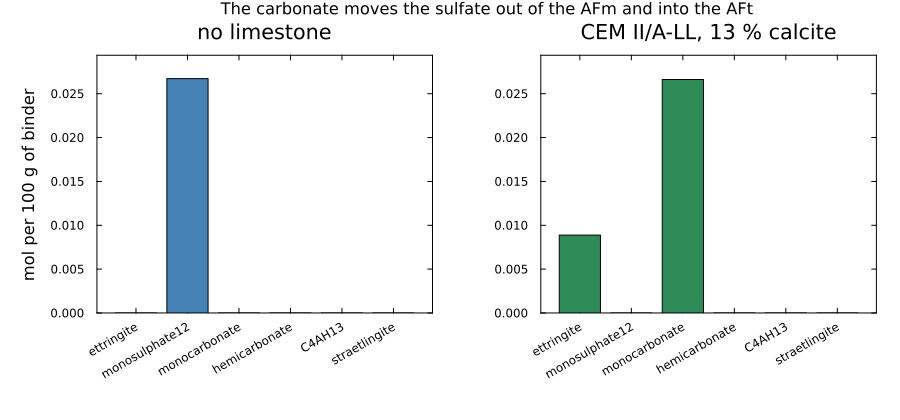
6. What the slag does — magnesium, and a sulfur it cannot use
The slag paste is a different problem. The aluminum arrives with no sulfate of its own, the magnesium has no clinker counterpart, and the sulfur arrives reduced:
println("CEM II/B-S:")
for (name, amount) in assemblage(eq_bs)
    @printf("  %-18s %9.5f mol\n", name, amount)
end

@printf("\npe  = %+.2f\nEh  = %+.3f V\n", pe(eq_bs, model), Eh(eq_bs, model))
@printf("aqueous S(VI)  : %.3e mol\naqueous S(-II) : %.3e mol\n",
        ustrip(us"mol", moles(eq_bs, "SO4-2")), ustrip(us"mol", moles(eq_bs, "HS-")))
CEM II/B-S:
Portlandite 0.22473 mol
CSHQ-JenD 0.15020 mol
CSHQ-TobD 0.11517 mol
CSHQ-JenH 0.09512 mol
monosulphate12 0.02987 mol
C3AFS0.84H4.32 0.02112 mol
KSiOH 0.01591 mol
NaSiOH 0.00751 mol
hydrotalcite 0.00625 mol
CSHQ-TobH 0.00477 mol
C3AH6 0.00361 mol
┌ Warning: `HS-` is at 9.85967654375977e-305 mol, at or near the solver floor, so the SO4-2/HS- couple does not buffer anything here: the `pe` returned is set by the floor `ϵ`, not by the chemistry. Read it as a bound, or choose a couple whose members are both present.
└ @ ChemistryLab ~/work/ChemistryLab.jl/ChemistryLab.jl/src/equilibrium/aqueous_properties.jl:660
pe = -9.47
Eh = -0.560 V
aqueous S(VI) : 9.403e-07 mol
aqueous S(-II) : 9.860e-305 molRead the potential as the CEM III page reads it: a couple buffers a potential only while both of its members are actually present in solution, and pe warns rather than returning a number silently when one of them is at the solver's floor. Compare the two aqueous sulfur figures printed above before reading the potential as a property of the paste — the smaller they are, the more the number is set by the floor and the less it is set by the chemistry.
The magnesium is the visible difference. It has no place in any calcium aluminate hydrate, so it leaves the solution as hydrotalcite — a phase that simply does not appear in a CEM I or a CEM II/A-LL calculation because the element is not there to form it.
7. All three together, and the measured heat
labels = ["CEM II/A-LL", "no limestone", "CEM II/B-S"]
eqs = [eq_ll, eq_ref, eq_bs]
vols = [ustrip(uconvert(us"cm^3", volume(e).total)) for e in eqs]
phs = [pH(e, model) for e in eqs]

p1 = bar(labels, vols; legend = false, ylabel = "total volume (cm³)",
         color = :seagreen, title = "Volume of the hydrated paste", xrotation = 15)
p2 = bar(labels, phs; legend = false, ylabel = "pH", ylims = (12.0, 13.6),
         color = :steelblue, title = "Pore solution pH", xrotation = 15)
fig2 = plot(p1, p2; layout = (1, 2), size = (900, 400),
            bottom_margin = 14Plots.mm, left_margin = 8Plots.mm)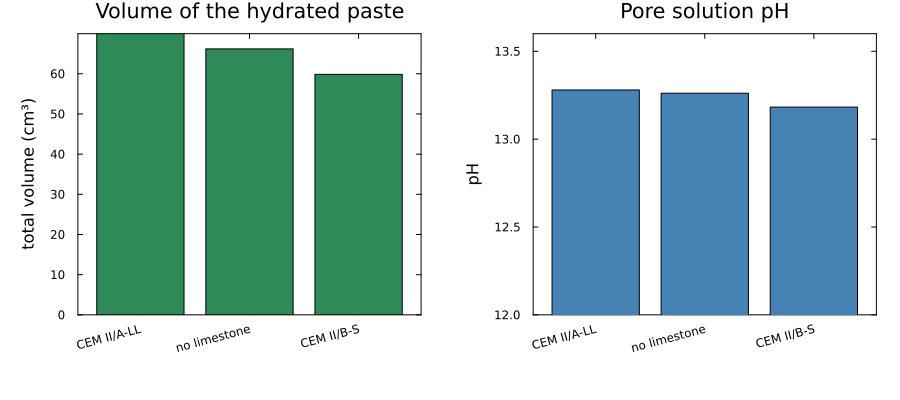
The equilibrium says what the paste tends to. What it cannot say is how fast it gets there, and that is exactly where the two replacements differ most:
function final_heat(file)
    t, Q = 0.0, 0.0
    for line in eachline(joinpath(datapath("experimental"), file))
        (startswith(line, "#") || startswith(line, "time")) && continue
        f = split(line, ',')
        t, Q = parse(Float64, f[1]), parse(Float64, f[3])
    end
    return t, Q
end

for (file, label) in (
        ("smilauer2025-122-cemI-52.5R-cizkovice.csv", "CEM I 52.5 R"),
        ("smilauer2025-165-cemII-A-LL-42.5R-hranice.csv", "CEM II/A-LL 42.5 R"),
        ("smilauer2025-149-cemII-B-S-32.5R-mokra.csv", "CEM II/B-S 32.5 R"),
    )
    t, Q = final_heat(file)
    @printf("  %-20s %6.0f h   %6.1f J/g\n", label, t, Q)
end
CEM I 52.5 R 262 h 376.0 J/g
CEM II/A-LL 42.5 R 384 h 329.3 J/g
CEM II/B-S 32.5 R 504 h 295.6 J/gBoth replacements lower the heat, because every joule comes from the clinker and neither calcite nor slag glass releases any of its own at this age. The slag lowers it further than the limestone does, at a larger replacement — 28 % against 13 % — so per unit of clinker removed the two are not far apart. What separates them is that the limestone's contribution to the solid volume is mostly the calcite itself plus the ettringite it stabilizes, while the slag's contribution grows over months as the glass dissolves, which an equilibrium calculation at a single instant cannot show at all.
The 28-day heat is not the final heat
The records stop at about three weeks. A slag binder is still reacting there, so its curve is truncated much further from its asymptote than the CEM I's is. Comparing final values of truncated curves understates the slag binder, and the deposit's own fitted DoHInf of 0.85 is a reminder that the depositors extrapolated rather than measured the end.