
A hydrating blended cement paste, coupled to its chemistry
Every other cement chapter of this documentation starts from a correlation: a Powers-type formula turns a water-to-cement ratio and a hydration degree into volume fractions, and the micromechanics takes it from there. This one does not. Here the volume fractions are computed — by integrating a hydration kinetics ODE, applying the reaction stoichiometry, and converting moles to volumes through the molar volumes of a thermodynamic database.
The model is that of [81], whose micromechanical part is close to [72] — see Quasi-brittle strength of cement paste and mortar — but whose volume fractions come from an extended Parrot & Killoh hydration model rather than from Powers.
The chemistry is carried by ChemistryLab.jl, a sibling package of this one. Neither package depends on the other: the coupling lives entirely in this chapter and in scripts/common/stoichiometric_hydration.jl.
The dotted arrow is not decoration. Both packages are ForwardDiff-clean, so the derivative of an effective modulus with respect to anything the chemistry depends on is one dual evaluation of the whole chain — no finite differences, no re-running the ODE. Section §6 uses it.
Setup
using MeanFieldHomogenization
using TensND
using ChemistryLab
using DynamicQuantities
using OrdinaryDiffEq
using ForwardDiff
using Printf
using Plots
gr()  # headless backend; GKSwstype is set to "100" in make.jl

const SCRIPTS = joinpath(pkgdir(MeanFieldHomogenization), "scripts")
include(joinpath(SCRIPTS, "common", "paste_micromechanics.jl"))
include(joinpath(SCRIPTS, "common", "stoichiometric_hydration.jl"))
The binder
The reference cement is the CEM I 52.5 N of [81] (its Table 9): a clinker of Bogue composition C₃S 65 / C₂S 11 / C₃A 11 / C₄AF 8, with 3.5 % calcite and 4.6 % gypsum, ground to a Blaine fineness of 380 m²/kg. The blends follow the paper's naming — C85L15 substitutes 15 % limestone filler for cement, C95SF05 5 % silica fume.
const CLINKER = (C3S = 0.65, C2S = 0.11, C3A = 0.11, C4AF = 0.08)
const BLAINE  = 380.0u"m^2/kg"

# Orientation bins for the hydrate-foam self-consistent scheme — the 20 of the
# paper. This costs almost nothing: a four-scale homogenization at this size runs
# in under 10 ms once compiled, and the page's cost is dominated by the hydration
# ODE (about 40 s per mix), not by the micromechanics.
const NTHETA = 20

hydrate(; wb, filler = 0.035, silica = 0.0) = run_hydration(;
    wb, clinker = CLINKER, gypsum = 0.046, filler, silica,
    blaine = BLAINE, tend = 90 * 86400.0,
)

const TIMES = 10 .^ range(log10(0.05 * 86400), log10(90 * 86400); length = 40)
run0 = hydrate(; wb = 0.5)
┌───────────────────────────────────────────────────┐
│ Loading database: data/cemdata18-thermofun.json │
└───────────────────────────────────────────────────┘
┌────────────────────┐
│ Building species │
└────────────────────┘
Progress: 1%|▍ | ETA: 0:05:32[K
Progress: 7%|███ | ETA: 0:00:44[K
Progress: 65%|██████████████████████████▋ | ETA: 0:00:03[K
Progress: 81%|█████████████████████████████████▎ | ETA: 0:00:01[K
Progress: 97%|███████████████████████████████████████▉ | ETA: 0:00:00[K
Progress: 100%|█████████████████████████████████████████| Time: 0:00:05[K
┌ Warning: Using arrays or dicts to store parameters of different types can hurt performance.
│ Consider using tuples instead.
└ @ SciMLBase ~/.julia/packages/SciMLBase/1DcFZ/src/performance_warnings.jl:33Hydration kinetics
Each clinker phase follows Parrot & Killoh in its canonical form [82], α̇ = min(α̇₁, α̇₂, α̇₃) — an Avrami nucleation-growth term, a Jander diffusion term and a power law — scaled by the Blaine fineness and capped by the Powers water-availability limit α_max = min(1, w/b / 0.42). The silica fume does not follow Parrot & Killoh at all: its pozzolanic reaction follows the sigmoid of Waller, far more thermo-activated than the clinker.
A signature of the 1984 parameter set, and a useful check that it has been transcribed correctly: C₂S has no nucleation-growth stage and C₃S no diffusion-controlled stage.
α = degrees_of_hydration(run0.sol, run0.kp; times = TIMES)
ᾱ = mean_degree_of_hydration(run0.sol, run0.kp; times = TIMES)

p_alpha = plot(
    TIMES ./ 86400, [α[k] for k in ("C3S", "C2S", "C3A", "C4AF")];
    xscale = :log10, xlabel = "age [days]", ylabel = "degree of hydration α",
    label = ["C₃S" "C₂S" "C₃A" "C₄AF"], lw = 2, legend = :topleft,
    size = (760, 460), title = "Parrot & Killoh kinetics, w/b = 0.50",
)
plot!(p_alpha, TIMES ./ 86400, ᾱ; lw = 3, color = :black, ls = :dash, label = "ᾱ (mass-weighted)")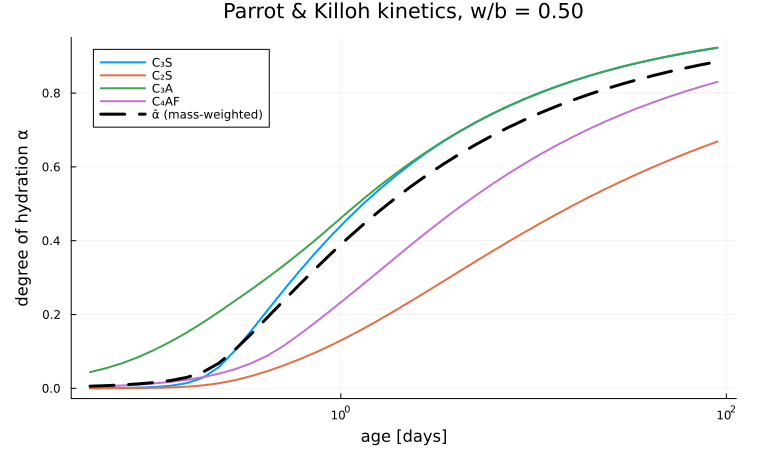
Alite is largely consumed within a week while belite is still below half at 90 days — the classical ordering.
From moles to volume fractions
The reactions are balanced by ChemistryLab, not written out by hand. This matters more than it sounds: CEMDATA18 stores Jennite with a rounded Ca:Si of 1.666667, so the textbook coefficients 4/3 and 103/30 leave a residual.
cs = build_cement_system()
for r in hydration_reactions(cs; wb = 0.5, blaine = BLAINE)
    println(rpad(String(ChemistryLab.symbol(r)), 24), r)
end
┌───────────────────────────────────────────────────┐
│ Loading database: data/cemdata18-thermofun.json │
└───────────────────────────────────────────────────┘
┌────────────────────┐
│ Building species │
└────────────────────┘
Progress: 45%|██████████████████▌ | ETA: 0:00:00[K
Progress: 84%|██████████████████████████████████▌ | ETA: 0:00:00[K
Progress: 100%|█████████████████████████████████████████| Time: 0:00:00[K
C3S hydration (CaO)₃SiO₂ + 3.43333H₂O@ = (SiO₂)₁(CaO)₅//₃(H₂O)₂.₁ + 4//3Ca(OH)₂
C2S hydration (CaO)₂SiO₂ + 2.43333H₂O@ = (SiO₂)₁(CaO)₅//₃(H₂O)₂.₁ + 1//3Ca(OH)₂
C3A + gypsum -> AFt (CaO)₃Al₂O₃ + 26H₂O@ + 3CaSO₄(H₂O)₂ = ((H₂O)₂)Ca₆Al₂(SO₄)₃(OH)₁₂(H₂O)₂₄
C3A + calcite -> Mc (CaO)₃Al₂O₃ + 11H₂O@ + CaCO₃ = Ca₄Al₂CO₉(H₂O)₁₁
C3A + AFt -> AFm (CaO)₃Al₂O₃ + 2H₂O@ + 1//2((H₂O)₂)Ca₆Al₂(SO₄)₃(OH)₁₂(H₂O)₂₄ = 3//2Ca₄Al₂SO₁₀(H₂O)₁₂
C3A -> hydrogarnet (CaO)₃Al₂O₃ + 6H₂O@ = Ca₃Al₂O₆(H₂O)₆
C4AF + C3S -> Fe hydrogarnet(CaO)₄(Al₂O₃)(Fe₂O₃) + 11.68H₂O@ + 1.68(CaO)₃SiO₂ = 2(AlFeO₃)[Ca₃O₃(SiO₂)₀.₈₄(H₂O)₄.₃₂] + 3.04Ca(OH)₂
C4AF + C2S -> Fe hydrogarnet(CaO)₄(Al₂O₃)(Fe₂O₃) + 10H₂O@ + 1.68(CaO)₂SiO₂ = 2(AlFeO₃)[Ca₃O₃(SiO₂)₀.₈₄(H₂O)₄.₃₂] + 1.36Ca(OH)₂
C4AF + gypsum -> AFt (CaO)₄(Al₂O₃)(Fe₂O₃) + 28H₂O@ + 3CaSO₄(H₂O)₂ = ((H₂O)₂)Ca₆Al₂(SO₄)₃(OH)₁₂(H₂O)₂₄ + Ca(OH)₂ + 2FeOOH
C4AF + calcite -> Mc (CaO)₄(Al₂O₃)(Fe₂O₃) + 13H₂O@ + CaCO₃ = Ca₄Al₂CO₉(H₂O)₁₁ + Ca(OH)₂ + 2FeOOH
C4AF + AFt -> AFm (CaO)₄(Al₂O₃)(Fe₂O₃) + 4H₂O@ + 1//2((H₂O)₂)Ca₆Al₂(SO₄)₃(OH)₁₂(H₂O)₂₄ = 3//2Ca₄Al₂SO₁₀(H₂O)₁₂ + Ca(OH)₂ + 2FeOOH
C4AF -> hydrogarnet (CaO)₄(Al₂O₃)(Fe₂O₃) + 8H₂O@ = Ca₃Al₂O₆(H₂O)₆ + Ca(OH)₂ + 2FeOOH
pozzolanic reaction SiO₂ + 0.43333H₂O@ + 5//3Ca(OH)₂ = (SiO₂)₁(CaO)₅//₃(H₂O)₂.₁Two features of that set are worth pointing out.
The aluminate cascade. Each aluminate drives several competing reactions, taken in a fixed order of priority — thirteen reactions in all:
| phase | priority order |
|---|---|
| C₃A | gypsum → AFt, then calcite → monocarboaluminate, then ettringite → AFm, then C₃AH₆ |
| C₄AF | C₃S then C₂S → siliceous hydrogarnet, then gypsum → AFt, then calcite, then ettringite, then C₃AH₆ |
Two of those orderings are easy to get wrong. Monocarboaluminate comes before monosulfoaluminate, and the dominant route for C₄AF is the siliceous hydrogarnet consuming the silicates — not the sulfate route. The deduction of the C₃S and C₂S eaten there, which the reference performs by hand on the silicate targets, is automatic here: C₃S is a kinetic species, so that consumption enters its own degree of reaction and hence its own rate.
The reference realizes the cascade by calling every reaction at each step with the remainder of the phase's increment, each taking what its scarcest co-reactant allows. The continuous analog is a partition of unity, wᵢ built from smooth availability gates gᵢ = xᵢ/(xᵢ+ε), with Σ wᵢ = 1 so the phase's total rate is conserved whichever routes are open.
No callbacks, and that is deliberate
Because each rate is proportional to x as the co-reactant runs out, the stock decays exponentially towards zero and cannot cross it — measured worst excursion over a 90-day run, refined around depletion, −1.7×10⁻¹⁶ mol. A ContinuousCallback on "gypsum exhausted" would be rooted on a quantity that never reaches zero, and would switch the rate discontinuously, which is what a Rosenbrock method handles worst.
The one thing the smooth form does not encode is the reference's absolute priority of C₃A over C₄AF for the shared sulfate. It does not matter here: C₃A's rate is far faster early on and C₄AF's silicate routes are open ahead of its sulfate route, so C₃A takes 3 × 0.0891 = 0.267 of the 0.2672 mol of gypsum available and the C₄AF sulfate route stays at zero. The priority emerges from the kinetics. Worth re-checking for a clinker in which C₄AF outpaces C₃A.
The gates read amounts of species that are not themselves kinetic — gypsum, calcite, ettringite. That works because the ODE state holds the reaction extents ξ, from which the residual reconstructs every species before evaluating the rates, and it is what makes reaction sequencing expressible at all: this chapter is the reason ChemistryLab acquired it. Without it the gates never close, and an earlier draft formed 0.44 mol of ettringite out of 0.27 mol of gypsum — expanding the paste and driving the chemical shrinkage negative, with the solver reporting success throughout.
One substitution to declare: the paper's Fe-siliceous hydrogarnet C₆AFS₂.₁₈H₁₉ is not in CEMDATA18. C3AFS0.84H4.32 is the available analog, of different stoichiometry.
Gel water. CEMDATA18 and [81] do not draw the boundary of "C-S-H" in the same place, and ignoring the difference changes the answer by a factor of two:
| C-S-H per mole of Si | molar volume | water held inside | |
|---|---|---|---|
| CEMDATA18 (Jennite) | (SiO₂)(CaO)₁.₆₆₇(H₂O)₂.₁ | 78.4 cm³/mol | structural only |
| [81] | C₁.₇SH₄ | 108.3 cm³/mol | structural + gel |
Both conventions are self-consistent; the thermodynamic one is cleaner. But the paper's micromechanical parameters — E_CSH = 25 GPa, aspect ratio 7, and the percolation threshold that follows — were calibrated on the second object. Feeding the first into them counts gel water as capillary porosity, overstates the porosity by some ten points and halves E. So fraction_history moves GEL_WATER_PER_CSH = 4 − 2.1 moles of water per mole of C-S-H from the aqueous phase into the hydrate. The chemistry is untouched: this re-partitions a computed volume, at the one place where the two conventions meet.
_, fs = fraction_history(run0, TIMES)

const PHASE_COLOR = [
    "anhydrous" => :grey35, "C-S-H" => :steelblue, "CH" => :indianred,
    "AFt" => :mediumpurple, "AFm" => :orchid, "hydrogarnet" => :darkorange,
    "FH3" => :sienna, "gypsum" => :gold, "calcite" => :darkkhaki,
    "silica" => :olive, "water" => :lightskyblue, "void" => :white,
]
present = [k for (k, _) in PHASE_COLOR if maximum(get.(fs, k, 0.0)) > 1.0e-3]
cols = [Dict(PHASE_COLOR)[k] for k in present]
Y = cumsum(reduce(hcat, [get.(fs, k, 0.0) for k in present]); dims = 2)

plot(
    TIMES ./ 86400, Y;
    xscale = :log10, xlabel = "age [days]", ylabel = "cumulative volume fraction",
    label = reshape(present, 1, :), lw = 0.5, linecolor = :grey30,
    fillrange = hcat(zeros(length(TIMES)), Y[:, 1:(end - 1)]),
    fillcolor = reshape(cols, 1, :), fillalpha = 0.9,
    legend = :outerright, ylims = (0, 1), size = (760, 460),
    title = "Phase assemblage of the sealed paste, w/b = 0.50",
)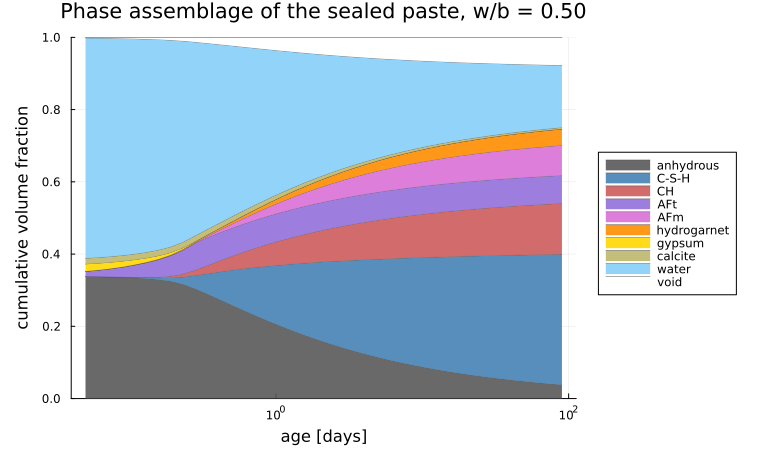
This is the classical Powers diagram — anhydrous grains consumed, C-S-H and portlandite growing, capillary water receding — except that nothing here was correlated. The white band at the top is the chemical shrinkage: under sealed curing the specimen keeps its volume while the reactions consume some, and the deficit is an empty, gas-filled porosity. It is a phase of the microstructure, not a rounding error, and volume_fractions returns it explicitly.
f28 = fraction_history(run0, [28 * 86400.0])[2][1]
@printf "sum of fractions = %.6f\n" sum(values(f28))
@printf "chemical shrinkage at 28 d = %.1f %% of the paste volume\n" 100 * f28["void"]
sum of fractions = 1.000000
chemical shrinkage at 28 d = 7.2 % of the paste volumeThe four scales
[81] upscales in four steps (its Fig. 2). The first is what distinguishes this model from [72], which collapses every hydrate into a single stiffness: here the hydrate species are merged first, by a self-consistent scheme with all phases spherical, and only the result is given the fibrillar morphology at the foam scale.
The aspect ratio
Phase stiffnesses are those of its Table 5 — clinker 130 GPa, portlandite 42.3 GPa, ettringite and hydrogarnet 22.4 GPa, calcite 83.8 GPa, and a single C-S-H at 25 GPa, the median of the high- and low-density values.
E_of(f) = paste_moduli(f; N = NTHETA).E
E_hist = [E_of(f) for f in fs]

p_perc = plot(
    ᾱ, E_hist;
    xlabel = "mean degree of hydration ᾱ", ylabel = "E [GPa]",
    lw = 2, legend = false, size = (760, 460), marker = :circle, ms = 2,
    title = "Setting: E against hydration degree, w/b = 0.50",
)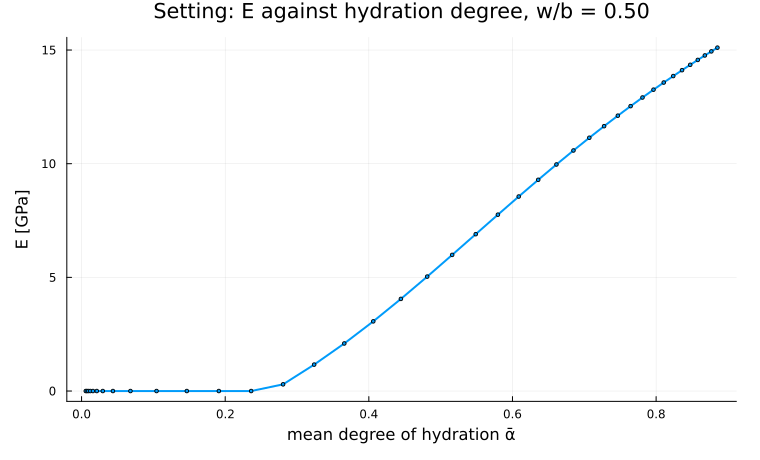
The curve leaves zero at a finite hydration degree: that is the percolation threshold of the hydrate foam, and it is a prediction of the self-consistent scheme, not a fitted setting time.
Effective Young's modulus
mixes = [
    ("C100, w/b = 0.50",    (wb = 0.5,  filler = 0.035, silica = 0.0)),
    ("C85L15, w/b = 0.50",  (wb = 0.5,  filler = 0.185, silica = 0.0)),
    ("C95SF05, w/b = 0.50", (wb = 0.5,  filler = 0.035, silica = 0.05)),
    ("C100, w/b = 0.32",    (wb = 0.32, filler = 0.035, silica = 0.0)),
]

p_E = plot(;
    xscale = :log10, xlabel = "age [days]", ylabel = "E [GPa]",
    legend = :topleft, size = (760, 460), title = "Effective Young's modulus",
)
E_table = String[]
for (i, (name, m)) in enumerate(mixes)
    # The first mix is the reference paste, already hydrated and already
    # homogenized above — reuse it rather than pay for it twice.
    E = if i == 1
        E_hist
    else
        r = hydrate(; wb = m.wb, filler = m.filler, silica = m.silica)
        [E_of(fi) for fi in fraction_history(r, TIMES)[2]]
    end
    plot!(p_E, TIMES ./ 86400, E; lw = 2, label = name)
    i1  = findmin(abs.(TIMES .- 86400))[2]
    i28 = findmin(abs.(TIMES .- 28 * 86400))[2]
    push!(E_table, @sprintf("| %-20s | %5.1f | %5.1f | %5.1f |", name, E[i1], E[i28], E[end]))
end
p_E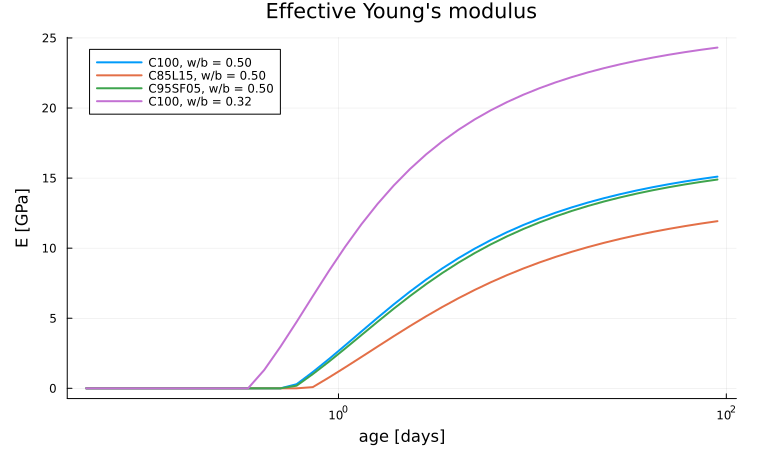
println("| mix                  | E(1 d) | E(28 d) | E(90 d) |")
println("|----------------------|--------|---------|---------|")
foreach(println, E_table)
| mix | E(1 d) | E(28 d) | E(90 d) |
|----------------------|--------|---------|---------|
| C100, w/b = 0.50 | 3.1 | 13.9 | 15.1 |
| C85L15, w/b = 0.50 | 1.5 | 10.7 | 11.9 |
| C95SF05, w/b = 0.50 | 2.8 | 13.6 | 14.9 |
| C100, w/b = 0.32 | 10.1 | 23.1 | 24.3 |Three things the model gets right, and one it does not.
The w/b effect is strong and in the right direction: halving the capillary porosity roughly doubles the 28-day modulus.
Limestone dilution lowers
Eat every age, the filler being inert apart from a little monocarboaluminate.Silica fume costs almost nothing at 28 days, its pozzolanic reaction replacing the clinker it displaced.
The absolute level is low. A w/b = 0.50 paste measures nearer 18–20 GPa at 28 days than the ~13 GPa here. The single C-S-H stiffness, with no high-/low-density distinction, and the drained convention
K_water = 0both push in that direction; [81] lists the uniform C-S-H density as a limitation of its own §5. The purpose of this chapter is the coupling, not a calibration.
Sensitivities through the chemistry
Because the whole chain is ForwardDiff-clean, the sensitivity of E to any phase fraction is one dual evaluation — including through the self-consistent fixed points.
sens = [(k, ForwardDiff.derivative(
            x -> paste_moduli(merge(f28, Dict(k => x)); N = 12).E, f28[k]))
        for k in keys(f28) if f28[k] > 1.0e-3]
sort!(sens; by = last, rev = true)

bar(
    [k for (k, _) in sens], [v for (_, v) in sens];
    xrotation = 40, ylabel = "∂E / ∂f  [GPa]", legend = false,
    size = (760, 460), title = "Sensitivity of E(28 d) to each phase fraction",
    color = [v > 0 ? :steelblue : :indianred for (_, v) in sens],
)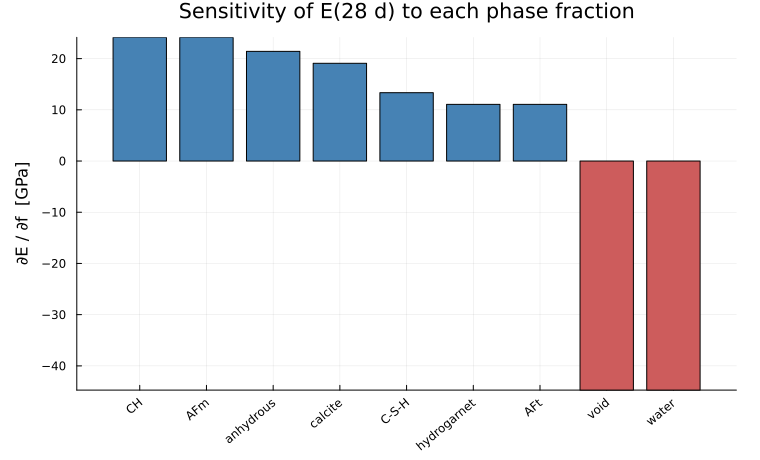
Portlandite and the unreacted clinker are the stiffest things present, so growing them at constant total volume helps most; water and the shrinkage void hurt most. The reading is at fixed total volume — these are not independent design variables, since the chemistry ties them together — but the ordering is what a calibration would exploit, and obtaining it cost no finite differences and no extra ODE solve.
What is not here
Compressive strength. The second half of [81] upscales strength from a Von Mises criterion on the hydrate needles, through Kreher's lemma over the 20 orientations, plus a statistical treatment of the stress fluctuation at the concrete scale — which is how it explains a mortar being weaker than its own paste. The ingredient exists here only as script-level code; see Quasi-brittle strength of cement paste and mortar.
Ageing creep.
homogenize_alvtakes constant volume fractions; time dependence is emulated by discretizing a growing phase into layers with individual setting times, driven by a postulated law — see Ageing creep of solidifying cementitious materials. Feeding it thef_r(t)computed above is the natural next step, and needs either an API accepting an amount law or a helper inverting an arbitrary kinetics into setting times.Thermodynamic equilibrium. The reaction set here is stoichiometric, as in the paper. ChemistryLab can instead solve for the equilibrium phase assemblage; that would replace the imposed products by computed ones, at a substantial cost in run time, and would not by itself settle the morphology, which stays a model.
Reproducing this chapter
scripts/44_stoichiometric_hydration_micromechanics.jl runs the same model standalone, with 20 orientation bins, and writes the figures to scripts/figures/. Unlike the other scripts it activates docs/ rather than the repository root, because it needs ChemistryLab and OrdinaryDiffEq:
julia --project=docs -e 'using Pkg; Pkg.instantiate()'
julia scripts/44_stoichiometric_hydration_micromechanics.jl