
From Echoes to MeanFieldHomogenization
MeanFieldHomogenization (MFH) is a Julia port of Echoes [73], the C++ mean-field homogenization library (with a Python interface) developed at Cerema. If you already have Echoes scripts, this page is a direct translation guide: the same RVE/scheme/homogenize concepts, a line-by-line API table, and a worked example that calls both implementations — Echoes live from Julia via PyCall.jl — to check that they agree.
The @example blocks run at build time; the Python and PyCall blocks are shown for reference, and the Echoes numbers below were captured by running them against Echoes 1.0.
API translation table
Both libraries share the same mental model: an RVE holding phases, each with a geometry and a property dictionary, homogenized by a named scheme. They differ on one point besides syntax. Echoes names the matrix when the RVE is built, rve(matrix="SOLID"); MeanFieldHomogenization does not, because the same microstructure is a matrix/inclusion composite under Mori–Tanaka and a matrix-free aggregate under the self-consistent scheme. The phase that takes up the volume complement is declared fraction = :rest, and a matrix-based scheme picks it up unless it names another — so a translated script behaves the same.
| Echoes (Python) | MeanFieldHomogenization (Julia) |
|---|---|
from echoes import * | using MeanFieldHomogenization, TensND |
rve(matrix="SOLID") | RVE() |
myrve["SOLID"] = ellipsoid(shape=spheroidal(1.), symmetrize=[ISO], prop={"C": stiff_kmu(k, μ)}) | add_phase!(rve, :SOLID, Spheroid(1.0), Dict(:C => iso_stiffness(k, μ)); fraction = :rest, symmetrize = IsoSymmetrize()) |
myrve["PORE"] = ellipsoid(...) then myrve["PORE"].fraction = φ | add_phase!(rve, :PORE, Spheroid(1.0), Dict(:C => ...); fraction = φ, symmetrize = IsoSymmetrize()) |
crack(shape=spheroidal(ω), density=d, symmetrize=[ISO], prop={"C": tZ4}) | add_phase!(rve, :CRACK, PennyCrack(1.0), Dict(:C => C0); density = d, symmetrize = IsoSymmetrize()) |
stiff_kmu(k, μ) | iso_stiffness(k, μ) |
stiff_Enu(E, ν) | iso_stiffness_E_nu(E, ν) |
tZ4 (zero 4th-order tensor, for voids/cracks) | iso_stiffness(1e-6, 1e-6) (near-zero, kept invertible) |
VOIGT, REUSS | Voigt, Reuss |
DIL, DILD | Dilute, DiluteDual |
MT | MoriTanaka |
SC, ASC | SelfConsistent, AsymmetricSelfConsistent |
MAX, PCW | Maxwell, PonteCastanedaWillis |
DIFF | DifferentialScheme |
homogenize(prop="C", rve=myrve, scheme=MT, epsrel=1e-6, maxnb=300, select_best=True) | homogenize(rve, MoriTanaka(), :C; reltol = 1e-6, abstol = 0, maxiters = 300, select_best = true) |
C.k, C.mu | k_mu(C) |
np.trace(K.array) / 3. | tr(Array(homogenize(rve, scheme, :K))) / 3 |
.paramsym(sym=TI) | best_fit_ti |
Two conventions worth flagging for a smooth transition:
Both
stiff_kmu/iso_stiffnesstake physical(k, μ). Where they differ is in what the resulting tensor stores: MFH's rawTensISO{3}(a, b)constructor takes the pair(3k, 2μ), not(k, μ)— see the first tutorial. Building withiso_stiffness(k, μ)(as in the table above) sidesteps this entirely.Symbol-string vs. type-instance schemes. Echoes selects a scheme via a module-level constant (
MT,SC, …) passed tohomogenize; MFH uses a scheme type instance (MoriTanaka(),SelfConsistent(; kwargs...)), which is also how solver options (abstol,reltol,maxiters,select_best) attach directly to the scheme rather than as loosehomogenizekeywords. ASymbolshortcut (:mt,:sc, …) is also accepted — see the schemes manual for the full alias table.
Same problem, both sides
The classic porous benchmark — a solid matrix with spherical pores, porosity
from echoes import *

ks, mus = 72., 32.
kp, mup = 1.e-6, 1.e-6

myrve = rve(matrix="SOLID")
myrve["SOLID"] = ellipsoid(shape=spheroidal(1.), symmetrize=[ISO],
                            prop={"C": stiff_kmu(ks, mus)})
myrve["PORE"] = ellipsoid(shape=spheroidal(1.), symmetrize=[ISO],
                           prop={"C": stiff_kmu(kp, mup)})

def Chom_porous(phi, scheme):
    myrve["PORE"].fraction = phi
    myrve["SOLID"].fraction = 1. - phi
    C = homogenize(prop="C", rve=myrve, scheme=scheme,
                   epsrel=1.e-6, maxnb=300, select_best=True)
    return max(C.k, 0.), max(C.mu, 0.)
The same problem, live, in MFH:
using MeanFieldHomogenization
using TensND
using LinearAlgebra
using Plots
gr()  # headless backend; GKSwstype is set to "100" in make.jl

const ks, mus = 72.0, 32.0
const kp, mup = 1.0e-6, 1.0e-6
C_s = iso_stiffness(ks, mus)
C_p = iso_stiffness(kp, mup)

function build_rve(φ)
    r = RVE()
    add_phase!(r, :SOLID, Spheroid(1.0), Dict(:C => C_s); fraction = :rest, symmetrize = IsoSymmetrize())
    add_phase!(r, :PORE, Spheroid(1.0), Dict(:C => C_p); fraction = φ, symmetrize = IsoSymmetrize())
    return r
end

φs = collect(0.0:0.1:1.0)
k_mt = [k_mu(homogenize(build_rve(φ), MoriTanaka(), :C))[1] for φ in φs]
k_mt[1:4]
4-element Vector{Float64}:
72.0
55.44385079613371
43.06542136824175
33.460581867908594Line for line, the two snippets build the same RVE and call the same scheme — this is the translation to internalize for every other Echoes script.
Calling Echoes from Julia with PyCall
To cross-check MFH against a live Echoes instead of hand-copied numbers, PyCall.jl can call Echoes directly from a Julia session. This requires Echoes installed in some Python environment — any interpreter where import echoes succeeds will do, conda or otherwise:
# One-time setup: point PyCall at the interpreter where `import echoes`
# succeeds, then rebuild the binding.
ENV["PYTHON"] = raw"/path/to/that/python"
using Pkg
Pkg.build("PyCall")using PyCall
py"""
from echoes import *
def run_echoes(phi, scheme_name):
_SCHEMES = {"MT": MT, "SC": SC, "DIFF": DIFF}
scheme = _SCHEMES[scheme_name]
myrve = rve(matrix="SOLID")
myrve["SOLID"] = ellipsoid(shape=spheroidal(1.), symmetrize=[ISO],
prop={"C": stiff_kmu(72., 32.)})
myrve["PORE"] = ellipsoid(shape=spheroidal(1.), symmetrize=[ISO],
prop={"C": stiff_kmu(1e-6, 1e-6)})
myrve["PORE"].fraction = phi
myrve["SOLID"].fraction = 1. - phi
C = homogenize(prop="C", rve=myrve, scheme=scheme,
epsrel=1e-6, maxnb=300, select_best=True)
return max(C.k, 0.), max(C.mu, 0.)
"""
k_e, μ_e = py"run_echoes"(0.3, "MT")Running this snippet against Echoes 1.0 returns (33.46058186790858, 17.626741619570563) at φ = 0.3, scheme = "MT", matching the reference table below to solver tolerance. This is the same pattern used throughout scripts/bench_echoes/ (see Production cross-checks) — a py"""...""" block defining a small helper, called from Julia like an ordinary function.
The benchmark result
The table below reproduces the captured Echoes 1.0 output for the porous benchmark above (ks, μs = 72, 32; φ = 0.0, 0.1, …, 1.0), obtained exactly as shown in the previous section. It is embedded here as literal data — reading it back requires no Echoes installation — so this page renders identically whether or not Echoes is available:
# Captured from a run of Echoes 1.0 (see the run_echoes snippet above),
# once per (φ, scheme) pair.
echoes_ref = Dict(
    "MT" => (
        k = [72.0, 55.443851, 43.065421, 33.460582, 25.791046, 19.525425, 14.31056, 9.90258, 6.127661, 2.858562, 1.0e-6],
        μ = [32.0, 26.415585, 21.685158, 17.626742, 14.106633, 11.024391, 8.303101, 5.882864, 3.716342, 1.765626, 1.0e-6],
    ),
    "DIFF" => (
        k = [72.0, 54.60602, 40.616795, 29.414749, 20.528772, 13.593911, 8.323876, 4.491934, 1.917566, 0.457355, 1.0e-6],
        μ = [32.0, 26.168105, 20.864777, 16.11255, 11.933231, 8.347851, 5.376596, 3.038716, 1.352384, 0.334464, 1.0e-6],
    ),
    "SC" => (
        k = [72.0, 53.608383, 37.156454, 22.689248, 10.27169, 0.076007, 6.0e-6, 3.0e-6, 2.0e-6, 1.0e-6, 1.0e-6],
        μ = [32.0, 25.866249, 19.629147, 13.264365, 6.737918, 0.056937, 5.0e-6, 2.0e-6, 2.0e-6, 1.0e-6, 1.0e-6],
    ),
)
MFH, computed live, against those captured references:
mfh_schemes = Dict(
    "MT" => MoriTanaka(),
    "DIFF" => DifferentialScheme(; nsteps = 300),
    "SC" => SelfConsistent(; reltol = 1.0e-6, abstol = 0.0, maxiters = 300, select_best = true),
)

_relerr(a, b) = abs(b) < 1.0e-9 ? abs(a - b) : abs(a - b) / abs(b)

plt = plot(;
    xlabel = "φ (porosity)", ylabel = "k_hom",
    legend = :topright, framestyle = :box, size = (760, 480),
)
for (name, color) in (("MT", :black), ("DIFF", :orange), ("SC", :red))
    k_jl = [max(k_mu(best_fit_iso(homogenize(build_rve(φ), mfh_schemes[name], :C)))[1], 0.0) for φ in φs]
    plot!(plt, φs, k_jl; label = "MFH $name", color = color, lw = 2)
    scatter!(plt, φs, echoes_ref[name].k; label = "Echoes $name", color = color, marker = :circle, markersize = 4)
end
plt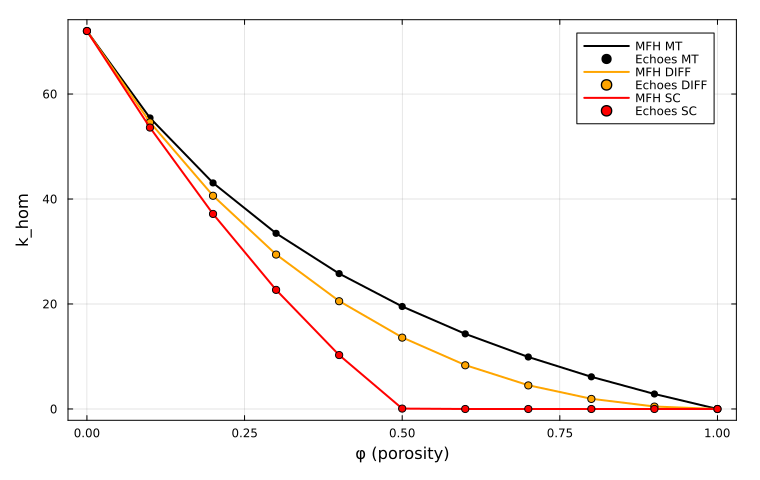
for name in ("MT", "DIFF", "SC")
    scheme = mfh_schemes[name]
    println("== $name ==")
    for (i, φ) in enumerate(φs)
        k_jl, _ = k_mu(best_fit_iso(homogenize(build_rve(φ), scheme, :C)))
        k_jl = max(k_jl, 0.0)
        k_e = echoes_ref[name].k[i]
        println("  φ=", round(φ, digits = 2), "  k_MFH=", round(k_jl, digits = 6),
                "  k_Echoes=", k_e, "  relerr=", round(_relerr(k_jl, k_e), sigdigits = 3))
    end
end
== MT ==
φ=0.0 k_MFH=72.0 k_Echoes=72.0 relerr=1.97e-16
φ=0.1 k_MFH=55.443851 k_Echoes=55.443851 relerr=3.68e-9
φ=0.2 k_MFH=43.065421 k_Echoes=43.065421 relerr=8.55e-9
φ=0.3 k_MFH=33.460582 k_Echoes=33.460582 relerr=3.95e-9
φ=0.4 k_MFH=25.791046 k_Echoes=25.791046 relerr=7.53e-9
φ=0.5 k_MFH=19.525425 k_Echoes=19.525425 relerr=1.07e-8
φ=0.6 k_MFH=14.31056 k_Echoes=14.31056 relerr=5.32e-9
φ=0.7 k_MFH=9.90258 k_Echoes=9.90258 relerr=1.42e-8
φ=0.8 k_MFH=6.127661 k_Echoes=6.127661 relerr=6.19e-8
φ=0.9 k_MFH=2.858562 k_Echoes=2.858562 relerr=6.34e-8
φ=1.0 k_MFH=1.0e-6 k_Echoes=1.0e-6 relerr=6.95e-9
== DIFF ==
φ=0.0 k_MFH=72.0 k_Echoes=72.0 relerr=1.97e-16
φ=0.1 k_MFH=54.611188 k_Echoes=54.60602 relerr=9.46e-5
φ=0.2 k_MFH=40.631978 k_Echoes=40.616795 relerr=0.000374
φ=0.3 k_MFH=29.43971 k_Echoes=29.414749 relerr=0.000849
φ=0.4 k_MFH=20.56085 k_Echoes=20.528772 relerr=0.00156
φ=0.5 k_MFH=13.62948 k_Echoes=13.593911 relerr=0.00262
φ=0.6 k_MFH=8.359112 k_Echoes=8.323876 relerr=0.00423
φ=0.7 k_MFH=4.523194 k_Echoes=4.491934 relerr=0.00696
φ=0.8 k_MFH=1.94151 k_Echoes=1.917566 relerr=0.0125
φ=0.9 k_MFH=0.470894 k_Echoes=0.457355 relerr=0.0296
φ=1.0 k_MFH=1.0e-6 k_Echoes=1.0e-6 relerr=1.66e-10
== SC ==
φ=0.0 k_MFH=72.0 k_Echoes=72.0 relerr=1.97e-16
φ=0.1 k_MFH=53.608383 k_Echoes=53.608383 relerr=3.58e-10
φ=0.2 k_MFH=37.156446 k_Echoes=37.156454 relerr=2.13e-7
φ=0.3 k_MFH=22.689245 k_Echoes=22.689248 relerr=1.47e-7
φ=0.4 k_MFH=10.271684 k_Echoes=10.27169 relerr=6.05e-7
φ=0.5 k_MFH=0.076512 k_Echoes=0.076007 relerr=0.00665
φ=0.6 k_MFH=6.0e-6 k_Echoes=6.0e-6 relerr=0.00386
φ=0.7 k_MFH=3.0e-6 k_Echoes=3.0e-6 relerr=0.0575
φ=0.8 k_MFH=2.0e-6 k_Echoes=2.0e-6 relerr=0.101
φ=0.9 k_MFH=1.0e-6 k_Echoes=1.0e-6 relerr=0.35
φ=1.0 k_MFH=1.0e-6 k_Echoes=1.0e-6 relerr=0.0| Scheme | Agreement | Source of the residual |
|---|---|---|
Mori-Tanaka | floating-point floor; closed form on both sides | |
Differential | sub-percent to | independent step counts and quadrature on the same ODE |
SelfConsistent | close to | past percolation both sides sit at solver tolerance ( |
Production cross-checks
scripts/bench_echoes/ runs the same PyCall pattern systematically; tolerances and measured agreement are in Cross-validation, timings in Performance vs Echoes.
Two tutorials carry a captured Echoes reference in the page itself, in the literal-data style used above, and are worth reading next because each one turns up a place where the two libraries do not line up trivially:
| Page | What the cross-check shows |
|---|---|
| Crack distributions: isotropic or parallel | MoriTanaka and SelfConsistent reproduce Echoes to AsymmetricSelfConsistent is a different fixed point, not the translation of Echoes' SC, and it percolates at about half the crack density |
| Ageing creep: loading age against inclusion shape | the ageing-viscoelastic counterpart of the table above: ViscoLaw(J, :creep) against Echoes' visco_prop={"C": (Js, CREEP)}, swept over loading ages and aspect ratios |
Without Echoes or PyCall, each cross-check has a PyCall-free counterpart: committed *_python.json dumps, and pure-Julia transcriptions such as scripts/55_ageing_creep_dirichlet_chains.jl.