
The Eshelby inclusion problem
Everything in this section rests on one result. This page states it, and defines the three tensors it produces —
The problem
Fill
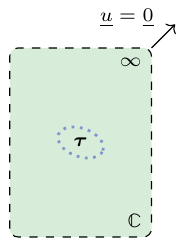
[6] showed that the resulting strain field is uniform inside the ellipsoid. This is the whole reason mean-field homogenization works, and it is specific to the ellipsoid: no other shape has it.
Three tensors, one contraction apart
The same solution is written three ways in the literature. Knowing which is which avoids most confusion when comparing formulas across papers.
Eshelby tensor
which is Eshelby's original form.
Second Hill tensor
In MeanFieldHomogenization, hill_tensor and eshelby_tensor. There is no public accessor for
P = hill_tensor(inclusion, C₀)
Q = C₀ - C₀ ⊡ P ⊡ C₀
which is all the crack machinery does internally before taking the flat limit.
The transport counterpart
Replace elasticity by a scalar diffusion problem — heat conduction, mass diffusion, electric conduction, Darcy flow. The unknown is a scalar potential
the convention fixed in Elasticity and transport: one set of formulas —
which is the elastic
The two problems are handled by the same functions in MeanFieldHomogenization, which dispatch on the order of the property tensor passed in: an order-4
See Conduction and diffusion for the call.
Why this matters for a real material
A real heterogeneous material is not one ellipsoid in an infinite medium. What comes closest is the inhomogeneity problem — an ellipsoid of a different stiffness
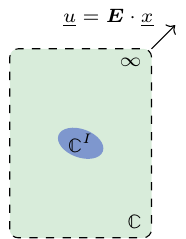
The step from there to an estimate of effective properties is the subject of the next two pages, and it has two parts:
each inclusion is treated as if it were alone in an infinite reference medium — this is what makes
usable, and it is exactly the approximation that distinguishes one mean-field scheme from another (Homogenization schemes); the choice of that reference medium is the scheme: the matrix itself (Mori–Tanaka), the effective medium being sought (self-consistent), or something in between (Localization).