
Thick-walled cylinder
The canonical MFront/FEniCS coupling demonstration, run the other way round: every Gauss point carries a microstructure, and the scheme that upscales it supplies the stress and the tangent.
Quarter annulus, plane strain, internal pressure
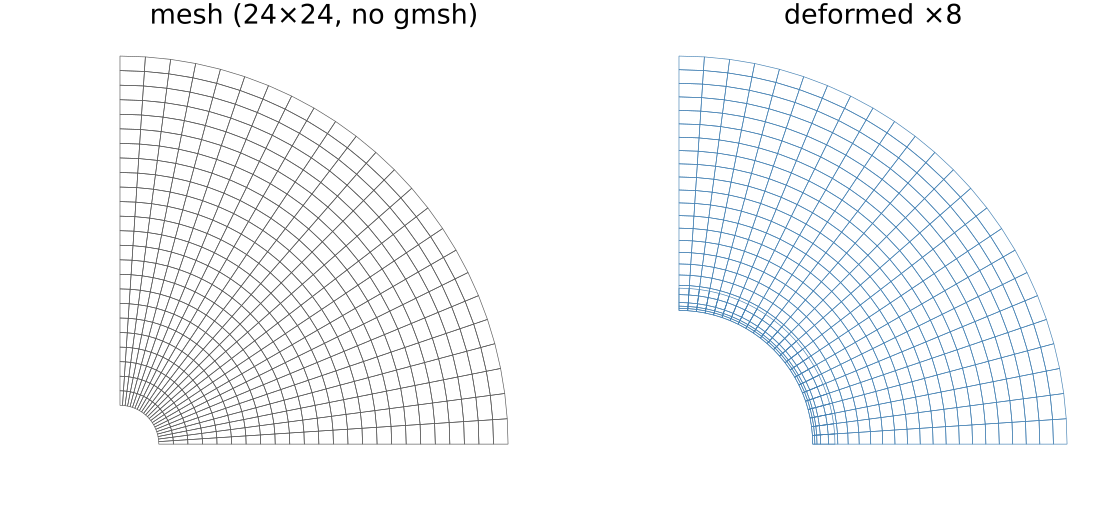
The mesh is a structured rectangle bent into annulus_grid — so no gmsh is involved.
This page is static
Figures come from scripts/fe/make_thick_cylinder_figures.jl, run by hand and committed, so no documentation build re-runs a finite-element solve. The model itself is scripts/88_fe_thick_cylinder.jl.
Step 1 — a linear composite, against Lamé
A matrix with 25 % stiff spherical inclusions is isotropic, so the closed form applies with the homogenized moduli:
rve = RVE()
add_phase!(rve, :M, Ellipsoid(1.0), Dict(:C => TensISO{3}(3 * 30.0, 2 * 18.0)); fraction = :rest)
add_phase!(rve, :I, Ellipsoid(1.0), Dict(:C => TensISO{3}(3 * 120.0, 2 * 80.0));
           fraction = 0.25)

mat = HomogenizedElastic(rve, MoriTanaka())      # E = 61.76 GPa, ν = 0.2427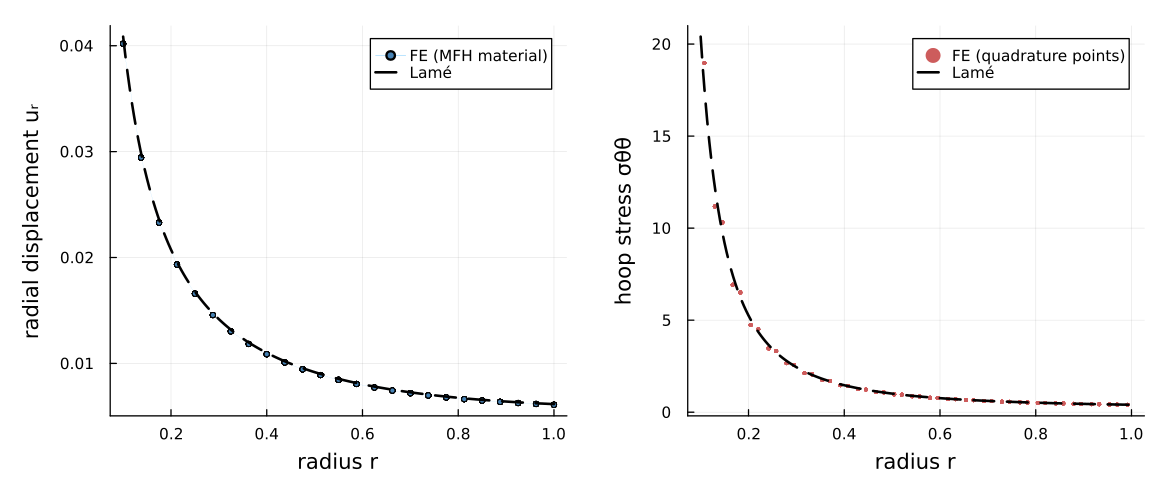
The error converges at the expected second order for Q1 elements, which is what validates the coupling — any defect in the plumbing would show up here:
| mesh | 24×24 | 48×48 | 96×96 |
|---|---|---|---|
| 1.6·10⁻² | 4.3·10⁻³ | 1.1·10⁻³ |
Step 2 — cracks that close
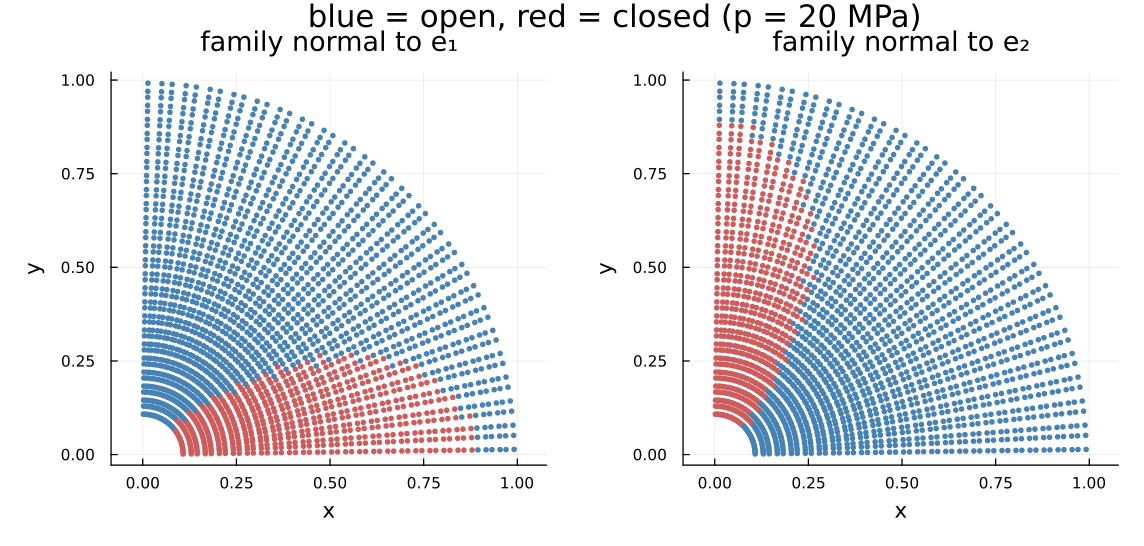
Two crack families, normals
add_phase!(rve, :Fx, PennyCrack(1.0; euler_angles = (π/2, 0.0)), props; density = 0.15)
add_phase!(rve, :Fy, PennyCrack(1.0; euler_angles = (π/2, π/2)), props; density = 0.15)

mat = MicrocrackedMaterial(rve, MoriTanaka(); ω₀ = (2.0e-3, 2.0e-3))
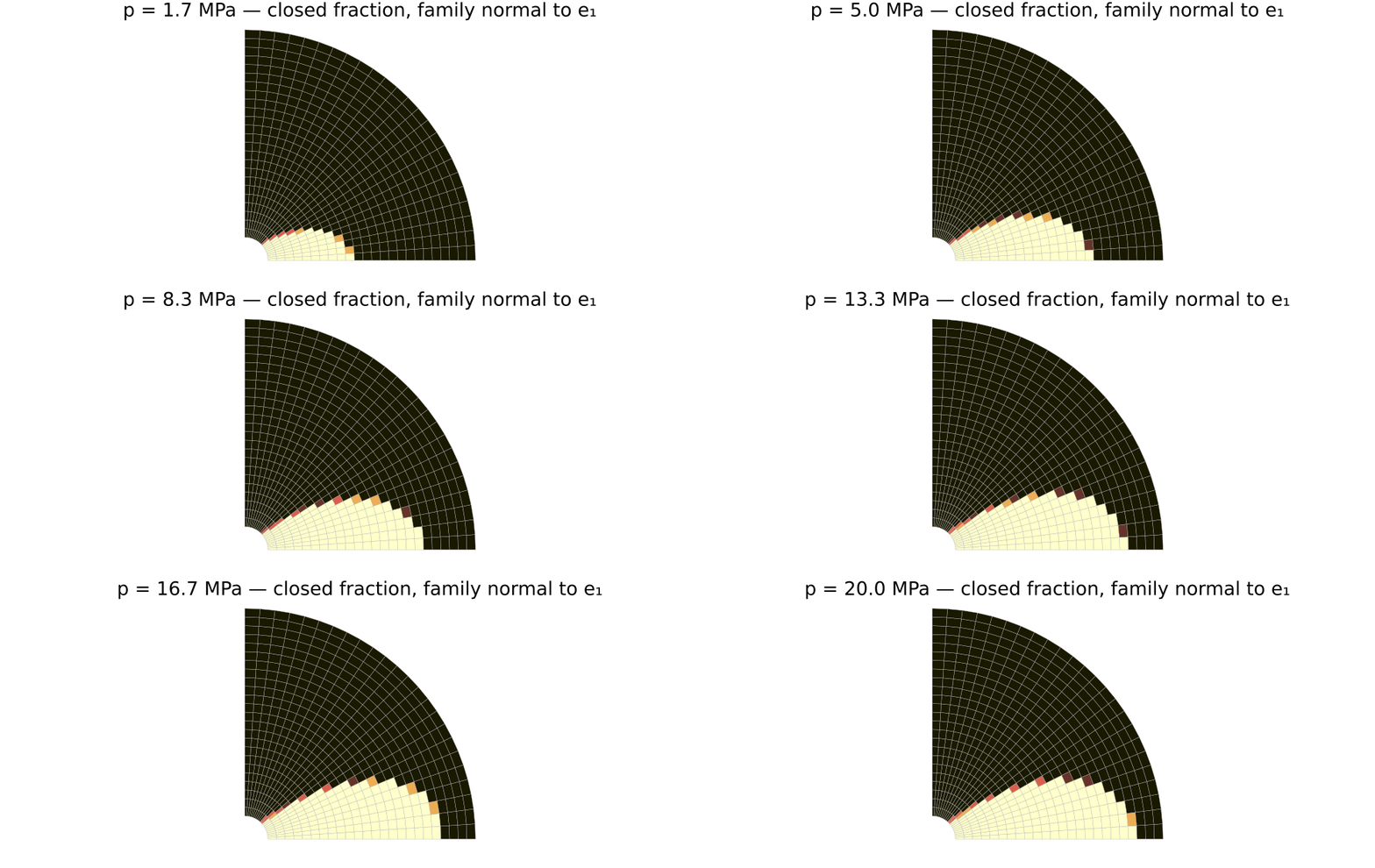
A family closes where the traction normal to its plane turns compressive. In a pressurized cylinder
so it closes near
What it costs
cracked run: 4 scheme solves for 2304 quadrature pointsThe homogenized stiffness depends on the state only through the discrete open/closed set — for a flat crack MaterialCache reduces 12 load steps × Newton iterations × 2304 points to four Mori-Tanaka solves.
The tangent is exact on every branch, so Newton keeps quadratic convergence without any algorithmic tangent being derived: see scale transition.