
A damage law written from scratch
The whole page as one script
Every block of this page, in order, is scripts/material_laws/02_damage.jl. From a clone of the repository, julia --project=docs -e 'using Pkg; Pkg.instantiate()' once, then julia scripts/material_laws/02_damage.jl, runs it end to end.
This example writes a law that is not shipped with the package, from its equations to a cyclic test, in about fifteen lines. It is a scalar isotropic damage law of the simplest kind, chosen for being easy to check by hand: the point is the procedure, which is the same for any law with internal variables.
The model
The material is linear elastic, of stiffness
The damage is driven by the elastic energy of the undamaged material,
Over a step this reads: if
The law in code
using MeanFieldHomogenization, StaticArrays, Plots

k, μ = 20e3, 12e3                                     # bulk and shear moduli, MPa
J = identity_mandel() * identity_mandel()' / 3        # the projector on volume changes
ℂ = 3k * J + 2μ * (one(SMatrix{6, 6, Float64}) - J)   # isotropic stiffness, Mandel form

Y(ε, p) = transpose(ε) * (p.ℂ * ε) / 2
d_star(ε, p) = 1 - sqrt(p.Y₀ / Y(ε, p))

damage = ResidualLaw(;
    name = :ScalarDamage,
    stress = (ε, y, p) -> (1 - y.d) * (p.ℂ * ε),
    residual = (y, g, prev, Δt, p) -> (d = y.d - d_star(g.ε, p),),
    elastic = (g, prev, Δt, p) -> d_star(g.ε, p) <= prev.y.d,
    layout = (d = 1,),
    p = (ℂ = ℂ, Y₀ = 1e-3),                            # Y₀ in MPa (energy per volume)
)
ScalarDamage (residual route; ε → σ; internal variables d)Each line is one piece of the model:
| code | model |
|---|---|
stress | |
residual | |
elastic | |
layout | one internal variable, the scalar d |
p | the stiffness and the threshold |
The derivative of the stress with respect to the strain, the consistent tangent of a damaging step, is not written: it comes from the implicit-function theorem applied to the residual. The contract checker confirms it against a finite difference:
check_material_interface(damage; verbose = false)trueA test with unloading
Uniaxial strain (
ε_axial(t) = t < 0.4 ? 5e-4 * t / 0.4 : t < 0.6 ? 5e-4 * (0.6 - t) / 0.2 : 1e-3 * (t - 0.6) / 0.4
path = LoadingPath(range(0, 1; length = 101); ε11 = ε_axial, ε22 = 0, ε33 = 0)
r = point_response(damage, path)
plot(r[:ε11] * 1e3, r[:σ11]; lw = 2, label = "ScalarDamage", legend = :topleft,
    xlabel = "axial strain ε₁₁ (‰)", ylabel = "axial stress σ₁₁ (MPa)")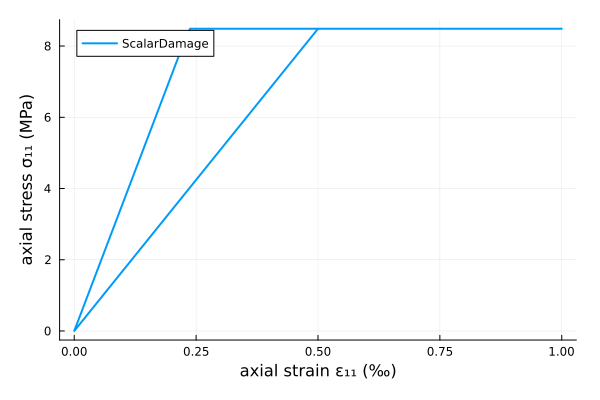
The unloading goes back to the origin along a straight line of reduced slope
Checking it by hand
In uniaxial strain
C11 = ℂ[1, 1]
d_ref = accumulate(max, [e == 0 ? 0.0 : max(0.0, 1 - sqrt(1e-3 / (C11 * e^2 / 2))) for e in r[:ε11]])
maximum(abs, r[:d] - d_ref), maximum(abs, r[:σ11] - (1 .- d_ref) .* C11 .* r[:ε11])
(1.1102230246251565e-16, 1.7763568394002505e-15)Both differences are at the rounding of the numbers.
This page was generated using Literate.jl.