
Voigt and Reuss bounds
Before this page
Homogenization schemes, where the concentration tensors
The two bounds use no shape, no reference medium and no Eshelby problem: they assume a uniform field throughout the RVE, the strain for one and the stress for the other. That crude assumption is what makes them rigorous, since a uniform field is admissible in the corresponding energy principle (Hill, 1952).
1. Voigt: a uniform strain
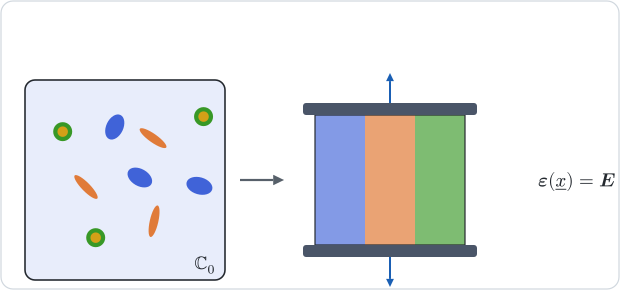
Every phase is assumed to undergo the macroscopic strain,
Its bound property follows from the principle of minimum potential energy. Under the affine boundary condition
2. Reuss: a uniform stress
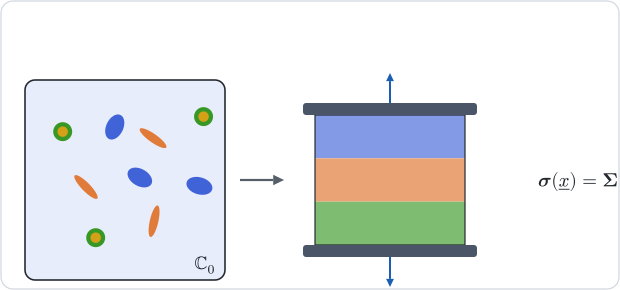
Every phase is assumed to carry the macroscopic stress, which is exact for layers loaded in series. The compliances then average,
and the principle of minimum complementary energy, applied to the statically admissible field
in the sense of quadratic forms, whatever the microstructure. A phase without stiffness, a void, makes
3. Cracks, conduction, laminates
A crack family has no volume, so it enters neither mean: both bounds ignore cracks, which is why Voigt and Reuss refuse an RVE holding cracks alone. In conduction the same arguments give
A laminate attains both, each on its own block: across the layers, the inverse of the acoustic tensor
4. Concentration tensors
The two assumptions are statements on the concentration tensors themselves, in the sense of the overview. Under Voigt every phase undergoes the macroscopic strain, so that
Where to go next
The bounds know nothing of shapes. The next page, Dilute estimates, introduces the Eshelby problem into the estimate, with each inclusion alone in the matrix, under either the remote strain or the remote stress. The bounds are computed on a first RVE in the tutorial Bounds and classical schemes.