
A creeping laminate: the multilayer in aging viscoelasticity
The whole page as one script
Every block of this page, in order, is scripts/39_laminate_alv.jl. From a clone of the repository, julia --project=docs -e 'using Pkg; Pkg.instantiate()' once, then julia scripts/39_laminate_alv.jl, runs it end to end.
Before this page
The tutorial Periodic multilayer: the exact laminate solution, whose elastic algebra is transposed here, and the theory page Aging linear Volterra behavior (ALV), where the Volterra products that replace the tensor products are defined.
The laminate solution is pure algebra — products of Kelvin-Mandel matrices and one inversion restricted to the out-of-plane subspace. Replacing each scalar by a discretized Volterra operator therefore transposes it verbatim to aging linear viscoelasticity: the same kernel runs, with the volterra_inverse on the out-of-plane restriction.
This script checks that transposition against the elastic answer, then uses it: a stack alternating a creeping binder with an elastic reinforcement relaxes very differently along the layers and across them.
using MeanFieldHomogenization
using TensND
using Printf
using LinearAlgebra
using Plots

default(; left_margin = 5Plots.mm, bottom_margin = 5Plots.mm)

iso(k, μ) = TensISO{3}(3k, 2μ)
iso (generic function with 1 method)The creeping phase is the COMPLIANT one — a binder between stiff, elastic reinforcing layers. That is the configuration in which the two directions behave most differently: across the layers (a series arrangement) the binder dominates, in their plane (a parallel one) the reinforcement does.
C_binder = iso(0.5, 0.2)    # creeping binder, instantaneous moduli
C_reinf = iso(2.0, 0.8)     # elastic reinforcement
f_binder, f_reinf = 0.4, 0.6
(0.4, 0.6)Diagonal time block of an ALV operator, as a 6×6 Mandel matrix.
blk(M, i) = M[(6 * (i - 1) + 1):(6 * i), (6 * (i - 1) + 1):(6 * i)]blk (generic function with 1 method)The elastic limit
Feeding each layer a Heaviside law built on its elastic stiffness must give back, in every diagonal time block, the elastic laminate — and nothing off-diagonal, an elastic material having no memory. That single check pins the whole Volterra transposition against a result already validated in closed form against Backus (1962).
times = [0.0, 1.0, 3.0, 7.0]

lam_el = Laminate(; normal = (0, 0, 1))
add_layer!(lam_el, :BINDER, Dict(:C => C_binder); thickness = f_binder)
add_layer!(lam_el, :REINF, Dict(:C => C_reinf); thickness = f_reinf)
C_elastic = Matrix(mandel(homogenize(lam_el, Laminated(), :C)))

lam_h = Laminate(; normal = (0, 0, 1))
add_layer!(lam_h, :BINDER, Dict(:C => heaviside_law(C_binder)); thickness = f_binder)
add_layer!(lam_h, :REINF, Dict(:C => heaviside_law(C_reinf)); thickness = f_reinf)
M_h = homogenize_alv(lam_h, Laminated(), :C; times = times)

err_diag = maximum(maximum(abs, blk(M_h, i) - C_elastic) for i in eachindex(times))
err_off = maximum(
    maximum(abs, M_h[(6 * (i - 1) + 1):(6 * i), (6 * (j - 1) + 1):(6 * j)])
        for i in 2:length(times) for j in 1:(i - 1)
)
@printf "elastic limit : max |diag block − ℂ_hom| = %.2e\n" err_diag
@printf "                max |off-diagonal block| = %.2e   (no memory)\n" err_off
elastic limit : max |diag block − ℂ_hom| = 2.22e-16
max |off-diagonal block| = 0.00e+00 (no memory)A genuinely creeping stack
The binder is a Maxwell chain that loses half its stiffness with a relaxation time of 3; the reinforcement stays elastic.
τ = 3.0
law_binder = maxwell_relaxation(iso(0.25, 0.1), [iso(0.25, 0.1)], [τ])
law_reinf = heaviside_law(C_reinf)

ts = collect(range(0.0, 20.0; length = 40))
lam = Laminate(; normal = (0, 0, 1))
add_layer!(lam, :BINDER, Dict(:C => law_binder); thickness = f_binder)
add_layer!(lam, :REINF, Dict(:C => law_reinf); thickness = f_reinf)

M = homogenize_alv(lam, Laminated(), :C; times = ts)
Mv = homogenize_alv(lam, Voigt(), :C; times = ts)
Mr = homogenize_alv(lam, Reuss(), :C; times = ts)

C33 = [blk(M, i)[3, 3] for i in eachindex(ts)]        # across the layers
C12 = [blk(M, i)[6, 6] / 2 for i in eachindex(ts)]    # in the plane
C33v = [blk(Mv, i)[3, 3] for i in eachindex(ts)]
C33r = [blk(Mr, i)[3, 3] for i in eachindex(ts)]
C12v = [blk(Mv, i)[6, 6] / 2 for i in eachindex(ts)]

@printf "\nrelaxation (τ = %.1f)\n" τ
@printf "  C₃₃₃₃ : %.6f (t=0) → %.6f (t=%.0f),  %.1f %% lost\n" C33[1] C33[end] ts[end] 100 * (1 - C33[end] / C33[1])
@printf "  C₁₂₁₂ : %.6f (t=0) → %.6f (t=%.0f),  %.1f %% lost\n" C12[1] C12[end] ts[end] 100 * (1 - C12[end] / C12[1])
relaxation (τ = 3.0)
  C₃₃₃₃ : 1.393939 (t=0) → 1.353685 (t=20),  2.9 % lost
  C₁₂₁₂ : 0.560000 (t=0) → 0.556857 (t=20),  0.6 % lost
The two directions relax by very different amounts, and for a structural reason: across the layers the stack is a series arrangement, so the creeping binder dominates and the effective stiffness follows it closely; in the plane it is a parallel one, so the elastic reinforcement carries the load and the loss is only the volume-weighted loss of the binder.
The exact saturations survive the transposition
In-plane Voigt and out-of-plane Reuss are equalities at every time.
@printf "\nat every time step :\n"
@printf "  max |C₁₂₁₂ − Voigt| = %.2e\n" maximum(abs, C12 .- C12v)
@printf "  max |C₃₃₃₃ − Reuss| = %.2e\n" maximum(abs, C33 .- C33r)
@printf "  and Reuss ≤ exact ≤ Voigt : %s\n" all(C33r .- 1.0e-12 .≤ C33 .≤ C33v .+ 1.0e-12)

p1 = plot(
    ts, C33; lw = 2, label = "exact (= Reuss)", xlabel = "t", ylabel = "C₃₃₃₃",
    title = "across the layers", legend = :topright
)
plot!(p1, ts, C33v; lw = 2, ls = :dash, label = "Voigt")

p2 = plot(
    ts, C12; lw = 2, label = "exact (= Voigt)", xlabel = "t", ylabel = "C₁₂₁₂",
    title = "in the plane of the layers", legend = :topright
)

plot(p1, p2; layout = (1, 2), left_margin = 8Plots.mm, bottom_margin = 8Plots.mm, size = (900, 350))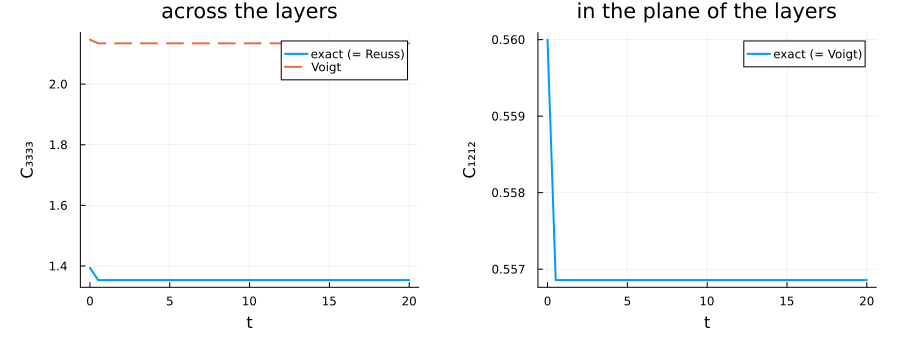
Transport
The same transposition at order 2, where the out-of-plane subspace is one-dimensional and volterra_inverse runs with block_size = 1.
K_A, K_B = TensISO{3}(2.0), TensISO{3}(0.3)
lam_k = Laminate(; normal = (0, 0, 1))
add_layer!(lam_k, :A, Dict(:K => heaviside_law(K_A)); thickness = 0.3)
add_layer!(lam_k, :B, Dict(:K => heaviside_law(K_B)); thickness = 0.7)
Mk = homogenize_alv(lam_k, Laminated(), :K; times = [0.0, 1.0, 3.0])
k_perp = Mk[3, 3]
@printf "\ntransport (elastic limit) : 1/k_⊥ = %.10f   series = %.10f\n" 1 / k_perp (0.3 / 2.0 + 0.7 / 0.3)
transport (elastic limit) : 1/k_⊥ = 2.4833333333 series = 2.4833333333Interfaces
Elastic interfaces carry over unchanged: a spring compliance still adds to the out-of-plane series law, at every time.
lam_i = Laminate(; normal = (0, 0, 1))
add_layer!(
    lam_i, :BINDER, Dict(:C => law_binder); thickness = f_binder,
    interface = SpringInterface(; sn = 5.0e-2, st = 5.0e-2)
)
add_layer!(lam_i, :REINF, Dict(:C => law_reinf); thickness = f_reinf)
Mi = homogenize_alv(lam_i, Laminated(), :C; times = ts)
C33i = [blk(Mi, i)[3, 3] for i in eachindex(ts)]
@printf "\nwith a spring interface : C₃₃₃₃ %.6f → %.6f (was %.6f → %.6f)\n" C33i[1] C33i[end] C33[1] C33[end]
@printf "  the interface softens the stack at every time : %s\n" all(C33i .< C33)
with a spring interface : C₃₃₃₃ 1.303116 → 1.267870 (was 1.393939 → 1.353685)
  the interface softens the stack at every time : true
The spring interface lowers the out-of-plane stiffness at every time, as the series law requires, and leaves the in-plane response unchanged.
Where to go next
The laminate is the one microstructure whose aging response needs no scheme. The derivatives used throughout these tutorials have their own group, from Derivatives and sensitivities; the Volterra assembly is differentiated in Derivatives through the aging-viscoelastic pipeline, and the calls of the laminate cell are documented in Laminates — periodic multilayer cells.
This page was generated using Literate.jl.