
The interfacial transition zone in concrete
Before this page
Layered inclusions, which explains how a composite sphere enters a scheme as a phase, the recurrences behind it in Layered sphere — bulk + shear recurrences and imperfect interfaces, and Self-consistent schemes and Mori–Tanaka for the estimates of the four scales.
Around every aggregate in a concrete there is a thin shell of cement paste that is more porous than the bulk paste: packing of cement grains against a rigid surface leaves more room for water, and the resulting interfacial transition zone (ITZ) is softer and weaker than the material around it. How much stiffness does that cost? Microstructural model of (Königsberger et al., 2013).
Scope: the elastic effect only
Königsberger et al. (2013) go further and use the ITZ to explain the elastic limit of concrete: the ITZ is where local failure initiates, so the macroscopic proportionality limit is reached long before the bulk paste fails. This page reproduces the elastic part of the model; the elastic limit is the subject of the next one, The elastic limit of concrete.
The three scales
The paste scale is the one used in Quasi-brittle strength — the hydrate foam and cement paste model of Pichler and Hellmich (2011), shared as scripts/common/quasibrittle_strength.jl. The new ingredient is the fourth phase geometry: coated aggregates.
| Scale | RVE | Phases | Scheme |
|---|---|---|---|
| 1 | Hydrate foam (HF) | oriented hydrate needles + water + air | Self-Consistent |
| 2 | Cement paste (CP) | HF matrix + clinker grains | Mori-Tanaka |
| 3 | ITZ | CP + extra capillary porosity | Mori-Tanaka |
| 4 | Concrete | CP matrix + ITZ-coated aggregates | Mori-Tanaka |
using MeanFieldHomogenization
using TensND
using LinearAlgebra
using Printf
using Plots
gr()  # headless backend; GKSwstype is set to "100" in make.jl

# Densities (relative to water) and phase moduli of pichler2011.
const d_clin, d_hyd, d_san = 3.15, 2.073, 2.648
const K_clin, μ_clin = 116.7, 53.8
const K_hyd, μ_hyd = 18.7, 11.8
const K_san, μ_san = 37.8, 44.3

# Powers hydration model: volume fractions from w/c and hydration degree α.
f_clin(wc, α) = (1 - α) / (1 + d_clin * wc)
f_w(wc, α) = d_clin * (wc - 0.42 * α) / (1 + d_clin * wc)
f_hyd(wc, α) = 1.42 * d_clin / d_hyd * α / (1 + d_clin * wc)
fh_san(wc, sc) = sc / d_san / (1 / d_clin + wc + sc / d_san)

const WC, ALPHA, SC_RATIO = 0.5, 1.0, 3.0

@printf("w/c = %.2f, α = %.1f, s/c = %.1f → aggregate volume fraction %.4f\n",
        WC, ALPHA, SC_RATIO, fh_san(WC, SC_RATIO))
w/c = 0.50, α = 1.0, s/c = 3.0 → aggregate volume fraction 0.5809Scale 1–2: the bulk cement paste
The hydrate foam is a self-consistent polycrystal of needle-shaped hydrates (
const N_BINS = 20
const ω_needle = 1.0e4
const TINY = 1.0e-3      # regularizes the exactly-zero water/air stiffness

function hydrate_foam(wc, α; N = N_BINS, ω = ω_needle)
    fclin = f_clin(wc, α)
    fw = f_w(wc, α)
    fhyd = f_hyd(wc, α)
    fair = max(0.0, 1 - fclin - fw - fhyd)
    ## Fractions renormalized to the foam, from which clinker is excluded.
    scale = 1 / (1 - fclin)
    C_hyd = TensISO{3}(3K_hyd, 2μ_hyd)
    C_fluid = TensISO{3}(3TINY, 2TINY)
    ez = (0.0, 0.0, 1.0)

    rve = RVE()
    ## Zero-volume matrix phase: a self-consistent seed only, since the
    ## inclusion fractions already sum to 1.
    add_phase!(rve, :CP, Ellipsoid(1.0), Dict(:C => C_hyd); fraction = :rest, symmetrize = :iso)
    for (i, bin) in enumerate(polar_orientation_bins(N))
        add_phase!(
            rve, Symbol(:HYD, i), Spheroid(ω; euler_angles = (bin.θ, 0.0, 0.0)),
            Dict(:C => C_hyd); fraction = fhyd * scale * bin.weight,
            symmetrize = TISymmetrize(ez),
        )
    end
    add_phase!(rve, :W, Ellipsoid(1.0), Dict(:C => C_fluid);
        fraction = fw * scale, symmetrize = :iso)
    add_phase!(rve, :AIR, Ellipsoid(1.0), Dict(:C => C_fluid);
        fraction = fair * scale, symmetrize = :iso)
    return homogenize(
        rve, SelfConsistent(; abstol = 1.0e-8, maxiters = 1000, damping = 0.5),
        :C; select_best = true,
    )
end
The converged foam estimate carries a residual transverse isotropy about the binning axis — an artifact of discretizing a uniform orientation distribution, not a physical texture. It is projected back to isotropy before the aggregate scale, which is also what the composite-sphere recurrence of the next section requires.
C_hf = best_fit_ti(hydrate_foam(WC, ALPHA), (0.0, 0.0, 1.0))

rve_cp = RVE()
add_phase!(rve_cp, :HF, Ellipsoid(1.0), Dict(:C => C_hf); fraction = :rest)
add_phase!(
    rve_cp, :CLIN, Ellipsoid(1.0),
    Dict(:C => TensISO{3}(3K_clin, 2μ_clin)); fraction = f_clin(WC, ALPHA),
)
k_cp, μ_cp = k_mu(best_fit_iso(homogenize(rve_cp, MoriTanaka(), :C)))
C_cp = TensISO{3}(3k_cp, 2μ_cp)

@printf("bulk cement paste : E = %.2f GPa, ν = %.3f\n", E_nu(C_cp)...)
┌ Warning: Phase :CP is averaged over every rotation (`symmetrize = :iso`), but the reference medium of the Eshelby problems of SelfConsistent, the self-consistent estimate, is not invariant under them (relative distance 1.1e-5 to its isotropic average). The average is defined only for a reference with that symmetry; the reference is projected onto it, so the estimate is an approximation. Give the reference that symmetry, or drop `symmetrize` on :CP.
└ @ MeanFieldHomogenization.Schemes ~/work/MeanFieldHomogenization.jl/MeanFieldHomogenization.jl/src/Schemes/average_domain.jl:69
bulk cement paste : E = 19.83 GPa, ν = 0.231Scale 3: what an ITZ is made of
The ITZ is modeled as the same paste carrying additional capillary porosity
function itz_stiffness(C_cp, φ)
    φ ≤ 0 && return C_cp
    rve = RVE()
    add_phase!(rve, :CP, Ellipsoid(1.0), Dict(:C => C_cp); fraction = :rest)
    add_phase!(rve, :PORE, Ellipsoid(1.0), Dict(:C => TensISO{3}(0.0, 0.0)); fraction = φ)
    return homogenize(rve, MoriTanaka(), :C)
end

for φ in (0.1, 0.3, 0.5)
    @printf("φ_ITZ = %.1f → E_ITZ = %5.2f GPa  (bulk paste %.2f GPa)\n",
            φ, E_nu(itz_stiffness(C_cp, φ))[1], E_nu(C_cp)[1])
end
φ_ITZ = 0.1 → E_ITZ = 16.22 GPa (bulk paste 19.83 GPa)
φ_ITZ = 0.3 → E_ITZ = 10.67 GPa (bulk paste 19.83 GPa)
φ_ITZ = 0.5 → E_ITZ = 6.60 GPa (bulk paste 19.83 GPa)Scale 4: coated aggregates
An aggregate of radius LayeredSphere — a composite sphere, which MeanFieldHomogenization accepts as an RVE phase directly: it enters the scheme through its concentration tensors, with no Hill tensor of its own.
Two bookkeeping points, both easy to get wrong:
the volume fraction to declare is that of the whole coated particle,
the matrix around it stays the bulk paste — the ITZ is already inside the inclusion, and counting it twice would double the softening.
const C_SAN = TensISO{3}(3K_san, 2μ_san)
const F_AGG = fh_san(WC, SC_RATIO)

function E_concrete(φ_itz, t_over_R)
    coated = LayeredSphere((1.0, 1.0 + t_over_R), (C_SAN, itz_stiffness(C_cp, φ_itz)))
    rve = RVE()
    add_phase!(rve, :CP, Ellipsoid(1.0), Dict(:C => C_cp); fraction = :rest)
    add_phase!(
        rve, :AGG, coated, Dict(:C => C_SAN);
        fraction = F_AGG * (1 + t_over_R)^3,
    )
    return E_nu(homogenize(rve, MoriTanaka(), :C))[1]
end

E_ref = E_concrete(0.0, 0.05)   # ITZ as stiff as the bulk paste ⇒ no ITZ at all
@printf("concrete without ITZ contrast : E = %.2f GPa\n", E_ref)
concrete without ITZ contrast : E = 44.36 GPaHow much stiffness does the ITZ cost?
φs = range(0.0, 0.5; length = 21)
plt = plot(
    xlabel = "additional ITZ porosity φ_ITZ", ylabel = "E_concrete / E (no ITZ)",
    legend = :bottomleft, title = "Elastic cost of a porous ITZ (w/c = $WC, α = $ALPHA)",
)
for t in (0.02, 0.05, 0.10)
    plot!(plt, φs, [E_concrete(φ, t) / E_ref for φ in φs];
          lw = 2, marker = :circle, ms = 2, label = "t/R = $t")
end
plt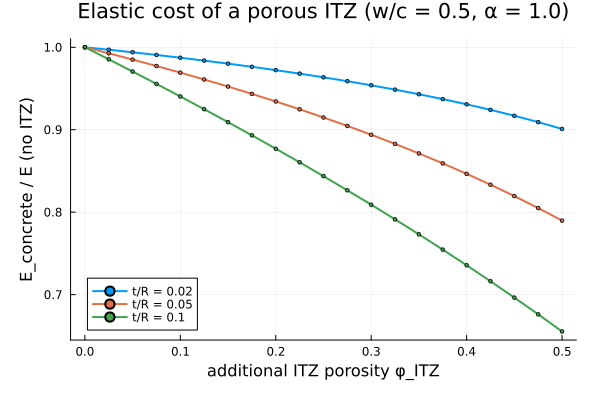
Three readings of the figure:
the loss is roughly linear in
and grows with thickness, as one would expect of a thin compliant shell in series with the load path; it is modest for realistic ITZs: at
the sensitivity to thickness is what makes the ITZ hard to identify from stiffness measurements alone:
and trade off against each other along the curves.
That last point is the reason Königsberger et al. (2013) turn to the elastic limit rather than the elastic modulus: the ITZ is a far more conspicuous feature of where concrete starts to fail than of how stiff it is.
@printf("t/R = 0.05, φ_ITZ = 0.30 → E/E₀ = %.3f\n", E_concrete(0.3, 0.05) / E_ref)t/R = 0.05, φ_ITZ = 0.30 → E/E₀ = 0.894The ratio printed is the one quoted in the second reading of the figure, for an ITZ of thickness
Where to go next
The two ways of writing a multiscale chain, explicit as on this page or as one nested object, are compared in Multiscale models. The next application, The elastic limit of concrete: ITZ failure and ITZ–aggregate separation, turns from the stiffness the ITZ costs to the stresses it concentrates, and derives the onset of cracking of concrete.