
Multiscale elasticity of a hydrating cement paste
Before this page
Self-consistent schemes and Mori–Tanaka, where the estimates chained below are derived, the tutorial Porous materials and the self-consistent trap on the percolation threshold of the self-consistent scheme, which is what makes the paste set, and Layered inclusions for the composite sphere of the last section.
Following Sanahuja et al. (2007) — and mirroring the corresponding chapter of the Echoes book (Barthélémy, 2026) — this page builds a two-scale micromechanical model of Portland cement paste predicting the effective Young's modulus from the water-to-cement ratio
The three ingredients are:
a self-consistent scheme at the C-S-H scale, whose percolation threshold produces the setting transition;
a two-step Mori-Tanaka homogenization at the paste scale, for the inner/outer core-shell morphology;
a Biot poromechanics correction turning drained into undrained moduli.
Sanahuja et al. (2007) embed a genuine composite sphere (anhydrous core + inner-hydrate shell) in the outer matrix. Both forms are available: a LayeredSphere enters the schemes directly through its concentration tensors (last section), while the two-step form below makes each scale explicit.
Microstructural model
Two C-S-H types coexist at the paste scale:
Inner (high-density) hydrates — a porous polycrystal of oblate solid bricks (aspect ratio
Outer (low-density) hydrates — thinner oblate platelets (
decreases as hydration proceeds.
using MeanFieldHomogenization
using TensND
using LinearAlgebra
using Plots
gr()  # headless backend; GKSwstype is set to "100" in make.jl

const ω_i, ω_o, φ_i = 0.12, 0.033, 0.30

C_sol = iso_stiffness_E_nu(71.6, 0.27)      # solid C-S-H
C_anhyd = iso_stiffness_E_nu(135.0, 0.3)    # anhydrous clinker
C_zero = TensISO{3}(0.0, 0.0)               # empty pore

(E_nu(C_sol), k_mu(C_sol))
((71.6, 0.27), (51.88405797101449, 28.188976377952752))Powers hydration model and volume fractions
The Powers model (Powers and Brownyard, 1946) gives the anhydrous fraction
The Tennis-Jennings model (Tennis and Jennings, 2000) splits the solid hydrates between low- and high-density C-S-H through the mass fraction
fa(wc, a) = 0.32 * (1 - a) / (wc + 0.32)
fp(wc, a) = (wc - 0.17a) / (wc + 0.32)
amax(wc) = min(1.0, wc / 0.4175)
mLD(wc, a) = clamp(3.017a * wc - 1.347a + 0.538, 0.0, 1.0)

function volume_fractions(wc, α)
    _fa, _fp = fa(wc, α), fp(wc, α)
    fhs = 1 - _fa - _fp                      # total solid hydrates
    fis = (1 - mLD(wc, α)) * fhs             # inner solid
    fos = mLD(wc, α) * fhs                   # outer solid
    fip = φ_i / (1 - φ_i) * fis              # inner porosity
    fop = _fp - fip                          # outer porosity
    fi = fis + fip                           # inner phase (solid + pores)
    φ_o = (fop + fos) > 1.0e-12 ? fop / (fop + fos) : 0.0
    return (; fa = _fa, fis, fos, fip, fop, fi, φ_o)
end

v = volume_fractions(0.45, 0.8 * amax(0.45))
(fa = round(v.fa, digits = 4), fi = round(v.fi, digits = 4), φ_o = round(v.φ_o, digits = 4))
(fa = 0.0831, fi = 0.3298, φ_o = 0.5261)Scale 0 — self-consistent estimate of the C-S-H phases
Both hydrate types are porous polycrystals: oblate solid bricks and spherical pores, homogenized by the self-consistent scheme. Its percolation threshold is what makes the paste set.
function C_porous_sc(φ, ω)
    r = RVE()
    add_phase!(r, :OUTER, Ellipsoid(1.0, 1.0, ω), Dict(:C => C_sol); fraction = :rest, symmetrize = IsoSymmetrize())
    add_phase!(
        r, :PORE, Ellipsoid(1.0, 1.0, 1.0), Dict(:C => C_zero);
        fraction = φ
    )
    return homogenize(r, SelfConsistent(), :C)
end

C_inner = C_porous_sc(φ_i, ω_i)
(E_inner = round(E_nu(C_inner)[1], digits = 3),)
(E_inner = 31.003,)The inner hydrates are fixed once and for all. The outer ones stiffen as
for φ in (0.2, 0.4, 0.6, 0.8, 0.9)
    E = E_nu(C_porous_sc(φ, ω_o))[1]
    println("φ_o = ", rpad(φ, 5), "   E_outer = ", round(E, digits = 4))
end
φ_o = 0.2 E_outer = 43.9774
φ_o = 0.4 E_outer = 22.6375
φ_o = 0.6 E_outer = 9.3638
φ_o = 0.8 E_outer = 1.5553
φ_o = 0.9 E_outer = 0.0The thinner the platelets, the lower the porosity at which the solid skeleton loses connectivity — this is precisely the mechanism that sets the setting threshold in the paper.
Scale 1 — cement paste
At the paste scale, the anhydrous grains are first embedded in the inner hydrates, and the composite inclusions so obtained are then embedded in the outer hydrates, whose stiffness is that of scale 0 at the current porosity
function C_paste(wc, α)
    v = volume_fractions(wc, α)
    (v.fop < 0 || v.φ_o >= 1) && return nothing
    C_out = C_porous_sc(v.φ_o, ω_o)
    k_mu(C_out)[1] <= 1.0e-9 && return nothing      # outer not percolating yet

    f_inc = v.fa + v.fi
    f_inc < 1.0e-12 && return C_out

    # Step 1 — core-shell inclusion: anhydrous grains in inner hydrates.
    r1 = RVE()
    add_phase!(r1, :INNER, Ellipsoid(1.0, 1.0, 1.0), Dict(:C => C_inner); fraction = :rest)
    add_phase!(
        r1, :ANH, Ellipsoid(1.0, 1.0, 1.0), Dict(:C => C_anhyd);
        fraction = v.fa / f_inc
    )
    C_comp = homogenize(r1, MoriTanaka(), :C)

    # Step 2 — composite inclusions in the outer matrix.
    r2 = RVE()
    add_phase!(r2, :OUTER, Ellipsoid(1.0, 1.0, 1.0), Dict(:C => C_out); fraction = :rest)
    add_phase!(
        r2, :INC, Ellipsoid(1.0, 1.0, 1.0), Dict(:C => C_comp);
        fraction = f_inc
    )
    return homogenize(r2, MoriTanaka(), :C)
end

println("        α/αmax:  0.1     0.3     0.5     0.7     0.9")
for wc in (0.25, 0.35, 0.45, 0.55)
    print("w/c = ", wc, " :  ")
    for a in (0.1, 0.3, 0.5, 0.7, 0.9)
        C = C_paste(wc, a * amax(wc))
        print(rpad(C === nothing ? "—" : round(E_nu(C)[1], digits = 2), 8))
    end
    println()
end
α/αmax: 0.1 0.3 0.5 0.7 0.9
w/c = 0.25 : 0.0 1.69 11.63 22.42 32.79
w/c = 0.35 : 0.0 2.06 10.92 20.03 27.76
w/c = 0.45 : 0.0 2.11 10.02 17.33 23.02
w/c = 0.55 : 0.0 1.05 7.45 13.12 17.58The three predictions of Sanahuja et al. (2007) are reproduced:
a setting threshold: the paste carries no stiffness at low
, because the outer phase has not percolated yet; a monotonic stiffening up to
; a lower asymptotic stiffness for higher
, reflecting the larger residual porosity at full hydration.
Plotting the Young's modulus against the hydration degree makes all three visible at once — the flat zero-stiffness plateau before percolation, the rise, and the
α_plot = 0.0:0.01:1.0
plt = plot(;
    xlabel = "hydration degree α", ylabel = "Young's modulus E (GPa)",
    legend = :topleft, framestyle = :box, size = (760, 480),
)
for wc in (0.25, 0.35, 0.45, 0.55)
    αs = Float64[]
    Es = Float64[]
    for a in α_plot
        a > amax(wc) && continue
        C = C_paste(wc, a)
        C === nothing && continue
        push!(αs, a)
        push!(Es, E_nu(C)[1])
    end
    plot!(plt, αs, Es; label = "w/c = $wc", lw = 2)
end
plt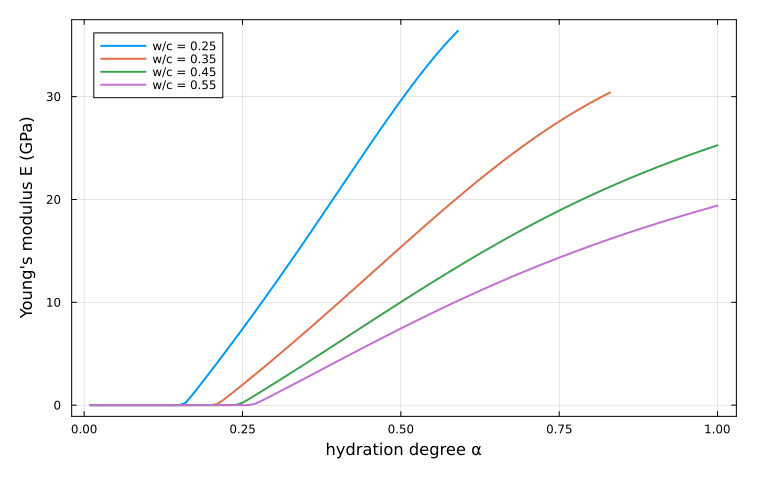
Undrained moduli
Ultrasonic measurements probe the undrained moduli of a saturated paste. For a porous medium with a homogeneous isotropic solid of bulk modulus
k_s = k_mu(C_sol)[1]

function undrained(C, φ)
    k, μ = k_mu(C)
    (k < 1.0e-12 || φ <= 0) && return C
    b = 1 - k / k_s
    M = k_s / max(b - φ, 1.0e-12)
    return iso_stiffness(k + M * b^2, μ)
end

C_inner_u = undrained(C_inner, φ_i)

function C_paste_undrained(wc, α)
    v = volume_fractions(wc, α)
    (v.fop < 0 || v.φ_o >= 1) && return nothing
    C_out = C_porous_sc(v.φ_o, ω_o)
    k_mu(C_out)[1] <= 1.0e-9 && return nothing
    C_out_u = undrained(C_out, v.φ_o)

    f_inc = v.fa + v.fi
    f_inc < 1.0e-12 && return C_out_u

    r1 = RVE()
    add_phase!(r1, :INNER, Ellipsoid(1.0, 1.0, 1.0), Dict(:C => C_inner_u); fraction = :rest)
    add_phase!(
        r1, :ANH, Ellipsoid(1.0, 1.0, 1.0), Dict(:C => C_anhyd);
        fraction = v.fa / f_inc
    )
    C_comp = homogenize(r1, MoriTanaka(), :C)

    r2 = RVE()
    add_phase!(r2, :OUTER, Ellipsoid(1.0, 1.0, 1.0), Dict(:C => C_out_u); fraction = :rest)
    add_phase!(
        r2, :INC, Ellipsoid(1.0, 1.0, 1.0), Dict(:C => C_comp);
        fraction = f_inc
    )
    return homogenize(r2, MoriTanaka(), :C)
end

println("w/c    α/αmax   E drained   E undrained")
for wc in (0.35, 0.55), a in (0.3, 0.6, 0.9)
    Cd = C_paste(wc, a * amax(wc))
    Cu = C_paste_undrained(wc, a * amax(wc))
    Ed = Cd === nothing ? NaN : E_nu(Cd)[1]
    Eu = Cu === nothing ? NaN : E_nu(Cu)[1]
    println(rpad(wc, 7), rpad(a, 9), rpad(round(Ed, digits = 2), 12), round(Eu, digits = 2))
end
w/c α/αmax E drained E undrained
0.35 0.3 2.06 2.99
0.35 0.6 15.53 20.43
0.35 0.9 27.76 33.13
0.55 0.3 1.05 1.48
0.55 0.6 10.43 13.52
0.55 0.9 17.58 21.28The undrained moduli are systematically higher, the gap being largest at low hydration degree where the pore network is still well connected. As
Direct composite-sphere form
Because a LayeredSphere is a first-class RVE phase, the paste scale can also be written exactly as in Sanahuja et al. (2007): one composite inclusion made of an anhydrous core coated by the inner hydrates, embedded in the outer matrix. The radius ratio follows from the volume-fraction constraint
The declared :C property of such a phase is irrelevant — the moduli live in the layers — so any placeholder is accepted.
function C_paste_composite(wc, α)
    v = volume_fractions(wc, α)
    (v.fop < 0 || v.φ_o >= 1) && return nothing
    C_out = C_porous_sc(v.φ_o, ω_o)
    k_mu(C_out)[1] <= 1.0e-9 && return nothing

    f_inc = v.fa + v.fi
    f_inc < 1.0e-12 && return C_out
    Ra = (v.fa / f_inc)^(1 / 3)
    Ra < 1.0e-6 && return nothing      # no anhydrous core left (α → 1)

    sphere = LayeredSphere((Ra, 1.0), (C_anhyd, C_inner))
    r = RVE()
    add_phase!(r, :OUTER, Ellipsoid(1.0, 1.0, 1.0), Dict(:C => C_out); fraction = :rest)
    add_phase!(r, :INC, sphere, Dict(:C => C_anhyd); fraction = f_inc)
    return homogenize(r, MoriTanaka(), :C)
end

println("        α/αmax:   0.3        0.5        0.7        0.9")
for wc in (0.35, 0.55)
    print("w/c = ", wc, " :  ")
    for a in (0.3, 0.5, 0.7, 0.9)
        C2 = C_paste_composite(wc, a * amax(wc))
        Cs = C_paste(wc, a * amax(wc))
        s = (C2 === nothing || Cs === nothing) ? "—" :
            string(round(E_nu(C2)[1], digits = 2), "/", round(E_nu(Cs)[1], digits = 2))
        print(rpad(s, 11))
    end
    println()
end
α/αmax: 0.3 0.5 0.7 0.9
w/c = 0.35 : 2.06/2.06 10.86/10.9219.88/20.0327.67/27.76
w/c = 0.55 : 1.05/1.05 7.44/7.45 13.08/13.1217.56/17.58Each cell shows composite sphere / two-step. The two agree closely at low inclusion fraction and diverge as it grows, the composite sphere being the morphologically faithful one: the two-step form loses the geometric constraint that the anhydrous core sits inside the inner-hydrate shell.
The same comparison over the whole hydration range, for two water-to-cement ratios:
α_plot = 0.0:0.01:1.0
plt = plot(;
    xlabel = "hydration degree α", ylabel = "Young's modulus E (GPa)",
    legend = :topleft, framestyle = :box, size = (760, 480),
)
for (wc, col) in ((0.35, 1), (0.55, 2))
    αs, Ecs, Ets = Float64[], Float64[], Float64[]
    for a in α_plot
        a > amax(wc) && continue
        C2 = C_paste_composite(wc, a)
        Cs = C_paste(wc, a)
        (C2 === nothing || Cs === nothing) && continue
        push!(αs, a)
        push!(Ecs, E_nu(C2)[1])
        push!(Ets, E_nu(Cs)[1])
    end
    plot!(plt, αs, Ecs; label = "composite sphere, w/c=$wc", lw = 2, color = col)
    plot!(plt, αs, Ets; label = "two-step, w/c=$wc", lw = 2, ls = :dash, color = col)
end
plt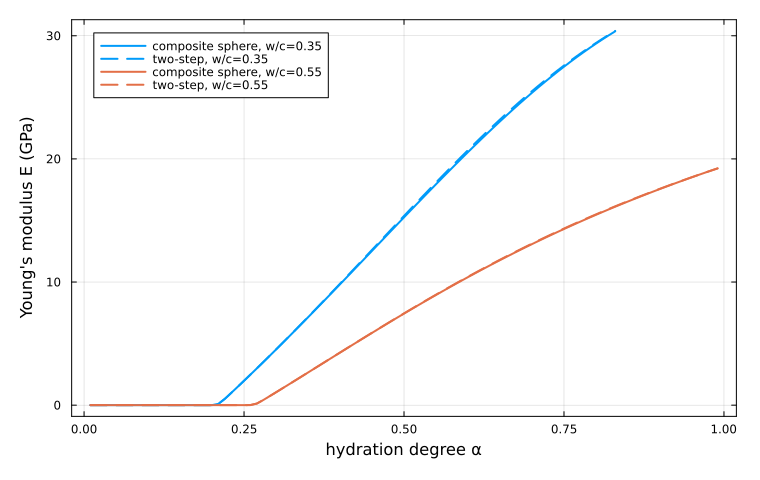
In this last figure, the solid and dashed curves of one color differ only by the morphology assumed at the paste scale. Both start at the same hydration degree, since the setting threshold is fixed at scale 0 by the percolation of the outer hydrates, which the two forms share.
Where to go next
The volume fractions of this page come from the Powers and Tennis–Jennings correlations. A hydrating blended cement paste, coupled to its chemistry computes them instead from the hydration kinetics and the stoichiometry of the reactions, and feeds them to a four-scale model of the same family. Cement paste: chloride diffusivity and elasticity keeps the Powers fractions and a three-layer composite sphere, and homogenizes the same microstructure for diffusivity as well as for stiffness. The recurrences behind LayeredSphere are derived in Layered sphere — bulk + shear recurrences and imperfect interfaces, and the Biot coefficients and undrained stiffness written out by hand above are computed by the library from a drained stiffness and a homogeneous solid, as described in Poromechanics.