
Self-consistent schemes
Before this page
Homogenization schemes, for the average relations and the limits through which a crack family enters, and Mori–Tanaka, the matrix-based estimate these schemes depart from.
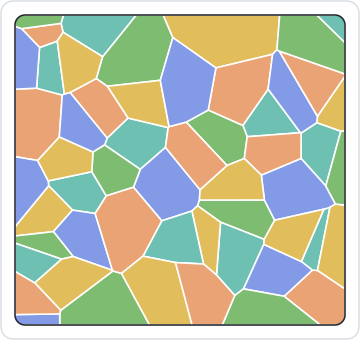
The schemes of the previous pages need a phase to play the role of the matrix. When none does — a polycrystal, a granular assembly, a foam whose walls and pores are equally connected — the reference medium has to be the effective medium itself, and the estimate becomes a fixed point.
1. SelfConsistent: every phase in the effective medium
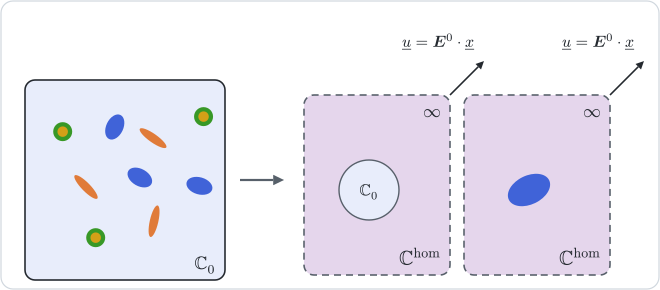
Each phase
Multiplying by the bracket on the right and subtracting gives an equivalent form,
taken as reference, the effective medium receives no net contribution from its phases. A crack family adds its two limits, evaluated in the effective medium:
Because the reference softens with the soft phases, the estimate exhibits a percolation threshold. Spherical voids in an isotropic solid make the stiffness vanish at a porosity of one half, and randomly oriented penny-shaped cracks at a density of 9/16 (Budiansky and O'Connell, 1976). The threshold is a feature of the scheme, not of every microstructure: the tutorial Porous materials and the self-consistent trap shows where it misleads.
The fixed point is solved numerically. Each iterate is projected on the major-symmetric tensors, within its symmetry class: a transversely isotropic estimate stays one, so the Hill tensor of a coaxial spheroid keeps its closed form from one iterate to the next (Degenerate shapes). The default solver is a damped Picard iteration (Anderson with memory 1), which accepts dual numbers. Loading NonlinearSolve.jl activates the MeanFieldHomogenizationNonlinearSolveExt extension, through which every SciML nonlinear algorithm (NewtonRaphson(), TrustRegion(), Anderson(), …) is available via the algorithm keyword of SelfConsistent. An iterative solve decides when to stop by comparing values, so that symbolic moduli are not accepted.
2. AsymmetricSelfConsistent: the matrix keeps its role
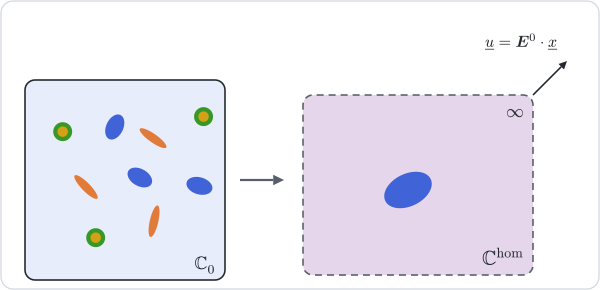
The asymmetric variant (Sævik et al., 2014) embeds the inclusions in the effective medium, as the symmetric one does, but measures their contrast against the matrix
The same fixed point is written on the compliance, with the stress concentration tensor
For solid phases the two forms are equivalent: multiplied by
The two self-consistent fixed points are related by a single term. Splitting
where the asymmetric scheme has
Like Mori–Tanaka, the asymmetric scheme depends on which phase is the matrix. It returns the matrix when the inclusions vanish, and the inclusion phase when a single one remains without matrix.
3. Concentration tensors
The construction of the overview applies with the effective medium as reference. In the symmetric scheme every phase, the matrix included, is loaded by the remote strain that the average fixes,
so that no phase takes the rest of the averages: the strain average holds by construction and the stress average is the fixed point itself, satisfied to the tolerance of the solver. In the asymmetric scheme the inclusions are loaded by the macroscopic strain,
4. Conduction and viscoelasticity
Both schemes carry over to conduction with order-2 tensors. In aging viscoelasticity the Hill kernel is built for an isotropic reference, and the reference of these schemes is the running estimate, so that every phase must keep it isotropic; see Aging linear Volterra behavior.
Where to go next
The self-consistent schemes place each inclusion in the final effective medium at once. The next page, The differential scheme, builds the composite gradually instead, adding inclusions in small amounts to the current effective medium. The syntax of the solvers and of their tolerances is in Homogenization schemes.