
The products of the alkali-silica reaction, synthesized at 80 °C
Before this page
The products of the alkali-silica reaction, for the database extension this page uses, and the certifying solver, for the ionic strength of section 4.
The alkali-silica reaction dissolves reactive silica of the aggregate in the alkaline pore solution of a concrete, and what precipitates in its place swells. Shi and Lothenbach (2019) synthesized the crystalline products at 80 °C: 4 g of silica fume, lime at a Ca/Si from 0 to 0.5 and KOH or NaOH at an alkali/Si of 0.5, in 30 to 100 g of water. After 90 days they identified the solids by X-ray diffraction (XRD) and analyzed the solutions: amorphous silica without lime, K- or Na-shlykovite at a low Ca/Si, and above it, in KOH, a potassium calcium silicate hydrate they name ASR-P1. From the solutions they derived the solubility products of the three solids at 80 °C. This page computes the 17 syntheses at equilibrium with Cemdata18 (Lothenbach et al., 2019), its C-S-H (CSHQ with the alkali end-member), and the three products.
using ChemistryLab, DynamicQuantities, Logging, OptimaSolver, Printf, Plots
default(framestyle = :box, grid = false)
include(joinpath(pkgdir(ChemistryLab), "scripts", "asr_products.jl"))
1. Two sets of constants for the products
The constants of the products come in two sets, and they disagree. Jin et al. (2023) gave the two shlykovites standard properties at 25 °C, which cemdata18-asr.json carries, by refining the measurements of Shi and Lothenbach (2019) with the pH recalculated at 80 °C, where the original authors had corrected the pH measured at 23 °C by subtracting 1.47. ASR-P1 has only the solubility product of Shi and Lothenbach (2019), at 80 °C. The set :jin takes the shlykovites of the database and ASR-P1 of Shi and Lothenbach (2019); the set :shi takes all three from Shi and Lothenbach (2019), consistent with one another and valid at 80 °C only. Their solubility products at 80 °C, computed through the aqueous species of Cemdata18:
g(sp) = ustrip(us"J/mol", sp[:ΔₐG⁰](T = SL19_T * u"K", P = 1.0e5u"Pa"; unit = true))
# The dissolution of each product as Table 5 writes it (sl19_reaction).
logK(sp) = -(sum(ν * g(SL19_DB[s]) for (s, ν) in sl19_reaction(symbol(sp))) - g(sp)) / (R_GAS * SL19_T * log(10))
println("product         set :jin   set :shi")
jin, shi = Dict(symbol(p) => p for p in sl19_products(:jin)), Dict(symbol(p) => p for p in sl19_products(:shi))
for name in ("K-shlykovite", "Na-shlykovite", "ASR-P1")
    @printf("%-14s %9.2f %10.2f\n", name, logK(jin[name]), logK(shi[name]))
end
product set :jin set :shi
K-shlykovite -28.01 -25.80
Na-shlykovite -30.78 -26.50
ASR-P1 -27.10 -27.10The shlykovites of the first set are two to four orders of magnitude less soluble. Within the second, the three products share one treatment of the pH; the first mixes two.
2. The 17 syntheses
# Each synthesis at equilibrium at 80 °C, in each set. The warnings of the solver,
# if any, are kept out of the page; the certificates are printed.
# `Any`: a container typed on the states it holds compiles for minutes.
runs = Dict{Symbol, Any}(set => sl19_syntheses(set) for set in (:jin, :shi))
println("sample   series    XRD                        set :jin                      set :shi")
for (a, b) in zip(runs[:jin], runs[:shi])
    @printf("%-8s %-8s  %-26s %-29s %s\n", a.sample, a.series, isempty(a.xrd) ? "(no sample)" : a.xrd, a.solids, b.solids)
end
for set in (:jin, :shi)
    println("set $set: ", count(r -> r.certified, runs[set]), " of ", length(runs[set]), " certified")
end
sample series XRD set :jin set :shi
SKC0 K-high SiO2 (am) SiO2 (am) SiO2 (am)
SKC0.1 K-high (no sample) SiO2 (am), K-shlykovite SiO2 (am), ASR-P1
SKC0.2 K-high ASR-P1, K-shlykovite K-shlykovite, C-S-H ASR-P1, C-S-H
SKC0.3 K-high ASR-P1 K-shlykovite, C-S-H ASR-P1, C-S-H
SKC0.4 K-high ASR-P1 K-shlykovite, C-S-H ASR-P1, C-S-H
SKC0.5 K-high ASR-P1, C-S-H K-shlykovite, C-S-H C-S-H
SKC0.1 K-low K-shlykovite SiO2 (am), K-shlykovite SiO2 (am), ASR-P1
SKC0.2 K-low K-shlykovite K-shlykovite, C-S-H ASR-P1, C-S-H
SKC0.3 K-low ASR-P1 K-shlykovite, C-S-H ASR-P1, C-S-H
SKC0.4 K-low ASR-P1 K-shlykovite, C-S-H ASR-P1, C-S-H
SKC0.5 K-low ASR-P1, C-S-H K-shlykovite, C-S-H C-S-H
SNC0 Na-high SiO2 (am) SiO2 (am) SiO2 (am)
SNC0.1 Na-high Na-shlykovite SiO2 (am), Na-shlykovite SiO2 (am), Na-shlykovite
SNC0.2 Na-high Na-shlykovite Na-shlykovite Na-shlykovite, C-S-H
SNC0.3 Na-high Na-shlykovite Na-shlykovite, C-S-H Na-shlykovite, C-S-H
SNC0.4 Na-high Na-shlykovite, C-S-H Na-shlykovite, C-S-H Na-shlykovite, C-S-H
SNC0.5 Na-high C-S-H Na-shlykovite, C-S-H C-S-H
set jin: 17 of 17 certified
set shi: 17 of 17 certifiedEvery synthesis certifies in both sets. Without lime both give amorphous silica, as observed. In the sodium series both give Na-shlykovite from a Ca/Si of 0.1, as observed, with a C-S-H beside it earlier than the XRD finds one: from 0.3 in the set :jin and 0.2 in the set :shi, where the XRD shows it at 0.4. At 0.5, where the XRD finds the C-S-H alone, the set :shi gives it alone and the set :jin keeps the shlykovite. The potassium series separates them. The XRD shows K-shlykovite at a Ca/Si of 0.1 and 0.2 and ASR-P1 from 0.3 up. The set :jin gives K-shlykovite at every Ca/Si, the set :shi ASR-P1 at every Ca/Si below 0.5: each reproduces one half of the series. The two solids have nearly the same composition, a Ca/Si of 0.25 and 0.29 and a K/Si of 0.25 and 0.13, so that which one forms is decided by a few kilojoules, less than the gap between the two treatments of the pH. Neither set is consistent with both halves of the measurements, and the first is not consistent with itself, its two potassium products having been derived from the same solutions with two pH treatments.
3. The solutions
fig = plot([1.0, 2000.0], [1.0, 2000.0]; xscale = :log10, yscale = :log10, color = :gray, linestyle = :dash,
           label = "", xlabel = "silicon measured (mmol/L)", ylabel = "silicon computed (mmol/L)",
           title = "syntheses at 80 °C, 90 days", legend = :topleft, size = (680, 460),
           left_margin = 6Plots.mm, bottom_margin = 6Plots.mm)
for (set, color, shape) in ((:jin, :steelblue, :circle), (:shi, :darkorange, :diamond))
    rows = [r for r in runs[set] if !isnan(r.Si_meas)]
    scatter!(fig, [r.Si_meas for r in rows], [r.Si for r in rows]; color, markershape = shape, label = "set :$set")
end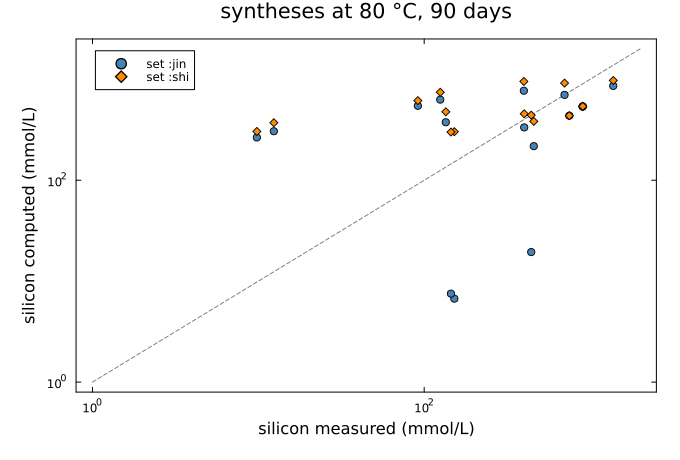
Where the solid is amorphous silica, or a shlykovite at a Ca/Si up to 0.2, the computed silicon is within a factor of about two of the measured one, between 400 and 1400 mmol/L. Beyond, the two sets part. In KOH from a Ca/Si of 0.3, where the measured silicon falls to 10 to 400 mmol/L, both keep several hundred: the products that hold the silicon there are not the ones the model forms, or not with the energies it gives them. In NaOH from 0.3, the set :jin goes the other way, its Na-shlykovite, four orders of magnitude less soluble than that of the set :shi, taking the silicon down to 7 to 19 mmol/L where 145 to 442 were measured; the set :shi keeps it within a factor of about two. Shi and Lothenbach (2019), Table 6, footnote c warn that at such concentrations polynuclear silicate species dominate the solution, of which Cemdata18 carries one, the tetramer; the solutions are the less telling comparison here, and they still side with the set whose constants were derived from them, consistently.
4. An equilibrium on the middle root of the ionic strength
The solution of SKC0, silica fume and KOH without lime, holds most of its dissolved silicon as the tetramer :jin:
skc0 = runs[:jin][1]
F = sl19_ionic_strength_equation(skc0.state, skc0.alkali)
@printf("%s: certified %s, ionic strength %.3f mol/kg, F there %.1e\n", skc0.sample, skc0.certified, skc0.I, F(log(skc0.I)))
s = range(log(0.05), log(8.0); length = 400)
fig = plot(exp.(s), F.(s); xscale = :log10, color = :steelblue, linewidth = 2, label = "F",
           xlabel = "ionic strength I (mol/kg)", ylabel = "F", title = "SKC0: SiO₂ and KOH at 80 °C",
           legend = :topright, size = (680, 420), left_margin = 6Plots.mm, bottom_margin = 6Plots.mm)
hline!(fig, [0.0]; color = :gray, label = "")
vline!(fig, [skc0.I]; color = :darkorange, linestyle = :dash, label = "the equilibrium")
SKC0: certified true, ionic strength 1.376 mol/kg, F there 1.9e-15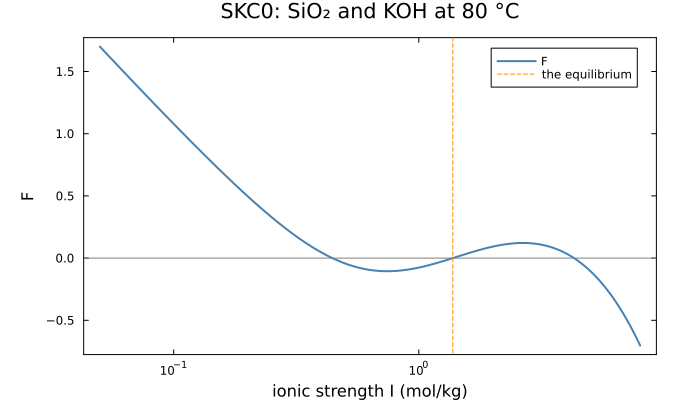
Its ionic strength lies above the range the extended Debye-Hückel model of Cemdata18 states for itself, which the certificate reports: the answer is that of the model past its range, and the model, not the solver, is what limits it.
Where to go next
The products of the alkali-silica reaction describes the database extension and its checks, and data/literature/ShiLothenbach2019.json and data/literature/Jin2023.json record the published values with where each was read.