Skip to content

The chemical potential and reactions ​

The two laws, and what the Gibbs energy measures ends with the Gibbs energy of a system whose composition is fixed. This page lets the composition change, by exchange of matter or by reaction, which brings in the chemical potential, and follows it to the equilibrium constant of a reaction. Formation quantities and the database then shows what a database stores to evaluate these potentials.

Questions this page answers

  • What is a chemical potential, and why is the Gibbs energy the sum of the potentials?

  • Why can a model not choose the activity of water independently of the solutes?

  • What is the difference between and , and what vanishes at equilibrium?

  • If a reaction lowers , why does it sometimes not happen?

1. Open systems: the chemical potential ​

When matter is exchanged or transformed, depends on the amounts as well, and its differential gains one term per constituent,

The chemical potential is thus the partial molar Gibbs energy of constituent : the change of per mole of added to a system so large that its composition does not change (Anderson and Crerar, 1993) (§9.2). Every extensive quantity has partial molar counterparts defined in the same way, among which the partial molar enthalpy   and entropy . Differentiating    with respect to gives   , and differentiating the Gibbs-Helmholtz relation of The two laws, and what the Gibbs energy measures §5 in the same way gives

This is the link between the two families of quantities: the chemical potential carries the Gibbs energy of a constituent, its temperature dependence carries the enthalpy.

Euler's theorem: the Gibbs energy is the sum of the potentials ​

The Gibbs energy is extensive. Take a phase at fixed temperature and pressure, and a second phase identical to it in every respect but times larger, every amount multiplied by : it has times the Gibbs energy,

A function with this property is said to be homogeneous of degree one in the amounts. Differentiating both sides with respect to , the left-hand side through each of its arguments by the chain rule, gives

and at   the derivatives are the chemical potentials. This is Euler's theorem on homogeneous functions, and it gives the Gibbs energy of the phase as the sum of the amounts weighted by their potentials (Anderson and Crerar, 1993) (§9.2),

the second following in the same way, since is extensive too.

The result is less obvious than it looks, because depends on the composition: adding a constituent changes the potentials of all the others. A construction shows why the sum is nevertheless exact. Build the phase from nothing by adding all its constituents at once, in their final proportions,    with running from 0 to 1. The composition is the same at every stage, so every potential keeps its final value throughout, and the Gibbs energy accumulates as   , whose integral from 0 to 1 is  . Since is a state function, any other way of building the same phase leads to the same value.

Two consequences are used throughout the chapter. The enthalpy of a system, and hence the heat of a change at constant pressure, is obtained by weighting the partial molar enthalpies by the amounts. And the function a Gibbs minimization works on,   in Thermochemistry §4, is the Gibbs energy itself, not an approximation of it. A system of several phases is the sum of its phases, each obeying the theorem for its own amounts.

Gibbs-Duhem: the potentials of one phase are not independent ​

Differentiating Euler's expression gives     . At fixed and , the differential of written at the start of this section is    alone, so the second sum must vanish. This is the Gibbs-Duhem relation, which holds within each phase,

Its content is a count. The potentials of a phase depend on its composition only, not on its size, and constituents have   independent proportions. The potentials therefore cannot vary independently: once   of them are given, the relation fixes the change of the last. At variable temperature and pressure it reads       .

Take water and one solute. The amount of solute is measured by its molality  , in moles per kilogram of water, being the molar mass of water in kg/mol; it is the concentration scale of aqueous chemistry because a mass of water does not change with temperature or pressure, whereas a volume of solution, on which a molarity in mol/L is built, does. For this mixture the relation gives     , and with  ,

Adding solute raises its potential and lowers that of the water, in a ratio set by the composition. If the solute is ideal, its potential is   , a form written in general just below, and   , so that    , and integrating from pure water gives    . The water activity is then not a separate choice: it is fixed by the solute's activity.

This is the general point. A model cannot prescribe the activity of the solvent independently of the activity coefficients it assigns to the solutes; it is by this relation that Activity models §3 obtains the activity of water, and a model that does otherwise no longer derives from one Gibbs energy (Does a model come from one excess Gibbs energy at all?).

Activity, and the enthalpy of a mixture ​

The chemical potential of a constituent of a mixture is written as a standard part, the potential of a reference state, plus a contribution of the composition through the activity ,

the reference state being the subject of Standard states. Inserted in the temperature derivative of given at the start of this section, the logarithm of an ideal activity does not depend on temperature at fixed composition and drops out, so that the partial molar enthalpy of a constituent of an ideal mixture is its standard enthalpy ; a non-ideal mixture adds an excess enthalpy, carried by the temperature dependence of the activity coefficients. The enthalpy of a state evaluated by enthalpy, and with it the heat of the calorimeters, is , which leaves the excess enthalpies out.

The Gibbs energy of a reaction is a slope, not a difference ​

Let one reaction    proceed in a closed system, the coefficients being counted positive for the products. Its progress is measured by the extent of reaction , in moles, defined by    for every constituent, so that one mole of extent consumes moles of each reactant and produces moles of each product. At fixed temperature and pressure the differential of written above becomes    , and the Gibbs energy of reaction is the derivative

Despite its , is not a difference between two states. It is the slope of along the reaction at the current composition, in J/mol, and it changes as the reaction proceeds, since the potentials depend on the amounts. The change of the Gibbs energy between two states joined by that reaction is the integral of the slope,

in joules, and the two are not interchangeable. A negative says that the reaction lowers by proceeding forward from the present composition; says by how much has fallen between two given compositions. At equilibrium the slope vanishes, whereas the between an initial state and the equilibrium state is negative, since has decreased all the way. The same distinction holds for every quantity of reaction:   is the heat per mole of extent at the current composition, and the heat of a finite change is its integral over the extent (Why an adiabatic reaction can raise the temperature).

Qualitative sketch at fixed temperature and pressure. The tangent gives in J/mol; the vertical change gives in J. The horizontal coordinate is reaction extent, not time. The horizontal tangent illustrates an interior equilibrium; a minimum at a feasibility bound instead obeys the one-sided conditions described in The certificate.

At equilibrium, the minimum of under the conservation of the elements implies two conditions, independent of the path by which the system reached it (Anderson and Crerar, 1993) (§14.2): a constituent present in two phases has the same chemical potential in both, and every reaction among the constituents has a vanishing slope,

Away from equilibrium,    is the affinity of the reaction, positive when it proceeds forward (§14.5), which is the quantity the rate laws of Rate laws are written with.

The affinity also states what the second law asks of a reaction in progress. In a closed system at fixed and , with no work other than that of the pressure, the entropy the reaction produces is       , so that any rate   has the sign of the affinity,   : a reaction runs only in the direction its affinity favors (Richet, 2001; Sec. 7.1b, Eqs. (7.10) and (7.14), pp. 160–161). The converse does not hold. A rate may vanish while does not, which is what a metastable state is: the reaction is allowed and does not proceed.

2. Reactions and equilibrium constants ​

Inserting    into separates the part of the standard states from that of the composition,

and the condition of equilibrium   fixes the value takes there, the equilibrium constant (Anderson and Crerar, 1993) (§13.1),

The two terms of have different origins. is the slope the reaction would have if every constituent were in its standard state, and it depends on and only. It carries what changes when atoms are rearranged from the reactants into the products: the energy of the bonds broken and formed, the energy and entropy of the thermal motion of the substances at that temperature, and, for a solute, its interaction with the surrounding water. carries the composition: how far the actual activities lie from those of the standard states. The first term is not, however, a property of the substances alone. A standard state is a convention, and for a solute it is a hypothetical solution at one mole per kilogram: changing the convention moves , by 9.96 kJ/mol at 25 °C between the mole-fraction and molality scales, and moves by the opposite amount, leaving unchanged (Standard states §3). A value of is therefore meaningful only together with the standard states it refers to.

The standard Gibbs energy of reaction decides which side a reaction favors between reactants and products in their standard states, and the equilibrium constant expresses the same thing in terms of activities. Written as above, requires the standard potentials of the species, which no measurement gives; Formation quantities and the database shows that the energies of formation a database tabulates are sufficient, and how they depend on temperature and pressure.

The package itself writes no reaction to find an equilibrium: it minimizes over all the constituents at once, and the conditions   of every reaction that can be written among them follow from the optimality conditions of the minimization (Proving that an answer is the answer).

Metastable does not mean a local minimum of ​

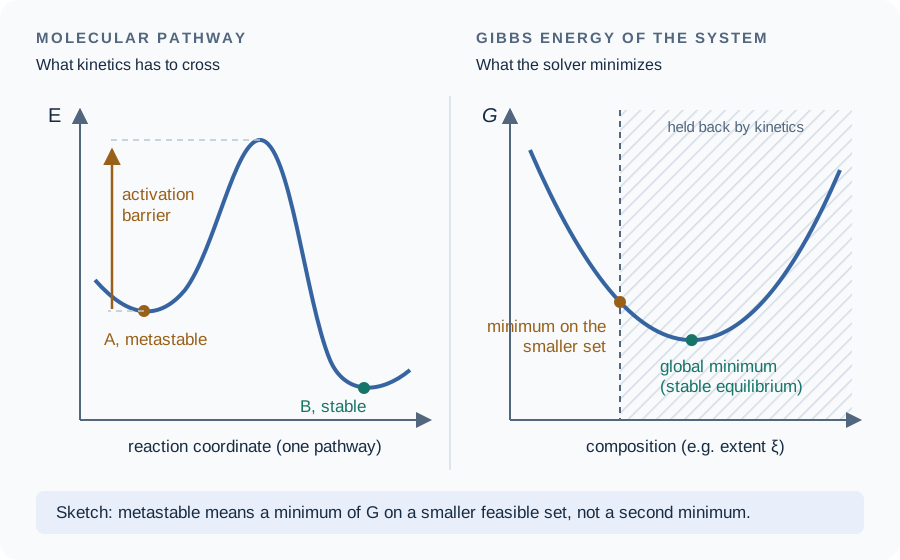
A reaction with a negative may still not happen. Diamond is less stable than graphite at room conditions, and a hydrating cement paste keeps unreacted clinker for years although its hydration lowers . It is tempting to picture such a state as sitting in a local minimum of , a hollow from which it has not yet escaped. That picture mixes up two different graphs.

Qualitative sketch. The two horizontal axes are different quantities: a coordinate along one molecular pathway on the left, the composition of the whole system on the right.

The barrier that keeps a state from changing lies on the left-hand graph. It is the energy that atoms must borrow to rearrange: breaking bonds before others form, or building the first nucleus of a new phase. That graph describes one molecular pathway, and its height decides how fast the change happens, through the rate laws of Rate laws. The Gibbs energy the solver minimizes is the right-hand graph, a function of the amounts of the constituents, and for an ideal mixture it is convex: it has one minimum and no hollow in which to stop (Proving that an answer is the answer). A barrier is not visible on that graph at all.

A metastable state is therefore described another way: as the minimum of over a smaller set of compositions, the set left once the transformations that cannot proceed are excluded. Leaving diamond's conversion out of the calculation, or holding the unreacted clinker at the amount the kinetics has reached, is what gives the metastable state as an answer. This is how the package treats a hydrating paste: the slow dissolution is integrated in time, and at every instant the rest is the minimum of given what has dissolved so far, an equilibrium called partial (Kinetics under partial equilibrium).

A non-convexity in composition is a different phenomenon. It arises where a mixing model has a strongly positive excess Gibbs energy, in solids, liquids and dense fluids alike (Richet, 2001; Secs. 7.3 and 10.1b, pp. 166–170 and 216): in this package, a solid solution with a miscibility gap (Solid solutions), a mixture of real gases (Real gases §5), and an aqueous model whose parameters are taken outside their range (Proving that an answer is the answer). The equilibrium is then two coexisting compositions of one phase. It is also the one case where a state held back is a local minimum of , though against small changes of composition only: between the spinodal and the binodal every small fluctuation raises , and the phase splits only through a nucleus large enough to pay for its interface (Richet, 2001; Sec. 7.3c, p. 170).

Where to go next ​

Formation quantities and the database is the next page: it shows how the standard potentials of this page are replaced by the energies of formation a database tabulates, how these are measured, and how they depend on temperature and pressure. A first reading can leave it for later and go on to Activity models, which computes the of this page for the aqueous phase.