
Chloride binding by C-S-H and Friedel's salt
Before this page
A charged surface, screened, and Chemistry that happens on a surface §8 and §9.
A hydrated paste takes chloride out of its pore solution in two ways. The AFm hydrates exchange their sulfate for it and become Kuzel's salt, then Friedel's salt; the C-S-H adsorbs it on its silanol sites. The two compete for the same chloride and neither can be read off the other, so a calculation that keeps only the salts assigns all of the bound chloride to them.
The surface model is that of Elakneswaran et al. (2010), as Guo et al. (2018) use it: silanol sites ≡SiOH on the C-S-H, which deprotonate and bind calcium, sodium and chloride, with the potential set by a diffuse layer. The proton, calcium and chloride constants were fitted to zeta potentials by (Elakneswaran et al., 2009), and the first two lie close to the values Pointeau et al. (2006) obtained by titration, −12.0 and −9.2 against −12.7 and −9.4.
What this calculation is, and what it is not
The C-S-H has a fixed composition and only carries the sites: it neither dissolves nor precipitates, and it is not the CSHQ solid solution of the cement pages. Putting the sites on CSHQ would count its calcium and its alkalis twice, once in the solid and once on the surface.
The diffuse layer sets the potential, following Dzombak and Morel (1990) as PHREEQC (Parkhurst and Appelo, 2013) does by default. The ions it holds are counted only in the last section, and there with a thickness that nothing published fixes for this paste.
The hydrates are those of CEMDATA18 (Lothenbach et al., 2019), and Guo et al. (2018) used Cemdata07 (Lothenbach et al., 2008). This is their model on the package's database, not a reproduction of their figure; the validation chapter compares the salts with that figure on its own terms.
The paste
Guo et al. (2018) state their inventory per liter of concrete (C-S-H, portlandite, AFm, AFt, and the porosity), and every amount below is brought to one kilogram of pore water. The site density and the specific area of the C-S-H are theirs, from the same file.
using ChemistryLab, DynamicQuantities, OptimaSolver, Printf, Plots

const DB = Dict(symbol(s) => s for s in
                build_species(datapath("cemdata18-thermofun.json"); verbose = false))
ions = [DB[s] for s in ("H2O@", "H+", "OH-", "Na+", "Cl-", "Ca+2", "AlO2-", "SO4-2")]
hydrates = [DB[s] for s in ("Portlandite", "monosulphate12", "monosulphate14",
                            "ettringite", "C4AClH10", "C4AsClH12")]

guo(q) = literature_value("Guo2018", q)
# A liter of concrete holds 10 × porosity grams of pore water.
const SCALE = 1000 / (10 * ustrip(guo("porosity_percent")))
grams = Dict("Portlandite" => guo("ch_per_liter"),
             "monosulphate12" => guo("afm_per_liter"),
             "ettringite" => guo("aft_per_liter"))
csh_g = ustrip(us"g", guo("csh_per_liter")) * SCALE
n_sites = ustrip(u"mol/g", guo("csh_site_density")) * csh_g
area = ustrip(u"m^2/g", guo("csh_specific_surface_area")) * csh_g
@printf("C-S-H %.0f g, %.2f mol of sites on %.3g m², per kg of pore water\n",
        csh_g, n_sites, area)
C-S-H 1541 g, 6.16 mol of sites on 7.71e+05 m², per kg of pore waterThe surface reactions are read from the table of the same file, written in PHREEQC's syntax, and site_family turns each constant into the standard energy of its complex. The potassium row is left out, since no potassium enters here.
t = literature_table("Guo2018", "surface_reactions_phreeqc")
reactions = [eq => lk for (eq, lk) in zip(t.reaction, t.log_K) if !occursin("K+", eq)]
for (eq, lk) in reactions
    @printf("  %-34s log K = %6.2f\n", eq, lk)
end

dl = DiffuseLayer(; area)
family = site_family(
    "Csh_w", reactions, ions; master = "Csh_w", site = "Xw",
    capacity = TotalSiteAmount(n_sites * u"mol"),
    support = SurfaceSupport("C-S-H", nothing, FixedSurfaceArea(area)), model = dl,
)
members = vcat([family.free_site], family.complexes)
cs = ChemicalSystem(
    vcat(ions, hydrates, members),
    [DB["H2O@"], DB["H+"], DB["Na+"], DB["Ca+2"], DB["Cl-"], DB["AlO2-"],
     DB["SO4-2"], family.free_site];
    site_families = [family],
)
idx = Dict(symbol(sp) => k for (k, sp) in enumerate(cs.species))
Csh_wOH = Csh_wO- + H+ log K = -12.70
Csh_wOH + Ca+2 = Csh_wOCa+ + H+ log K = -9.40
Csh_wOH + Cl- = Csh_wOHCl- log K = -0.35
Csh_wOH + Na+ = Csh_wONa + H+ log K = -13.60A sweep in sodium chloride
The paste is charged with sodium chloride up to 0.4 mol per kilogram of water and solved at each step, from the saltiest point down, each solve starting from the previous answer. Every point is certified.
function paste(nacl)
    n = Any[fill(1.0e-14u"mol", length(cs.species))...]
    n[idx["H2O@"]] = 1.0u"kg" / DB["H2O@"][:M]
    for (ph, g) in grams
        n[idx[ph]] = g * SCALE / DB[ph][:M]
    end
    n[idx["XwOH"]] = n_sites * u"mol"
    n[idx["Na+"]] = n[idx["Cl-"]] = max(nacl, 1.0e-10) * u"mol"
    return ChemicalState(cs, n)
end

model = DaviesActivityModel()
NACL = [0.4, 0.3, 0.2, 0.15, 0.1, 0.07, 0.05, 0.03, 0.02, 0.01, 0.0]
budgets = [budget(paste(c)) for c in NACL]
states, certs = equilibrate_path(paste(first(NACL)), budgets; model)
println("certified: ", count(c -> c.optimal, certs), " of ", length(certs))
certified: 11 of 11The chloride out of solution sits in three places: two per Friedel's salt, one per Kuzel's salt, and one per ≡SiOHCl⁻ complex.
const MV = 1000 * R_GAS * 298.15 / FARADAY          # mV per unit of FΨ/RT
mol(eq, s) = ustrip(us"mol", eq.n[idx[s]])
z = Float64[charge(sp) for sp in members]
function partition(eq)
    friedel = 2mol(eq, "C4AClH10")
    kuzel = mol(eq, "C4AsClH12")
    surface = mol(eq, "XwOHCl-")
    psi = diffuse_layer_potential(dl, z, [mol(eq, symbol(sp)) for sp in members],
                                  ionic_strength(eq), 298.15)
    return (; friedel, kuzel, surface, bound = friedel + kuzel + surface,
            pH = pH(eq, model), psi_mV = psi * MV)
end
rows = [partition(eq) for eq in states]

println(" NaCl     pH     Ψ/mV   Cl in Friedel  Kuzel   surface   bound   surface share")
for (c, r) in zip(NACL, rows)
    share = r.bound > 1.0e-9 ? @sprintf("%5.1f %%", 100r.surface / r.bound) : "   –"
    @printf("%5.2f  %6.3f  %6.1f  %9.4f  %9.4f  %8.4f  %7.4f   %s\n",
            c, r.pH, r.psi_mV, r.friedel, r.kuzel, r.surface, r.bound, share)
end
NaCl pH Ψ/mV Cl in Friedel Kuzel surface bound surface share
0.40 13.024 1.4 0.1321 0.0000 0.0692 0.2013 34.4 %
0.30 12.977 4.0 0.0000 0.0792 0.0619 0.1412 43.9 %
0.20 12.959 5.2 0.0000 0.0792 0.0357 0.1149 31.0 %
0.15 12.946 6.0 0.0000 0.0792 0.0217 0.1008 21.5 %
0.10 12.906 8.3 0.0000 0.0555 0.0147 0.0702 20.9 %
0.07 12.864 10.7 0.0000 0.0286 0.0146 0.0433 33.8 %
0.05 12.832 12.6 0.0000 0.0108 0.0146 0.0254 57.4 %
0.03 12.801 14.4 0.0000 0.0000 0.0118 0.0118 100.0 %
0.02 12.788 15.1 0.0000 0.0000 0.0080 0.0080 100.0 %
0.01 12.773 16.0 0.0000 0.0000 0.0041 0.0041 100.0 %
0.00 12.755 17.1 0.0000 0.0000 0.0000 0.0000 –fig = plot(; xlabel = "NaCl added (mol per kg of pore water)", ylabel = "chloride bound (mol per kg of pore water)",
legend = :topleft, size = (760, 420), left_margin = 5Plots.mm, bottom_margin = 5Plots.mm,
title = @sprintf("C-S-H sites %.2f mol, Davies, diffuse layer, 25 °C", n_sites))
for (f, lab, st) in ((:friedel, "Friedel's salt", :solid), (:kuzel, "Kuzel's salt", :solid),
(:surface, "C-S-H surface", :solid), (:bound, "all bound", :dash))
plot!(fig, NACL, [getproperty(r, f) for r in rows]; lw = 2, ls = st, marker = :circle, ms = 3, label = lab)
end
fig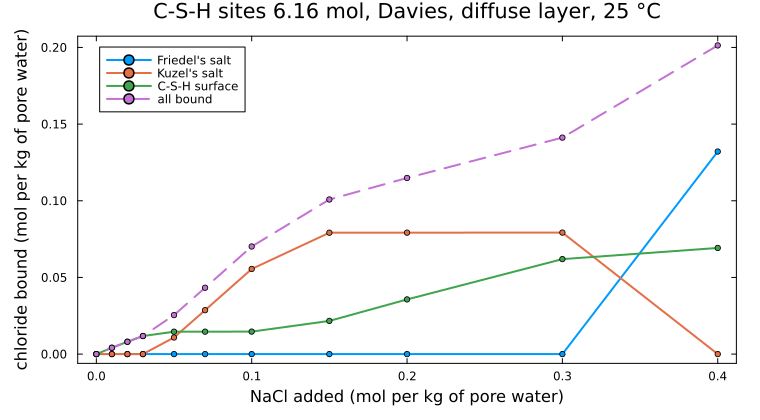
Against PHREEQC
The same paste is computed by PHREEQC on the same model: the same reactions and constants, the hydrates with the log K the package gives them, the Davies equation (Davies, 1962) on both sides and the diffuse layer of Dzombak and Morel (1990). The generator, test/reference/phreeqc_csh_surface.py, asks the package for every energy and molar mass it uses, so the comparison is of the two solvers and of nothing else.
using JSON
ORACLE = JSON.parsefile(joinpath(pkgdir(ChemistryLab), "test", "reference",
                                 "phreeqc_csh_paste.json"))
worst = (phase = 0.0, surface = 0.0, pH = 0.0, psi_mV = 0.0)
for pt in ORACLE["points"]
    k = findfirst(≈(pt["nacl"]), NACL)
    eq, r = states[k], rows[k]
    for (ph, m) in pt["phases"]
        global worst = merge(worst, (phase = max(worst.phase, abs(mol(eq, ph) - m)),))
    end
    for (sp, m) in pt["surface"]
        s = replace(sp, "Csh_w" => "Xw"; count = 1)
        global worst = merge(worst, (surface = max(worst.surface, abs(mol(eq, s) - m)),))
    end
    global worst = merge(worst, (pH = max(worst.pH, abs(r.pH - pt["pH"])),
                                 psi_mV = max(worst.psi_mV, abs(r.psi_mV - 1000pt["psi_V"]))))
end
@printf("over %d points: %.1e mol on a phase, %.1e mol on a surface species,\n",
        length(ORACLE["points"]), worst.phase, worst.surface)
@printf("%.1e on the pH, %.3f mV on the potential\n", worst.pH, worst.psi_mV)
over 6 points: 3.4e-05 mol on a phase, 8.2e-05 mol on a surface species,
1.6e-04 on the pH, 0.009 mV on the potentialpts = ORACLE["points"]
p_psi = plot(NACL, [r.psi_mV for r in rows]; lw = 2, label = "here", ylabel = "Ψ (mV)",
xlabel = "NaCl (mol/kg)", title = "Surface potential", titlefontsize = 10)
scatter!(p_psi, [pt["nacl"] for pt in pts], [1000pt["psi_V"] for pt in pts]; color = :black, ms = 4,
marker = :diamond, label = "PHREEQC")
p_ph = plot(NACL, [r.pH for r in rows]; lw = 2, label = "here", ylabel = "pH", xlabel = "NaCl (mol/kg)",
title = "pH", titlefontsize = 10)
scatter!(p_ph, [pt["nacl"] for pt in pts], [pt["pH"] for pt in pts]; color = :black, ms = 4, marker = :diamond,
label = "PHREEQC")
plot(p_psi, p_ph; layout = (1, 2), size = (860, 360), left_margin = 6Plots.mm, bottom_margin = 6Plots.mm)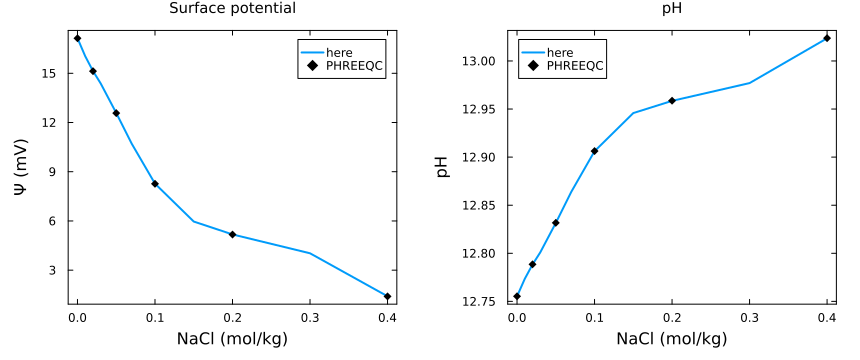
Reading the partition
The surface is positive throughout. Calcium outnumbers the deprotonated sites and reverses the sign that a silanol surface has in a calcium-free solution, which is what lets chloride bind to it at all. Salt then lowers the potential by screening it and by adding negative complexes.
The surface takes the first chloride. Up to 0.03 mol/kg no salt has formed and all of the bound chloride is on the C-S-H. The monosulfate then turns into Kuzel's salt, which holds one chloride per formula unit, and between 0.3 and 0.4 mol/kg Kuzel's salt gives way to Friedel's salt, which holds two.
From 0.05 to 0.1 mol/kg the chloride on the surface does not move, while Kuzel's salt grows fivefold. The monosulfate and Kuzel's salt coexist there, with ettringite and portlandite, and coexisting hydrates fix the activity of the chloride they exchange: the salt added goes into Kuzel's salt, and the surface, which responds to activities alone, sees no change. Once the monosulfate is gone the activity rises again, and so does the surface's share, to 44 % of the bound chloride at 0.3 mol/kg. A model that kept only the salts would miss a third of the bound chloride at the top of the sweep and all of it at the bottom.
The chloride retained in the diffuse layer is the term missing from these totals. With a positive surface every anion is in excess in the layer, so the next section counts it.
The chloride of the diffuse layer
A DonnanLayer makes that layer explicit, as PHREEQC's SURFACE -Donnan does, after Appelo and Wersin (2007): a layer of water of fixed thickness on the surface, holding each solute at the average Boltzmann enrichment whose charge balances the surface's, while the surface keeps its Gouy-Chapman potential. equilibrate_donnan withdraws what the layer holds from the solution and solves again until the two agree. Against PHREEQC, on the surface alone in the eighteen solutions of the test suite, the layer's chloride agrees to 3 × 10⁻⁴ relative.
The thickness is the parameter of the approach, and nothing published fixes it here. One Debye length of the solution, computed from its ionic strength, is taken below; the layer's water is taken from the pore solution, as it must be in a closed paste.
debye_length(I) = sqrt(water_relative_permittivity(298.15, 1.0e5) * VACUUM_PERMITTIVITY *
                       R_GAS * 298.15 / (2 * FARADAY^2 * I * 1000))
println(" NaCl  thickness  layer water  Cl excess  surface  Kuzel  Friedel   bound  (no layer)")
for c in (0.4, 0.2, 0.1)
    k = findfirst(==(c), NACL)
    λ = debye_length(ionic_strength(states[k]))
    res = equilibrate_donnan(states[k], DonnanLayer(thickness = λ); model, water = :taken)
    r = partition(res.state)
    ex = res.layer.excess[idx["Cl-"]]
    @printf("%5.2f  %6.2f nm  %8.3f kg  %9.4f  %7.4f  %6.4f  %7.4f  %6.4f  (%6.4f)\n",
            c, 1.0e9λ, res.layer.water, ex, r.surface, r.kuzel, r.friedel, r.bound + ex,
            rows[k].bound)
end
NaCl thickness layer water Cl excess surface Kuzel Friedel bound (no layer)
0.40 0.53 nm 0.412 kg 0.0052 0.0685 0.0000 0.1321 0.2058 (0.2013)
0.20 0.71 nm 0.547 kg 0.0116 0.0338 0.0792 0.0000 0.1246 (0.1149)
0.10 0.91 nm 0.703 kg 0.0099 0.0146 0.0503 0.0000 0.0748 (0.0702)The layer adds 2 to 8 % to the bound chloride. At 0.1 mol/kg its excess is two thirds of what the surface complexes hold, and part of it is chloride the salts would otherwise have taken: Kuzel's salt falls from 0.0555 to 0.0503 mol, since the layer lowers the concentration the AFm phases see. A layer one Debye length thick holds 41 to 70 % of the pore water here, because the pores of this paste are barely wider than the layer: this is where a Donnan average is a coarse description, and where the number depends on the thickness chosen more than on anything measured.
See also
A charged surface, screened — the diffuse layer checked alone, on ferrihydrite.
Chemistry that happens on a surface — the site families and the potential.
Validation against published data — the salts of Guo et al. (2018) against their figure, without the surface.
test/csh_surface.jl— the Donnan layer against PHREEQC's-Donnan.