
CEM I 52.5 R with slag, fly ash and limestone, integrated in time
Before this page
CEM I 52.5 N and slag pastes, integrated in time, the first blended cement on the kinetic path, and Recipes for the materials and their templates.
Schöler et al. (2015) replaced half of a CEM I 52.5 R by blast-furnace slag, siliceous fly ash and limestone powder in ten proportions (their Table 4), the SO₃ of every mix brought to 3 % with anhydrite, and followed the pastes at 20 °C by thermogravimetry from one day to six months: the bound water and the portlandite of their Table 8. Their own calculations take the slag and the fly ash at the degrees of reaction reported after a year in the literature they cite, as long-term states. Here the ten pastes are integrated from the mixing, the four clinker phases under the Parrott–Killoh law (Parrott and Killoh, 1984), the glass of each addition under the Waller law (Waller, 1999), the limestone and everything else at equilibrium, and compared with Table 8, which nothing below was fitted to.
1. The materials
The four materials come from their templates (data/recipe_templates.toml), built from the analyses and the Rietveld phases of (Schöler et al., 2015; Tables 1 and 2): the cement by its phases, the polymorphs of C₂S and of C₃A each summed into one constituent; the slag and the fly ash as their crystals and their glass, found by difference; the limestone by its analysis. As in the authors' calculations, only the glass of the two additions reacts, and glass_species gives each a formula, which with_species puts in its place.
using ChemistryLab, DynamicQuantities, OptimaSolver, Printf, Plots
include(joinpath(pkgdir(ChemistryLab), "scripts", "scholer2015_kinetics.jl"))

setup = s15_setup()
cs, mats = setup.cs, setup.mats
for m in (mats.opc, mats.bfs, mats.fa)
    println(m.name, ": ", join((@sprintf("%s %.3f", c.name, c.mass_fraction) for c in m.constituents), ", "))
end
OPC (Schöler 2015): C3S 0.615, C2S 0.085, C3A 0.055, C4AF 0.124, Calcite 0.015, Arcanite 0.007, Periclase 0.002, Portlandite 0.017, Bassanite 0.031, Gypsum 0.012, Syngenite 0.014, Quartz 0.002, minor oxides 0.022
blast-furnace slag (Schöler 2015): Quartz 0.002, Calcite 0.004, Akermanite 0.002, Merwinite 0.004, Gypsum 0.003, BFS 0.985
siliceous fly ash (Schöler 2015): Mullite 0.192, Free lime 0.002, Maghemite 0.009, Quartz 0.102, Calcite 0.004, Anhydrite 0.004, FA 0.6872. The time of each glass
No parameter set of the Waller law is published for these materials. Its exponent is the one Lavergne et al. (2018) fitted for a fly ash, assumed for both glasses, and the characteristic time of each is calibrated on the degree the article assumes for it after a year, 71.1 % of the slag glass and 43.6 % of the fly-ash glass; Table 8 stops at six months.
for (which, key) in ((:bfs, "assumed_reaction_slag_glass"), (:fa, "assumed_reaction_fly_ash_glass"))
    @printf("%s glass: τ = %.0f days, %.1f %% after one year\n", which,
            ustrip(us"d", s15_glass_time(which)), literature_value("Scholer2015", key))
end
bfs glass: τ = 101 days, 71.1 % after one year
fa glass: τ = 528 days, 43.6 % after one year3. The ten pastes
Each paste is integrated over the six months of (Schöler et al., 2015; Table 8), at 20 °C, in the activity model the authors used. Neither law reads the equilibrium partition, so the trajectory does not depend on it: the run solves it at each accepted step only to report it, with the interior point, and everything below is computed on the certified replay of each run (speciated_states).
day = 86400.0
mixes = literature_table("Scholer2015", "mixes").mix
# `Any`: the type of a run is long enough that a dictionary specialized on it
# takes minutes to compile.
runs = Dict{String, Any}(name => s15_run(cs, mats, name) for name in mixes)
for name in mixes
    r = runs[name]
    @printf("%-9s %s, %3d steps, anhydrite %.2f g\n", name, r.sol.retcode, length(r.sol.t), s15_anhydrite(r.mix))
end
20-30-0 Success, 165 steps, anhydrite 2.21 g
20-25-5 Success, 162 steps, anhydrite 2.22 g
20-20-10 Success, 167 steps, anhydrite 2.22 g
20-15-15 Success, 162 steps, anhydrite 2.23 g
20-10-20 Success, 164 steps, anhydrite 2.23 g
30-20-0 Success, 161 steps, anhydrite 1.95 g
30-15-5 Success, 166 steps, anhydrite 1.96 g
30-10-10 Success, 165 steps, anhydrite 1.96 g
30-5-15 Success, 161 steps, anhydrite 1.97 g
30-0-20 Success, 162 steps, anhydrite 1.97 g4. Bound water and portlandite, against Table 8
What the thermobalance weighs is computed on the replayed states: the water of every hydrate but portlandite, and the portlandite, in percent of the sample dried at 500 °C, every hydrate taken to have lost all its water there (s15_tga).
tga = Dict(name => s15_tga(runs[name], s15_measured(name).days) for name in mixes)
ages = s15_measured(first(mixes)).days
mean(x) = sum(x) / length(x)
println(" days   bound water: computed  measured   portlandite: computed  measured   (mean over the ten pastes)")
for (k, d) in enumerate(ages)
    bw = [tga[n][k].bound_water for n in mixes]
    bwm = [s15_measured(n).bound_water[k] for n in mixes]
    ch = [tga[n][k].portlandite for n in mixes]
    chm = [s15_measured(n).portlandite[k] for n in mixes]
    @printf("%5.0f   %20.1f %9.1f   %22.1f %9.1f\n", d, mean(bw), mean(bwm), mean(ch), mean(chm))
end
days bound water: computed measured portlandite: computed measured (mean over the ten pastes)
1 10.3 10.5 5.2 9.0
2 12.8 14.6 6.5 11.1
7 15.8 18.2 8.5 11.8
28 19.3 20.1 8.0 12.0
91 23.1 23.3 5.5 12.1
182 25.7 22.8 3.2 11.7Paste by paste, the two extremes of the substitution of fly ash by limestone at each level of slag:
for name in ("20-30-0", "20-10-20", "30-20-0", "30-0-20")
    m = s15_measured(name)
    println(name, "   days  BW computed / measured   CH computed / measured")
    for (k, d) in enumerate(m.days)
        @printf("          %4.0f   %7.1f / %4.1f          %7.1f / %4.1f\n", d,
                tga[name][k].bound_water, m.bound_water[k], tga[name][k].portlandite, m.portlandite[k])
    end
end
20-30-0 days BW computed / measured CH computed / measured
1 9.7 / 10.2 5.8 / 8.6
2 12.6 / 14.8 6.9 / 10.8
7 15.6 / 18.0 8.7 / 11.4
28 19.1 / 18.6 7.5 / 11.5
91 23.5 / 23.7 3.6 / 11.9
182 26.7 / 21.8 0.0 / 11.0
20-10-20 days BW computed / measured CH computed / measured
1 10.7 / 10.4 4.7 / 9.3
2 13.0 / 14.9 6.1 / 11.6
7 15.8 / 18.0 8.3 / 11.6
28 18.7 / 18.1 8.4 / 12.0
91 21.7 / 22.1 6.9 / 12.2
182 23.7 / 20.9 5.4 / 12.0
30-20-0 days BW computed / measured CH computed / measured
1 9.8 / 10.5 5.8 / 8.6
2 12.5 / 14.6 7.0 / 10.9
7 15.8 / 18.1 8.7 / 11.6
28 19.8 / 20.8 7.6 / 11.8
91 24.5 / 21.6 4.1 / 11.7
182 27.7 / 23.4 1.1 / 11.2
30-0-20 days BW computed / measured CH computed / measured
1 10.8 / 10.4 4.6 / 9.4
2 13.0 / 15.0 6.2 / 11.7
7 15.9 / 18.1 8.4 / 12.6
28 19.4 / 21.6 8.5 / 12.8
91 22.9 / 24.7 7.3 / 13.5
182 24.9 / 24.5 6.4 / 13.2The same four pastes in time, the lines computed at the ages of the measurements:
four = ("20-30-0", "20-10-20", "30-20-0", "30-0-20")
function versus_age(field, ylabel, title)
    p = plot(; xscale = :log10, xlabel = "age (days)", ylabel, title, titlefontsize = 10, legend = false)
    for (k, name) in enumerate(four)
        plot!(p, ages, [getproperty(tga[name][j], field) for j in eachindex(ages)]; lw = 2, color = k,
              marker = :circle, ms = 3, label = name * ", computed")
        scatter!(p, ages, getproperty(s15_measured(name), field); color = k, marker = :diamond, label = name * ", measured")
    end
    return p
end
plot(versus_age(:bound_water, "% of the dry sample", "Bound water, 20 °C"),
     versus_age(:portlandite, "% of the dry sample", "Portlandite, 20 °C"),
     plot(fill(NaN, 1, 2length(four)); framestyle = :none, legend = :left,
          label = permutedims(vcat([[n * ", computed", n * ", measured"] for n in four]...)),
          color = permutedims(repeat(1:length(four); inner = 2)), seriestype = permutedims(repeat([:path, :scatter], length(four))),
          marker = permutedims(repeat([:circle, :diamond], length(four))), lw = 2);
     layout = @layout([a b c{0.2w}]), size = (1000, 400), left_margin = 5Plots.mm, bottom_margin = 6Plots.mm)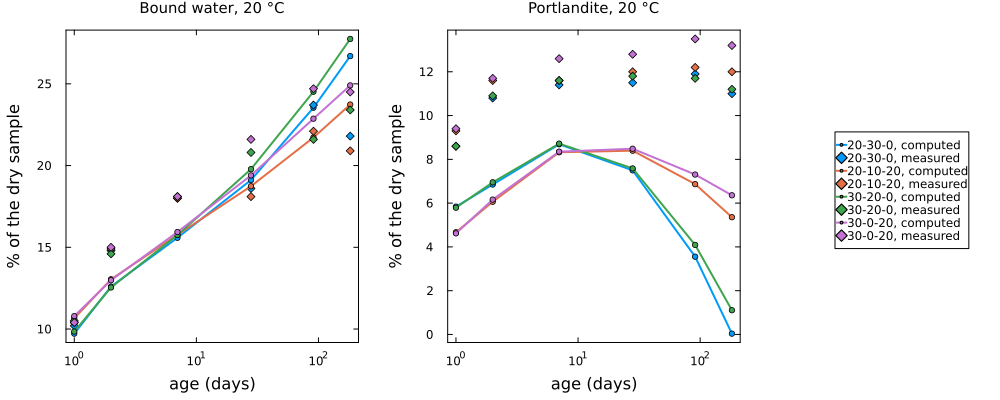
Schöler et al. (2015) computed the two pastes without limestone at the degrees of reaction they assume for the long term (their Table 7, in percent of the dry hydrates rather than of the dry sample):
t7 = literature_table("Scholer2015", "modeled_long_term")
println("paste     portlandite: this page, 182 days   the authors' calculation   measured, 182 days")
for (k, name) in enumerate(t7.mix)
    @printf("%-9s %30.1f %26.1f %20.1f\n", name, tga[name][end].portlandite, t7.portlandite[k],
            s15_measured(name).portlandite[end])
end
paste portlandite: this page, 182 days the authors' calculation measured, 182 days
30-20-0 1.1 1.0 11.2
20-30-0 0.0 0.0 11.0And where the aluminum goes, in the paste richest in limestone after six months (mol per 100 g of binder):
r = runs["20-10-20"]
st = only(speciated_states(r.sol, r.kp; times = [182day]))
shown_phases = ("Cal", "ettringite", "monocarbonate", "hemicarbonate", "monosulphate12", "C3AFS0.84H4.32", "C3FS0.84H4.32")
amounts = [ustrip(us"mol", st.n[findfirst(x -> symbol(x) == s, r.kp.system.species)]) for s in shown_phases]
for (s, a) in zip(shown_phases, amounts)
    @printf("%-16s %.4f\n", s, a)
end
# The aluminum carriers, in mmol; the calcite, which holds none, is left out.
p_al = bar(collect(shown_phases[2:end]), 1000amounts[2:end]; legend = false, color = :steelblue, xrotation = 30,
    ylabel = "mmol per 100 g of binder", title = "20-10-20 after 182 days, 20 °C",
    size = (760, 400), left_margin = 6Plots.mm, bottom_margin = 12Plots.mm)
plot!(p_al; ylims = (0, 1.1 * ylims(p_al)[2]))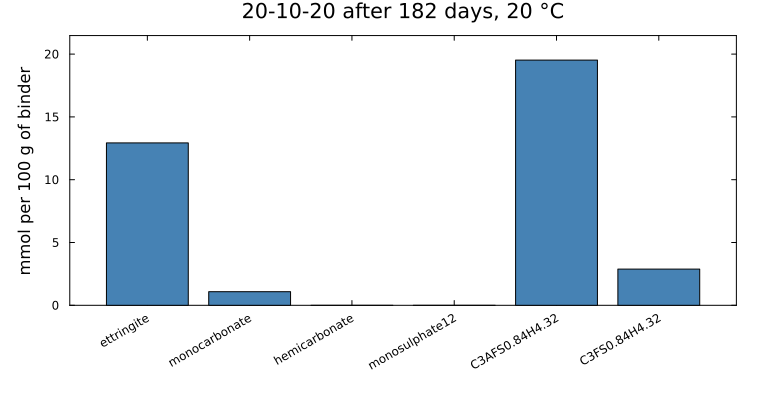
5. What the comparison says
The bound water follows the measurements. Its mean over the ten pastes is within one point of the measured one at one day, 28 days and 91 days, about two points low at two and seven days, and three points high at six months, where the computed water keeps rising with the glasses and the measured one stops. Nothing was fitted to it: the clinker law has its published parameters, and the time of each glass is set on the degree Schöler et al. (2015) assume after a year. The direction of the gap at six months is the one the preparation of the samples gives: the thermobalance weighs a sample dried at 40 °C after a solvent exchange, which has already lost part of the water of the C–S–H and of the AFm phases, and the computation counts all of it.
The portlandite is where the computation and the measurement part. Computed, it is below the measurement from the first day, and its mean over the pastes reaches its maximum at seven days and then declines, consumed by the pozzolanic reaction of the two glasses, the more so the more fly ash the paste holds: the paste 20-30-0 has none left at six months, and 30-0-20, without fly ash, keeps the most. Measured, it stays near 12 % from two days on. The authors' own calculation, at their long-term degrees, leaves as little in the two pastes without limestone. The gap is therefore that of the equilibrium model, with these degrees of reaction, rather than that of the kinetics: an equilibrium in which the C–S–H the glasses form takes its calcium from portlandite cannot keep the portlandite, and neither calculation describes what keeps it in these pastes. Section 6 runs the two other gels the package ships.
The limestone stays calcite. In Cemdata18 (Lothenbach et al., 2019), used here, the aluminum the clinker and the glasses release goes to ettringite and to the siliceous hydrogarnet C₃(A,F)S₀.₈₄H₄.₃₂, and little of it to monocarbonate: in the paste richest in limestone, a twentieth of the amount of hydrogarnet after six months, and no hemicarbonate. Schöler et al. (2015) calculated hemicarbonate and monocarbonate in the presence of limestone, with the database of the time (their Fig. 2), and found both by X-ray diffraction after six months (their Fig. 4). The difference is in which phases the equilibrium may form, which this page leaves as Cemdata18 does.
6. The two other gels
The paste with the most fly ash and the one without, with CNASH_ss (Myers et al., 2014) and then CASH+NK (Miron et al., 2022) in place of CSHQ, everything else as in Section 3 (s15_setup(; gel)):
gel_runs = Dict{Tuple{String, String}, Any}()
cshq_last = Dict{String, Any}()
for name in ("20-30-0", "30-0-20")
    cshq_last[name] = only(speciated_states(runs[name].sol, runs[name].kp; times = [ages[end] * 86400.0]))
end
for gel in ("CNASH_ss", "CASH+NK")
    s = s15_setup(; gel)
    for name in ("20-30-0", "30-0-20")
        r = s15_run(s.cs, s.mats, name)
        gel_runs[(gel, name)] = (; tga = s15_tga(r, ages), last = only(speciated_states(r.sol, r.kp; times = [ages[end] * 86400.0])))
    end
end
for name in ("20-30-0", "30-0-20")
    println(name, ", portlandite, % of the dry sample")
    println("  days      CSHQ  CNASH_ss  CASH+NK  measured")
    for (k, d) in enumerate(ages)
        @printf("%6.0f  %8.1f %8.1f %8.1f %9.1f\n", d, tga[name][k].portlandite,
                gel_runs[("CNASH_ss", name)].tga[k].portlandite, gel_runs[("CASH+NK", name)].tga[k].portlandite,
                s15_measured(name).portlandite[k])
    end
    ratio(st, gel) = (e = solid_solution_totals(st, gel).elements; @sprintf("Ca/Si %.2f, Al/Si %.3f", e[:Ca] / e[:Si], get(e, :Al, 0.0) / e[:Si]))
    println("  the gel at ", Int(ages[end]), " days: CSHQ ", ratio(cshq_last[name], "CSHQ"), "; CNASH_ss ",
            ratio(gel_runs[("CNASH_ss", name)].last, "CNASH_ss"), "; CASH+NK ", ratio(gel_runs[("CASH+NK", name)].last, "CASH+NK"))
end
20-30-0, portlandite, % of the dry sample
days CSHQ CNASH_ss CASH+NK measured
1 5.8 8.9 5.8 8.6
2 6.9 10.9 6.8 10.8
7 8.7 13.3 8.6 11.4
28 7.5 14.5 7.5 11.5
91 3.6 13.1 3.7 11.9
182 0.0 11.3 0.3 11.0
the gel at 182 days: CSHQ Ca/Si 1.60, Al/Si 0.000; CNASH_ss Ca/Si 1.17, Al/Si 0.099; CASH+NK Ca/Si 1.59, Al/Si 0.000
30-0-20, portlandite, % of the dry sample
days CSHQ CNASH_ss CASH+NK measured
1 4.6 8.0 4.6 9.4
2 6.2 10.1 6.1 11.7
7 8.4 13.2 8.3 12.6
28 8.5 15.4 8.5 12.8
91 7.3 16.1 7.3 13.5
182 6.4 16.2 6.4 13.2
the gel at 182 days: CSHQ Ca/Si 1.60, Al/Si 0.000; CNASH_ss Ca/Si 1.17, Al/Si 0.085; CASH+NK Ca/Si 1.60, Al/Si 0.000panels = map(("20-30-0", "30-0-20")) do name
p = plot(; xscale = :log10, xlabel = "age (days)", ylabel = "portlandite, % of the dry sample",
title = name, titlefontsize = 10, legend = name == "20-30-0" ? :bottomleft : false)
plot!(p, ages, [x.portlandite for x in tga[name]]; lw = 2, marker = :circle, ms = 3, label = "CSHQ")
for gel in ("CNASH_ss", "CASH+NK")
plot!(p, ages, [x.portlandite for x in gel_runs[(gel, name)].tga]; lw = 2, marker = :circle, ms = 3, label = gel)
end
scatter!(p, ages, s15_measured(name).portlandite; color = :black, marker = :diamond, label = "measured")
end
plot(panels...; layout = (1, 2), size = (900, 380), left_margin = 6Plots.mm, bottom_margin = 6Plots.mm)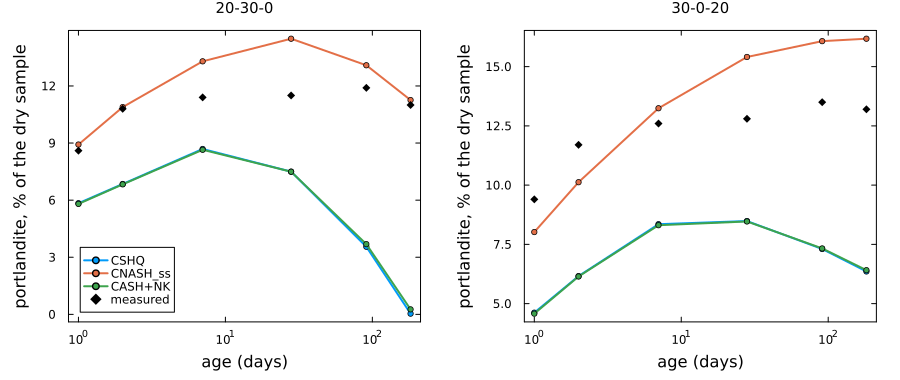
CNASH_ss keeps the portlandite near the measurement in the paste with the most fly ash: within 0.3 points at one, two and 182 days, 1.2 to 3.0 points high between. Without fly ash it is 1.4 and 1.6 points low at one and two days, then 0.6 to 3.0 points high from seven. It does so with a gel at a Ca/Si of 1.17 holding aluminum, an Al/Si of 0.085 and 0.099, poorer in calcium than a gel beside portlandite: the calcium it does not take is the portlandite that stays. CASH+NK gives the portlandite of CSHQ within 0.3 points. The measurement lies between the two models, as in the fly-ash pastes of De Weerdt et al. (2011) (integrated in time here), whose gel was measured at a Ca/Si of 1.4: neither gel reproduces the gel and the portlandite together, CNASH_ss is the closer on the portlandite of these blends for a gel too poor in calcium, and CSHQ stays the gel of this page.
Where to go next
Kinetics under partial equilibrium writes the formulation these runs integrate, and CEM I 52.5 N and slag pastes, integrated in time the same path on a slag cement, with its heat.