
C-S-H in water and in alkaline solutions: the CASH+ model
Before this page
Solid solutions, sections 7 and 8, where the site model and the compound energy formalism are derived.
CASH+ is a model of the C-S-H gel by Kulik et al. (2022), which Miron et al. (2022), Miron et al. (2022) extended to sodium and potassium. Like the CNASH gel of the site-mixing page, it mixes on the structural sites of the silicate chain and of the interlayer. It also adds two terms: the energy of the reciprocal reactions between its end-members, and interactions between the species of one site. ChemistryLab writes it as a CompoundEnergyModel.
This page does five things. It computes the gel in water, from the Ca/Si at which amorphous silica stops forming to the one at which portlandite starts, and compares both ends with Kulik et al. (2022). It then adds sodium and potassium. It checks the model against the calculation of 110 gel compositions by Miron et al. (2022). It computes the pore solution of a hydrating Portland cement with CASH+NK and with CSHQ, against its analysis. Finally it extends the interlayer to the other alkali and alkaline-earth metals.
The model has two mixing sites. The bridging tetrahedron (BT) of the silicate chain holds a silicate S, a vacancy v or a calcium C. The interlayer cation (IC) holds a vacancy v, a calcium C and, with the alkalis, a sodium N or a potassium K. An end-member is named by what it puts on each: TSCh has a silicate on the bridging tetrahedron and a calcium in the interlayer (T and h stand for the fixed dimeric unit and interlayer water).
using ChemistryLab
using DynamicQuantities
using OptimaSolver
using Printf
using Plots
default(framestyle = :box, grid = false)

# Cemdata18 with the thirty-three end-members of CASH+ and its extensions, the
# CaSiO3@ complex the model was fitted with, and the aqueous species the
# extensions add (built on first use).
substances = build_species(datapath("cemdata18-cashplus.json"); verbose = false)
byname = Dict(symbol(s) => s for s in substances)
phases = Dict(ChemistryLab.name(p) => p for p in build_solid_solutions(datapath("solid_solutions.toml"), byname))

# The activity model the paper fits with: extended Debye-Hückel with the ion size
# and B-dot Cemdata18 gives for KOH solutions.
model = cemdata18_activity_model(:KOH)

# The gel and the aqueous species of its elements, with portlandite and
# amorphous silica, which may form beside it. The neutral complexes of the
# alkalis (NaOH@, KOH@ ...) are left out, as Miron et al. left them out when they
# fitted the alkali end-members; the Ca(OH)2@ complex they derived for that fit
# is kept with the alkali model and left out of the core model, which Kulik et
# al. fitted without it.
function gel_system(gel)
    members = symbol.(phases[gel].end_members)
    sp = speciation(substances, vcat(["Portlandite", "Amor-Sl"], members); aggregate_state = [AS_AQUEOUS],
                    exclude_species = gel == "CASH+" ? ["Ca(OH)2@"] : String[])
    alkali_complex(s) = charge(s) == 0 && any(el -> haskey(atoms(s), el), (:Na, :K)) &&
        aggregate_state(s) == AS_AQUEOUS
    return ChemicalSystem(filter(!alkali_complex, sp), CEMDATA_PRIMARIES; solid_solutions = [phases[gel]])
end

# A kilogram of water with 0.05 mol of silica and lime at the Ca/Si given.
function paste(cs, ca_si)
    st = ChemicalState(cs)
    set_quantity!(st, "H2O@", 1.0u"kg")
    set_quantity!(st, "Amor-Sl", 0.05u"mol")
    set_quantity!(st, "Portlandite", ca_si * 0.05u"mol")
    b = budget(st)
    return equilibrate_certified(st; model, b)
end

# Moles of an element in solution per kilogram of water, and the amount of a phase.
function in_solution(eq, element)
    cs = eq.system
    n = ustrip.(us"mol", eq.n)
    iw = only(cs.idx_solvent)
    kg_water = n[iw] * ustrip(us"kg/mol", cs.species[iw][:M])
    return sum(get(atoms(cs.species[i]), element, 0) * n[i] for i in cs.idx_solutes) / kg_water
end
amount(eq, sp) = ustrip(us"mol", eq.n[findfirst(s -> symbol(s) == sp, eq.system.species)])

# The site fractions of the gel, from the amounts of its end-members.
function sites(eq, gel)
    p = phases[gel]
    x = [amount(eq, symbol(m)) for m in p.end_members]
    return site_fractions(ChemistryLab.model(p), x ./ sum(x))
end
1. The C-S-H in water
Each paste is 0.05 mol of silica and some lime in a kilogram of water, from a Ca/Si of 0.6 to 2.4. This is how the solubility of a C-S-H is measured: the gel is equilibrated in water and the solution analyzed. The core model is enough here, since there is no alkali.
cs = gel_system("CASH+")
lattice = ChemistryLab.model(phases["CASH+"]).lattice
ratios = 0.6:0.1:2.4
rows = []
println("Ca/Si   certified  silica  portl.  gel Ca/Si  Ca (mmol/kg)  Si (mmol/kg)   pH")
for r in ratios
    eq, cert = paste(cs, r)
    gel = solid_solution_totals(eq, "CASH+").elements
    y = sites(eq, "CASH+")
    push!(rows, (; r, gel = gel[:Ca] / gel[:Si], ca = 1000in_solution(eq, :Ca), si = 1000in_solution(eq, :Si),
                 pH = pH(eq, model), y, silica = amount(eq, "Amor-Sl"), portlandite = amount(eq, "Portlandite")))
    row = rows[end]
    @printf("%4.2f    %-9s  %-6s  %-6s  %7.3f    %10.3f    %10.4f    %6.3f\n", r, cert.optimal,
            row.silica > 0 ? "yes" : "", row.portlandite > 0 ? "yes" : "", row.gel, row.ca, row.si, row.pH)
end
Ca/Si certified silica portl. gel Ca/Si Ca (mmol/kg) Si (mmol/kg) pH
0.60 true yes 0.723 1.166 4.1803 9.842
0.70 true 0.730 1.104 3.5648 9.936
0.80 true 0.803 0.796 1.1730 10.696
0.90 true 0.883 1.156 0.3672 11.253
1.00 true 0.956 2.317 0.1318 11.603
1.10 true 1.023 3.940 0.0709 11.828
1.20 true 1.090 5.545 0.0502 11.967
1.30 true 1.161 7.019 0.0398 12.062
1.40 true 1.232 8.418 0.0330 12.134
1.50 true 1.305 9.805 0.0278 12.194
1.60 true 1.376 11.236 0.0236 12.248
1.70 true 1.445 12.773 0.0199 12.297
1.80 true 1.511 14.498 0.0166 12.346
1.90 true 1.570 16.529 0.0136 12.397
2.00 true 1.620 19.014 0.0108 12.451
2.10 true yes 1.640 20.378 0.0097 12.477
2.20 true yes 1.640 20.378 0.0097 12.477
2.30 true yes 1.640 20.378 0.0097 12.477
2.40 true yes 1.640 20.378 0.0097 12.477Every paste certifies. Amorphous silica forms beside the gel at the lowest Ca/Si and portlandite at the highest; between the two, the gel is the only solid. At each end, three phases share three components (CaO, SiO₂ and H₂O) at a fixed temperature and pressure, so the composition of every phase is fixed: adding lime beyond the portlandite point, or silica below the silica point, only makes more of the solid that forms. Kulik et al. (2022) give both ends:
q(name) = literature_value("Kulik2022", name)
at_silica = rows[findlast(r -> r.silica > 0, rows)]
at_portlandite = rows[findfirst(r -> r.portlandite > 0, rows)]
@printf("gel Ca/Si beside amorphous silica: %.3f   (paper %.2f)\n", at_silica.gel, q("silica_saturation_Ca_Si"))
@printf("gel Ca/Si beside portlandite:      %.3f   (paper %.2f)\n", at_portlandite.gel, q("portlandite_saturation_Ca_Si"))
printed = literature_table("Kulik2022", "portlandite_saturated_site_fractions")
println("\nsite fractions beside portlandite:")
for (site, sp, f) in zip(printed.site, printed.species, printed.fraction)
    s = findfirst(==(site), lattice.sites)
    @printf("  %s %s  %.3f   (paper %.2f)\n", site, sp, at_portlandite.y[s][findfirst(==(sp), lattice.species[s])], f)
end
gel Ca/Si beside amorphous silica: 0.723 (paper 0.72)
gel Ca/Si beside portlandite: 1.640 (paper 1.64)
site fractions beside portlandite:
BT C 0.772 (paper 0.77)
BT v 0.203 (paper 0.20)
BT S 0.026 (paper 0.03)
IC C 0.550 (paper 0.55)
IC v 0.450 (paper 0.45)Both ends agree with Kulik et al. (2022) to the digits they print. The figure shows the solution and the sites between them:
gel_ratio = [r.gel for r in rows]
p1 = plot(gel_ratio, [r.si for r in rows]; label = "Si", yscale = :log10, marker = :circle,
          xlabel = "Ca/Si of the gel", ylabel = "in solution (mmol/kg)", legend = :right)
plot!(p1, gel_ratio, [r.ca for r in rows]; label = "Ca", marker = :square)
p2 = plot(; xlabel = "Ca/Si of the gel", ylabel = "site fraction", legend = :right, ylims = (0, 1))
for (s, style) in ((1, :solid), (2, :dash)), (i, sp) in enumerate(lattice.species[s])
    plot!(p2, gel_ratio, [r.y[s][i] for r in rows]; label = "$(lattice.sites[s]) $sp", linestyle = style, linewidth = 2)
end
fig = plot(p1, p2; layout = (1, 2), size = (900, 380), left_margin = 6Plots.mm, bottom_margin = 7Plots.mm)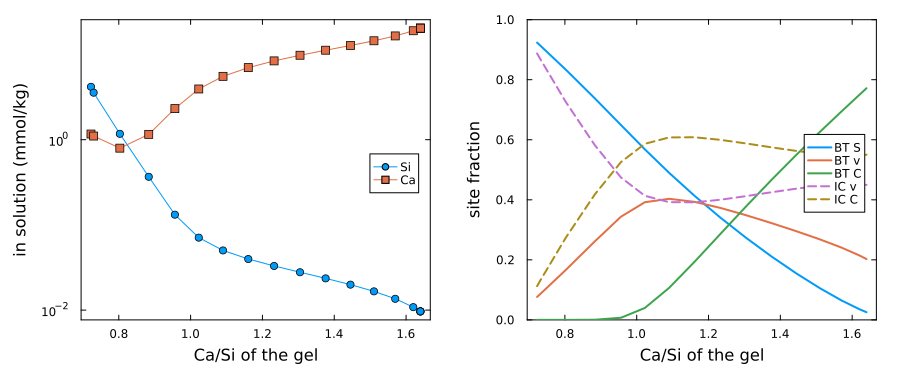
As the gel takes up calcium, the silicate leaves the bridging tetrahedra, first for vacancies and then, from a Ca/Si of about 1, for calcium. The interlayer fills with calcium up to a Ca/Si of about 1.1, then gives a little of it back to vacancies. The silicon in solution falls by more than two orders of magnitude, from 4.18 to 0.0097 mmol/kg, and the calcium rises to 20.4 mmol/kg, that of the solution in equilibrium with portlandite.
The same gel at 50 and 90 °C
Kulik et al. (2022) fitted the model at 25 °C and gave its end-members and the CaSiO₃⁰ complex heat capacities for use up to 100 °C (their Section 3.5). They describe what the model then predicts: the calcium and silicon in solution change little with temperature, the pH falls by 2 to 2.5 units over a hundred degrees, and beside portlandite the silicon rises a little. The pastes of Ca/Si 1.2 and 2.4 above, at three temperatures:
function paste_at(cs, ca_si, T)
    st = ChemicalState(cs; T = T)
    set_quantity!(st, "H2O@", 1.0u"kg")
    set_quantity!(st, "Amor-Sl", 0.05u"mol")
    set_quantity!(st, "Portlandite", ca_si * 0.05u"mol")
    b = budget(st)
    return equilibrate_certified(st; model, b)
end
println(" Ca/Si    T (°C)   certified   Ca (mmol/kg)   Si (mmol/kg)     pH")
for r in (1.2, 2.4), Tc in (25, 50, 90)
    eq, cert = paste_at(cs, r, (Tc + 273.15)u"K")
    @printf("%5.1f    %5d      %-9s  %10.3f     %10.4f     %6.3f\n", r, Tc, cert.optimal,
            1000in_solution(eq, :Ca), 1000in_solution(eq, :Si), pH(eq, model))
end
Ca/Si T (°C) certified Ca (mmol/kg) Si (mmol/kg) pH
1.2 25 true 5.545 0.0502 11.967
1.2 50 true 4.982 0.0564 11.182
1.2 90 true 3.950 0.0710 10.195
2.4 25 true 20.378 0.0097 12.477
2.4 50 true 17.173 0.0103 11.656
2.4 90 true 12.691 0.0137 10.630Every paste certifies. From 25 to 90 °C the pH falls by 1.8 units at a Ca/Si of 1.2 and by 1.8 beside portlandite, about 2.8 units per hundred degrees, somewhat more than the 2 to 2.5 Kulik et al. (2022) state. Beside portlandite the silicon rises, from 0.0097 to 0.0137 mmol/kg, as the paper states, while the calcium falls from 20.4 to 12.7 mmol/kg, with the solubility of portlandite.
2. Sodium and potassium: CASH+NK
CASH+NK puts sodium and potassium in the interlayer, as NaHOH⁺ and KHOH⁺. With twelve end-members, it is the one to use for a cement paste. The pastes below have a Ca/Si of 1 and of 1.6, in a solution of sodium and potassium hydroxides with three times as much potassium as sodium, as in the pore solution of a Portland cement. Potassium dominates, so the Debye-Hückel parameters are those Cemdata18 (Lothenbach et al., 2019) gives for KOH:
cs_nk = gel_system("CASH+NK")
println("Ca/Si  Na, K added (mol/kg)  certified   Na, K in solution (mmol/kg)   gel Na/Si, K/Si   pH")
uptake = Dict()
for r in (1.0, 1.6), na in (0.01, 0.02, 0.05, 0.1)
    st = ChemicalState(cs_nk)
    set_quantity!(st, "H2O@", 1.0u"kg")
    set_quantity!(st, "Amor-Sl", 0.05u"mol")
    set_quantity!(st, "Portlandite", r * 0.05u"mol")
    set_quantity!(st, "Na+", na * u"mol")
    set_quantity!(st, "K+", 3na * u"mol")
    set_quantity!(st, "OH-", 4na * u"mol")
    b = budget(st)
    eq, cert = equilibrate_certified(st; model, b)
    gel = solid_solution_totals(eq, "CASH+NK").elements
    point = (na = 1000in_solution(eq, :Na), k = 1000in_solution(eq, :K), gna = gel[:Na] / gel[:Si], gk = gel[:K] / gel[:Si])
    push!(get!(uptake, r, []), point)
    @printf("%4.1f   %5.2f, %5.2f          %-9s  %8.2f, %8.2f              %6.4f, %6.4f   %6.3f\n",
            r, na, 3na, cert.optimal, point.na, point.k, point.gna, point.gk, pH(eq, model))
end
Ca/Si Na, K added (mol/kg) certified Na, K in solution (mmol/kg) gel Na/Si, K/Si pH
1.0 0.01, 0.03 true 9.48, 27.65 0.0105, 0.0475 12.500
1.0 0.02, 0.06 true 18.97, 55.59 0.0209, 0.0890 12.779
1.0 0.05, 0.15 true 47.89, 141.90 0.0427, 0.1637 13.159
1.0 0.10, 0.30 true 96.80, 288.79 0.0651, 0.2277 13.458
1.6 0.01, 0.03 true 9.97, 29.94 0.0006, 0.0012 12.604
1.6 0.02, 0.06 true 19.93, 59.87 0.0015, 0.0028 12.829
1.6 0.05, 0.15 true 49.72, 149.51 0.0057, 0.0102 13.183
1.6 0.10, 0.30 true 99.23, 298.69 0.0156, 0.0271 13.473fig = plot(; xlabel = "alkali in solution (mmol/kg)", ylabel = "alkali/Si of the gel", legend = :topleft,
xscale = :log10, size = (720, 400), left_margin = 6Plots.mm, bottom_margin = 7Plots.mm)
for (r, style) in ((1.0, :solid), (1.6, :dash))
pts = uptake[r]
plot!(fig, [p.na for p in pts], [p.gna for p in pts]; label = "Na, gel Ca/Si $r", color = :steelblue, linestyle = style, marker = :circle)
plot!(fig, [p.k for p in pts], [p.gk for p in pts]; label = "K, gel Ca/Si $r", color = :firebrick, linestyle = style, marker = :square)
end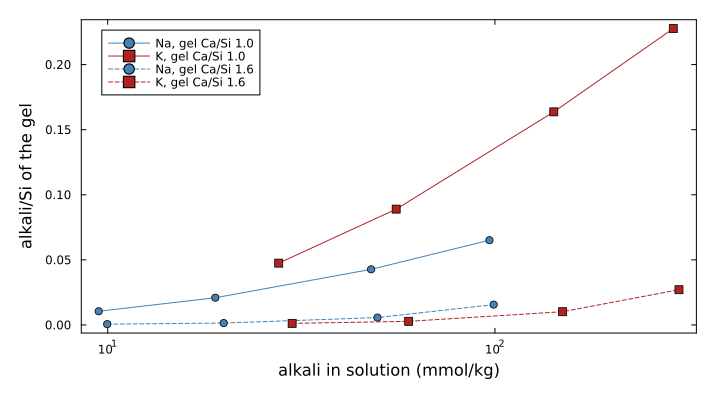
Every paste certifies. The gel takes up both alkalis, a little more potassium than their ratio in solution: at a Ca/Si of 1, with 96.8 mmol/kg of sodium and 288.8 of potassium in solution, it holds 0.065 Na and 0.228 K per Si. At a Ca/Si of 1.6 and nearly the same solution it holds four times less sodium and eight times less potassium, 0.016 and 0.027 per Si: the calcium that fills the interlayer leaves the alkalis little room, the suppression of alkali uptake at high Ca/Si that Miron et al. (2022) describe.
3. Against the authors' own calculation
Miron et al. (2022) also publish the model discretized: 110 gels of fixed composition, each with the Gibbs energy their implementation computes for it, given as the equilibrium constant of its dissolution. The formula of each fixes the site fractions, so the Gibbs energy of our model at that composition can be set against theirs, with no solver in between. The first gel is
dsp = literature_table("Miron2022a", "dsp_pseudocompounds")
println(dsp.name[1], ":  ", dsp.reaction[1])
CSH072+N0000: Ca2.0993Si2.9298Na0.0004O11.0585H6.1988 + 4.199H+ = 2.9298SiO2@ + 0.0004Na+ + 5.1989H2O@ + 2.0993Ca+2The block below reads the site fractions from each formula, as the moieties of the sites give them (silicon, alkali, hydrogen and calcium in turn), evaluates the Gibbs energy of the model there, and subtracts the one the reaction gives:
nk = ChemistryLab.model(phases["CASH+NK"])
lat = nk.lattice
T = 298.15
RT = ChemistryLab.R_GAS * T
G25(sp) = ustrip(us"J/mol", byname[sp][:ΔₐG⁰](T = T * u"K", P = 1.0e5u"Pa"; unit = true))
# The energies of the end-members as Miron et al. (2022a) fit them: the database
# carries TCNh and TCKh as their second paper fine-tunes them.
alkali = literature_table("Miron2022a", "alkali_standard_properties")
Gm(m) = m in alkali.end_member ? ustrip(us"J/mol", alkali.G[findfirst(==(m), alkali.end_member)]) : G25(m)
g = [Gm(symbol(m)) / RT for m in phases["CASH+NK"].end_members]
# The Gibbs energy of the gel per formula unit at site fractions y, written out
# as in the theory: the reference surface, the configurational term of each site
# and the site interactions. A fraction the rounding of a formula makes -1e-4
# counts as an empty site.
xlogx(v) = v > 0 ? v * log(v) : 0.0
function gibbs(y)
    o = lat.occupancy
    reference = RT * sum(g[k] * y[1][o[1, k]] * y[2][o[2, k]] for k in axes(o, 2))
    configurational = RT * sum(sum(xlogx, ys) for ys in y)
    interactions = sum(W * y[s][i] * y[s][l] for (s, i, l, W) in nk.interactions)
    return reference + configurational + interactions
end
misfit = map(eachindex(dsp.name)) do r
    lhs, rhs = split(dsp.reaction[r], " = ")
    c = Dict(Symbol(m[1]) => parse(Float64, m[2]) for m in eachmatch(r"([A-Z][a-z]?)([0-9.]+)", first(split(lhs, " + "))))
    el(e) = get(c, e, 0.0)
    yN, yK = el(:Na), el(:K)
    yCIC = (el(:H) - 6 - yN - yK) / 2        # the interlayer calcium carries three H, an alkali two
    yS = el(:Si) - 2                         # the dimeric unit holds two Si
    yCBT = el(:Ca) - 2 - yCIC                # and two Ca
    y = [[yS, 1 - yS - yCBT, yCBT], [1 - yCIC - yN - yK, yCIC, yN, yK]]   # BT (S, v, C), IC (v, C, N, K)
    products = sum(split(rhs, " + ")) do term
        m = match(r"^\s*([0-9.]*)(\S+)$", term)
        (isempty(m[1]) ? 1.0 : parse(Float64, m[1])) * G25(String(m[2]))
    end
    gibbs(y) - (products - ustrip(us"J/mol", dsp.dG[r]))
end
@printf("%d gels: largest difference %.3f kJ/mol, median %.3f kJ/mol\n",
        length(misfit), maximum(abs, misfit) / 1000, sort(misfit)[end ÷ 2] / 1000)
110 gels: largest difference 0.064 kJ/mol, median -0.003 kJ/molThe two implementations agree on every gel to within 0.064 kJ/mol, with a median difference of 0.003 kJ/mol. That is the rounding of the formulas, which are printed to four decimals; the energies of mixing and of the reciprocal reactions are some ten kilojoules per mole.
4. A Portland cement with limestone (PC4)
Miron et al. (2022) tuned the calcium alkali end-members of CASH+NK on the pore solutions of hydrated cements, among them the Portland cement with 4 % limestone (PC4) of Lothenbach et al. (2008), whose pore solution was analyzed from one day to 400 days. The same paste is computed here twice, with its C-S-H as CSHQ and as CASH+NK, everything else equal:
the cement is the normative composition of Lothenbach et al. (2008), Table 1: the four clinker phases, periclase, free lime, calcite, gypsum and the readily soluble alkali sulfates;
the clinker phases hydrate by the law of Parrott and Killoh (1984) with the constants of Lothenbach et al. (2008), Table 3, including the two it adapts for belite and the critical degree of hydration of each phase;
the minor oxides of the clinker (0.052 g of K₂O, 0.31 g of Na₂O, 0.87 g of MgO and 0.11 g of SO₃ per 100 g) are released with the phases that hold them. Lothenbach et al. (2008) give their totals, not how they are shared among the phases. This page assumes the sharing of Lothenbach and Winnefeld (2006), after Taylor, as a content per gram of each phase;
the phases that may form are those of the Portland paste of the validation page, a paste of the same laboratory and the same modeling.
The recipe and both systems are written once, in scripts/lothenbach_2008.jl, which the test of this page includes too.
include(joinpath(pkgdir(ChemistryLab), "scripts", "lothenbach_2008.jl"))
days = l08_days()
# `Any`: a container typed on the states of a run compiles for minutes.
runs = Dict{Symbol, Any}(gel => hydrate(l08_recipe("PC4"), l08_system(gel), days; model) for gel in (:CSHQ, :CASHNK))
for gel in (:CSHQ, :CASHNK)
    @printf("%-7s certified at %s of %d ages\n", gel, count(rs -> rs.certificate.optimal, runs[gel].states), length(days))
end
CSHQ certified at 5 of 5 ages
CASHNK certified at 5 of 5 agesThe table sets the two calculations against the analysis, at each age. The model gives millimoles per kilogram of water and the analysis millimoles per liter of solution; they differ by a few percent at these concentrations.
elements = ["Na", "K", "Ca", "Si", "S"]
println("  age   element   measured    CSHQ   CASH+NK")
for (k, d) in enumerate(days)
    with = Dict(gel => pore_solution_mmol(runs[gel].states[k].state) for gel in (:CSHQ, :CASHNK))
    for e in elements
        @printf("%5.0f d  %-7s  %9.3g  %8.3g  %8.3g\n", d, e, l08_measured("PC4", d, e), with[:CSHQ][e], with[:CASHNK][e])
    end
    @printf("%5.0f d  %-7s  %9.3g  %8.3g  %8.3g\n", d, "pH", l08_measured("PC4", d, "pH"),
            (pH(runs[gel].states[k].state, model) for gel in (:CSHQ, :CASHNK))...)
end
age element measured CSHQ CASH+NK
1 d Na 100 98.5 148
1 d K 404 357 402
1 d Ca 2.4 1.37 1.53
1 d Si 0.27 0.0542 0.0666
1 d S 1.9 52.8 84.8
1 d pH 13.6 13.6 13.6
7 d Na 148 102 155
7 d K 483 299 343
7 d Ca 1.6 0.998 1.11
7 d Si 0.26 0.0598 0.0951
7 d S 5.8 2.97 6.19
7 d pH 13.7 13.6 13.7
28 d Na 172 105 160
28 d K 532 290 338
28 d Ca 1.4 1.02 1.11
28 d Si 0.25 0.0588 0.0951
28 d S 14 2.84 6.18
28 d pH 13.8 13.6 13.7
197 d Na 297 107 163
197 d K 570 283 334
197 d Ca 1.3 1.03 1.11
197 d Si 0.14 0.0581 0.0951
197 d S 41 2.76 6.18
197 d pH 13.7 13.6 13.7
400 d Na 331 108 164
400 d K 563 281 334
400 d Ca 1 1.04 1.11
400 d Si 0.53 0.0579 0.0951
400 d S 34 2.74 6.17
400 d pH 13.8 13.6 13.7panels = map(("Na", "K")) do e
p = plot(; xscale = :log10, title = e, xlabel = "time (days)", ylabel = "mmol/kg or mmol/L",
legend = e == "Na" ? :topleft : false)
for (gel, color) in ((:CSHQ, :darkorange), (:CASHNK, :steelblue))
plot!(p, days, [pore_solution_mmol(rs.state)[e] for rs in runs[gel].states];
label = gel === :CSHQ ? "CSHQ" : "CASH+NK", color, linewidth = 2, marker = :circle)
end
scatter!(p, days, [l08_measured("PC4", d, e) for d in days]; label = "measured", color = :black)
p
end
fig = plot(panels...; layout = (1, 2), size = (900, 380), left_margin = 6Plots.mm, bottom_margin = 7Plots.mm)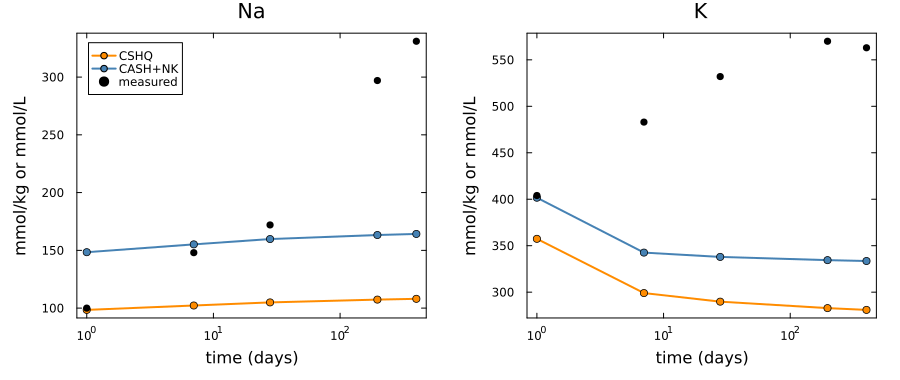
Both models certify the paste at every age. From 7 days on, CASH+NK leaves more sodium and potassium in solution than CSHQ, and closer to the analysis: at 28 days 160 and 338 mmol/kg against 172 and 532 measured, where CSHQ gives 105 and
- That is the improvement Miron et al. (2022) report. Neither model follows the rise
of both alkalis after 28 days, to 331 and 563 mmol/L at 400 days: CASH+NK stays near 164 and 334, CSHQ near 108 and 281. The pH follows the same order, 13.7 with CASH+NK, 13.6 with CSHQ and 13.7 to 13.8 measured. After the first day the calcium is 1.1 mmol/kg with CASH+NK and 1.0 with CSHQ, against 1.6 to 1.0 measured; with CASH+NK it is carried in part by the Ca(OH)₂⁰ complex of the alkali fit. The sulfate is the largest difference of the two models alike: measured, it falls to 1.9 mmol/L at one day and climbs to 34 to 41 after six months; computed, it stays in solution at one day (53 and 85 mmol/kg) and between 2.7 and 6.2 afterwards.
5. The other cations: lithium to radium
Miron et al. (2022) extended the interlayer site further, to lithium, rubidium and cesium and to magnesium, strontium, barium and radium, and fitted each on uptake experiments (Miron et al., 2022). CASH+ext is that model: 33 end-members, with the interaction parameters of their Table A3. Their Table A2 gives the equilibrium constant of the dissolution of each end-member into Ca²⁺, SiO₂⁰, water and its interlayer cation, computed from their own energies; the database gives them back:
ext = phases["CASH+ext"]
printed = literature_table("Miron2022a", "dissolution_log_K")
cation = Dict("N" => "Na+", "K" => "K+", "Li" => "Li+", "Rb" => "Rb+", "Cs" => "Cs+",
              "Mg" => "Mg+2", "Sr" => "Sr+2", "Ba" => "Ba+2", "Ra" => "Ra+2")
# The energies `Gm` of section 3: the first paper's for the alkali members, whose
# TCNh and TCKh the database carries as the second paper fine-tunes them.
worst = maximum(ext.end_members) do m
    n = symbol(m)
    c = atoms(m)
    x = get(cation, n[3:(end - 1)], nothing)
    hplus = 2c[:Ca] + (x === nothing ? 0 : charge(byname[x]))
    products = c[:Ca] * G25("Ca+2") + c[:Si] * G25("SiO2@") + (c[:H] + hplus) / 2 * G25("H2O@") + (x === nothing ? 0.0 : G25(x))
    abs(-(products - Gm(n)) / (RT * log(10)) - printed.log_K[findfirst(==(n), printed.species)])
end
@printf("%d end-members: largest difference from Table A2, %.3f in log K\n", length(ext.end_members), worst)
33 end-members: largest difference from Table A2, 0.006 in log KWith strontium and cesium at a millimole per kilogram beside the sodium and potassium of section 2, at a Ca/Si of 1.2, the gel takes up both:
sp = speciation(substances, vcat(["Portlandite", "Amor-Sl"], symbol.(ext.end_members)); aggregate_state = [AS_AQUEOUS])
complexes(s) = charge(s) == 0 && any(el -> haskey(atoms(s), el), (:Na, :K, :Li, :Rb, :Cs)) && aggregate_state(s) == AS_AQUEOUS
# Cemdata18 has no component for the five cations the extension adds.
primaries = vcat(CEMDATA_PRIMARIES, ["Li+", "Rb+", "Cs+", "Ba+2", "Ra+2"])
cs_ext = ChemicalSystem(filter(!complexes, sp), primaries; solid_solutions = [ext])
st = ChemicalState(cs_ext)
set_quantity!(st, "H2O@", 1.0u"kg")
set_quantity!(st, "Amor-Sl", 0.05u"mol")
set_quantity!(st, "Portlandite", 0.06u"mol")
for (s, x) in ("Na+" => 0.02, "K+" => 0.06, "Sr+2" => 0.001, "Cs+" => 0.001)
    set_quantity!(st, s, x * u"mol")
end
set_quantity!(st, "OH-", 0.083u"mol")
eq, cert = equilibrate_certified(st; model)
gel = solid_solution_totals(eq, "CASH+ext").elements
n = ustrip.(us"mol", eq.n)
held(el) = gel[el] / sum(get(atoms(s), el, 0) * x for (s, x) in zip(cs_ext.species, n))
@printf("certified: %s; the gel holds %.0f %% of the Sr, %.0f %% of the Cs, %.0f %% of the Na and %.0f %% of the K\n",
        cert.optimal, 100held(:Sr), 100held(:Cs), 100held(:Na), 100held(:K))
certified: true; the gel holds 78 % of the Sr, 4 % of the Cs, 2 % of the Na and 2 % of the KThe database gives back Table A2 for the 33 end-members, to 0.006 in log K. In that solution the gel certifies, and holds 78 % of the strontium but 4 % of the cesium, 2 % of the sodium and 2 % of the potassium. Strontium takes the place of the interlayer calcium one for one (TSSrh is TSCh with Sr for one Ca), where a monovalent cation takes it with one hydroxide less (TSNh). The uptake experiments on which Miron et al. (2022) fitted each cation are not reproduced here.
Where to go next
The derivation of the model is in Solid solutions, section 8, and The models of the C-S-H gel lists the models of the gel the package ships, CASH+ among them.