
Mixing on sites: the CSH3T and CNASH gels
Before this page
Solid solutions, section 7, where the site model is derived.
A C-S-H gel is modeled as a solid solution of a few end-members, and there are two ways of mixing them. The simpler one mixes the end-members themselves, as if each were a molecule placed at random. The other mixes what actually changes from one end-member to the next: the few structural sites of the silicate chain and of the interlayer, each held by one species or another. The second is how Kulik (2011) defines the CSH3T gel and Myers et al. (2014) the C-(N-)A-S-H gel, and it is what SublatticeModel implements.
This page does two things. It solves the same CSH3T gel in water both ways and shows how much the pore solution depends on the choice. Then it computes a C-(N-)A-S-H gel with the model of Myers et al. (2014) and reads from it the minimum chain length of their Eq. (11).
using ChemistryLab
using DynamicQuantities
using OptimaSolver
using Printf
using Plots
default(framestyle = :box, grid = false)

substances = build_species(datapath("cemdata18-thermofun.json"); verbose = false)
byname = Dict(symbol(s) => s for s in substances)

# No alkali in the first part and little in the second: the ion size and B-dot of
# Cemdata18 for KOH solutions are used, as on the cement pages.
model = cemdata18_activity_model(:KOH)

# A gel phase and the aqueous species of its elements, plus the pure phases that
# may form beside it.
function gel_system(names, mixing; pure)
    sp = speciation(substances, vcat(pure, names); aggregate_state = [AS_AQUEOUS])
    gel = SolidSolutionPhase("C-S-H", [byname[m] for m in names]; model = mixing)
    return ChemicalSystem(sp, CEMDATA_PRIMARIES; solid_solutions = [gel])
end

# Moles of an element in solution, per kilogram of water.
function in_solution(eq, element)
    cs = eq.system
    n = ustrip.(us"mol", eq.n)
    iw = only(cs.idx_solvent)
    kg_water = n[iw] * ustrip(us"kg/mol", cs.species[iw][:M])
    return sum(get(atoms(cs.species[i]), element, 0) * n[i] for i in cs.idx_solutes) / kg_water
end
1. CSH3T, mixed by end-members and by sites
CSH3T has three end-members: TobH, the silica-rich one, T2C, the calcium-rich one, and T5C between them, with a Ca/Si of 1. Cemdata18 (Lothenbach et al., 2019) ships them as an ideal mixture of end-members. Their site form puts Si or Ca on two bridging positions of the silicate chain: TobH has Si on both, T2C Ca on both, T5C Ca on one and Si on the other. The same three records serve both declarations:
CSH3T = ["CSH3T-TobH", "CSH3T-T5C", "CSH3T-T2C"]
members = [byname[m] for m in CSH3T]
pure = ["Portlandite", "Amor-Sl"]
systems = ["end-members" => gel_system(CSH3T, IdealSolidSolutionModel(); pure),
           "sites" => gel_system(CSH3T, sublattice_model("Kulik2011:csh3t", members); pure)]
Each paste below is 0.05 mol of silica and some lime in a kilogram of water, from a Ca/Si of 0.7 to 1.6. That is how the solubility of a C-S-H is measured: the gel is equilibrated in water and the solution analyzed.
ratios = 0.7:0.1:1.6
curves = Dict(label => (gel = Float64[], si = Float64[], ca = Float64[]) for (label, _) in systems)
println("Ca/Si   mixing        certified   Ca (mmol/kg)   Si (mmol/kg)    pH     gel Ca/Si")
for r in ratios, (label, cs) in systems
    st = ChemicalState(cs)
    set_quantity!(st, "Amor-Sl", 0.05u"mol")
    set_quantity!(st, "Portlandite", r * 0.05u"mol")
    set_quantity!(st, "H2O@", 1.0u"kg")
    b = budget(st)
    eq, cert = equilibrate_certified(st; model, b)
    gel = solid_solution_totals(eq, "C-S-H").elements
    c = curves[label]
    push!(c.gel, gel[:Ca] / gel[:Si]); push!(c.si, 1000in_solution(eq, :Si)); push!(c.ca, 1000in_solution(eq, :Ca))
    @printf("%4.2f    %-12s  %-9s  %10.3f     %10.4f     %6.3f   %6.3f\n",
            r, label, cert.optimal, c.ca[end], c.si[end], pH(eq, model), c.gel[end])
end
Ca/Si mixing certified Ca (mmol/kg) Si (mmol/kg) pH gel Ca/Si
0.70 end-members true 0.986 2.8633 10.023 0.722
0.70 sites true 0.954 2.0383 10.355 0.710
0.80 end-members true 0.792 1.1675 10.668 0.803
0.80 sites true 0.899 1.2416 10.750 0.802
0.90 end-members true 0.934 0.5559 11.074 0.891
0.90 sites true 0.965 0.7939 11.008 0.895
1.00 end-members true 1.442 0.2616 11.370 0.976
1.00 sites true 1.372 0.3626 11.326 0.980
1.10 end-members true 2.355 0.1435 11.605 1.056
1.10 sites true 2.888 0.1516 11.690 1.045
1.20 end-members true 3.601 0.0951 11.788 1.130
1.20 sites true 4.209 0.1125 11.850 1.118
1.30 end-members true 5.152 0.0696 11.936 1.199
1.30 sites true 5.395 0.0924 11.953 1.194
1.40 end-members true 7.061 0.0530 12.063 1.260
1.40 sites true 6.644 0.0769 12.038 1.269
1.50 end-members true 9.408 0.0409 12.177 1.313
1.50 sites true 8.129 0.0631 12.119 1.339
1.60 end-members true 12.250 0.0319 12.281 1.356
1.60 sites true 10.083 0.0499 12.204 1.400fig = plot(; xlabel = "Ca/Si of the gel", ylabel = "silicon in solution (mmol/kg)",
yscale = :log10, title = "CSH3T in water", legend = :topright, size = (720, 420),
left_margin = 8Plots.mm, bottom_margin = 8Plots.mm)
for (label, color) in (("end-members", :steelblue), ("sites", :firebrick))
plot!(fig, curves[label].gel, curves[label].si; label = "mixed by $label",
marker = :circle, color, linewidth = 2)
end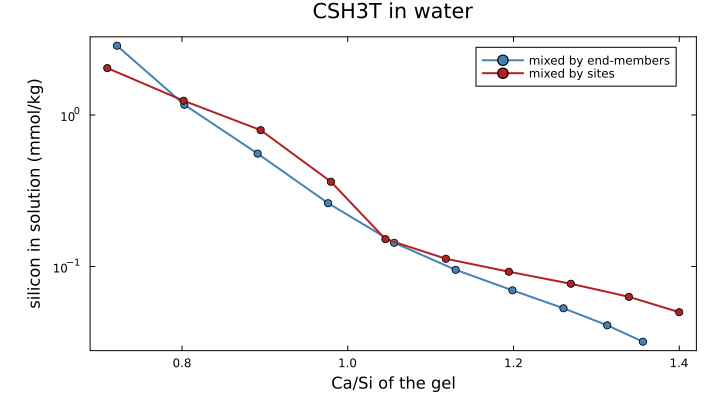
Both declarations certify every paste, and they agree on the gel: its Ca/Si follows the lime added, and the two differ by 0.05 at most. They disagree on the solution. Mixed by sites, the gel leaves more silicon in solution at every Ca/Si from 0.8 up, half as much again at a Ca/Si of 1.5 (0.063 against 0.041 mmol/kg), and from 1.4 up less calcium. The two models give the three end-members different activities at the same composition, so the solution in equilibrium with a given gel is another one. Which of the two is closer to measured solubilities is not settled here; what the table settles is how much the choice weighs.
2. The C-(N-)A-S-H gel and its chain length
The CNASH gel of Myers et al. (2014) has eight end-members on six sites. Its formula unit counts the silicate chain in dreierketten units, three tetrahedra each: two paired ones, and a bridging one that can be vacant. Their Table 1 gives, for each end-member, the fraction
with
CNASH = ["T2C-CNASHss", "T5C-CNASHss", "TobH-CNASHss", "5CA", "5CNA", "INFCA", "INFCN", "INFCNA"]
cnash = sublattice_model("Myers2014:cnash", [byname[m] for m in CNASH])
table1 = literature_table("Myers2014", "cnash_bridging_vacancies")
ν = Dict(zip(table1.end_member, ustrip.(table1.bridging_vacancies)))

println("end-member     Ca/Si   Al/Si   Na/Si    ν     chain length")
for m in CNASH
    a = atoms(byname[m])
    ratio(el) = get(a, el, 0) / a[:Si]
    @printf("%-13s  %5.3f   %5.3f   %5.3f   %3.1f   %s\n", m, ratio(:Ca), ratio(:Al), ratio(:Na),
            ν[m], ν[m] == 0 ? "infinite" : @sprintf("%.0f", 3 / ν[m] - 1))
end
end-member Ca/Si Al/Si Na/Si ν chain length
T2C-CNASHss 1.500 0.000 0.000 1.0 2
T5C-CNASHss 1.000 0.000 0.000 0.5 5
TobH-CNASHss 0.667 0.000 0.000 0.0 infinite
5CA 1.250 0.250 0.000 0.5 5
5CNA 1.250 0.250 0.500 0.5 5
INFCA 0.842 0.263 0.000 0.0 infinite
INFCN 0.667 0.000 0.417 0.0 infinite
INFCNA 0.842 0.263 0.579 0.0 infiniteFour end-members have no vacant bridging site, and so infinite chains: TobH and the three whose name starts with INF. T2C, with every bridging site vacant, is a gel of dimers.
A gel of Ca/Si 1 in a dilute sodium hydroxide solution, with more and more aluminum, shows what the aluminum does to the chains. Gibbsite, amorphous aluminum hydroxide and the calcium aluminate hydrates are declared, so that the aluminum the gel cannot take has somewhere to go:
pure_n = ["Portlandite", "Amor-Sl", "Gbs", "AlOHam", "C3AH6", "C4AH13", "straetlingite"]
cs_n = gel_system(CNASH, cnash; pure = pure_n)
println("Al/Si added  certified   gel Ca/Si  Al/Si  Na/Si   chain length    pH    other solids")
for alsi in (0.0, 0.05, 0.10, 0.15)
    st = ChemicalState(cs_n)
    set_quantity!(st, "Amor-Sl", 0.05u"mol")
    set_quantity!(st, "Portlandite", 0.05u"mol")
    alsi > 0 && set_quantity!(st, "Gbs", alsi * 0.05u"mol")
    set_quantity!(st, "Na+", 0.02u"mol")
    set_quantity!(st, "OH-", 0.02u"mol")
    set_quantity!(st, "H2O@", 1.0u"kg")
    b = budget(st)
    eq, cert = equilibrate_certified(st; model, b)
    gel = solid_solution_totals(eq, "C-S-H")
    χ = [gel.members[m] for m in CNASH] ./ gel.amount
    CL = 3 / sum(χ[k] * ν[CNASH[k]] for k in eachindex(CNASH)) - 1
    el = gel.elements
    n = ustrip.(us"mol", eq.n)
    others = [symbol(cs_n.species[i]) for i in cs_n.idx_crystal
              if n[i] > 1.0e-6 && !(symbol(cs_n.species[i]) in CNASH)]
    @printf("   %4.2f       %-9s   %5.3f     %5.3f  %5.3f     %5.2f       %6.3f   %s\n", alsi, cert.optimal,
            el[:Ca] / el[:Si], get(el, :Al, 0.0) / el[:Si], get(el, :Na, 0.0) / el[:Si], CL,
            pH(eq, model), isempty(others) ? "none" : join(others, ", "))
end
Al/Si added certified gel Ca/Si Al/Si Na/Si chain length pH other solids
0.00 true 0.987 0.000 0.160 5.20 12.069 none
0.05 true 0.991 0.050 0.176 6.02 12.031 none
0.10 true 0.994 0.100 0.179 7.03 12.014 none
0.15 true 0.995 0.125 0.180 7.66 11.979 GbsWithout aluminum, the gel of Ca/Si 1 has a chain length of 5.2 tetrahedra. Each step of aluminum lengthens it, to 7.7 at an Al/Si of 0.125, since the members that take the aluminum have fewer vacant bridging sites than T2C. The gel also takes sodium, about 0.18 per silicon. At this Ca/Si it holds no more aluminum than 0.125 per silicon: of the 0.15 added, the rest precipitates as gibbsite (Gbs). Every paste certifies. The chain length is a lower bound, since Eq. (11) counts the chains as not crosslinked, as Myers et al. (2014) state.
Where to go next
The derivation of the site model, its convexity and what the solver does with it are in Solid solutions. The CEM IV page uses the CNASH gel in a cement paste, beside the CSHQ model of the same gel, and The models of the C-S-H gel lists the six models the package ships. The CASH+ page adds to site mixing the energies of the compounds, in the model of Kulik et al. (2022).