
Aluminum in the C-S-H: two ways that were tried, and why neither is shipped
Before this page
Solid solutions in a calculation, for how a gel is declared and what its end-members can hold, and Aluminum uptake by C-S-H, which computes the syntheses used below with the two gels of Cemdata18 (Lothenbach et al., 2019).
What this page fits, and what it ships
The two extensions below are ChemistryLab's own, each with one energy fitted on published measurements. Neither is part of Cemdata18, of a published model or of the package's databases: they live in scripts/csh_aluminum.jl, and this page records what they give, so that the question of a C-S-H with aluminum at a high Ca/Si is documented rather than answered by a model that has not earned it.
The calcium silicate hydrate of a hydrated cement holds aluminum. In the pastes of De Weerdt et al. (2011), measured by electron microprobe, the gel of a Portland cement has a Ca/Si of 1.8 ± 0.1 and an Al/Si of 0.06 ± 0.01; with fly ash it moves to about 1.4 and 0.13 after 140 days. A model of the gel for such binders has to hold both the calcium of a gel beside portlandite and some aluminum, and none of the gels ChemistryLab ships does. CSHQ (Kulik, 2011) and the CASH+ family (Kulik et al., 2022; Miron et al., 2022) hold no aluminum; CNASH_ss (Myers et al., 2014) holds it, and its Ca/Si stops at 1.5, that of its calcium-richest end-member, its gel reaching 1.16 in the pastes of De Weerdt et al. (2011), where 1.8 was measured (the validation page).
1. What the literature offers
The authors of CASH+ describe how aluminum would enter their model, as an aluminate on the bridging site of the silicate chain, and cite the extension as in preparation (Kulik et al., 2022; ref. 25). Yan et al. (2022) compare their measurements with a CASH+ model that holds aluminum, cited in turn as in preparation. A search of Crossref on 2026-10-06 finds no publication of it, and its parameters are not available, so that ChemistryLab can neither use it nor recompute the curves of Yan et al. (2022).
The measurements are another matter. L'Hôpital et al. (2015) and L'Hôpital et al. (2016) synthesized C-A-S-H at 20 °C at a Ca/Si from 0.6 to 1.6 and an Al/Si up to 0.33, without alkali and, for the first, at a Ca/Si of 1.0 in 0.5 M KOH; L'Hôpital et al. (2016) at an Al/Si of 0.05 in KOH and NaOH solutions up to 0.5 M; Yan et al. (2022) at a Ca/Si of 1.0 in NaOH and KOH up to 1 M. Each reports the gel by mass balance, its Al/Si included, and the solution. Two other sources were examined and not used: Haas and Nonat (2015) give a model of their own, by surface reactions, on C-A-S-H made by adding a C-S-H to a calcium aluminate solution for a week, the kind of short experiment that L'Hôpital et al. found to put more aluminum in the gel than equilibrium does; and Roosz et al. (2018) measured two C-A-S-H by calorimetry, whose aluminum, an Al/Si of 0.04 and 0.016, is too little to fix the energy of an aluminum end-member.
using ChemistryLab, DynamicQuantities, Logging, OptimaSolver, Printf, Plots
default(framestyle = :box, grid = false)
include(joinpath(pkgdir(ChemistryLab), "scripts", "csh_aluminum.jl"))
2. What the syntheses say before any model
Two readings of the measurements decide how a model can be fitted on them.
The first concerns the other solids. Beyond an Al/Si of about 0.05 the syntheses hold strätlingite and katoite beside the gel, and the Al/Si of the gel stays near 0.1, which reads like the limit a model should reproduce. The saturation indices L'Hôpital et al. (2015) compute from their own solutions say otherwise: those solutions are undersaturated with respect to the strätlingite they hold, by 1.2 to 3.4 log units, and to the katoite, by 6 to 11 ((L'Hôpital et al., 2015; Appendix C), recorded in data/literature/LHopital2015.json). These phases are not at equilibrium with the solution, and the Al/Si the gel keeps beside them is not an equilibrium datum. What is one is the pair the gel and its solution form: the Al/Si of the gel, measured by mass balance, against the aluminum dissolved beside it. That pair, the uptake isotherm, is what the models below are fitted and tested on, with the aluminum-bearing pure phases left out of the calculation.
The second concerns the shape of that isotherm. Without alkali, at a Ca/Si of 1.0 and below an Al/Si of 0.05, where the gel holds all the aluminum:
g = literature_table("LHopital2015", "gel_composition")
p = literature_table("LHopital2015", "pore_solution")
pts = [(g.Al_Si[i], ustrip(us"mmol/L", p.concentration[j])) for i in eachindex(g.Al_Si)
       for j in eachindex(p.element)
       if !ismissing(g.Al_Si[i]) && g.Al_Si_target[i] <= 0.05 && p.Al_Si_target[j] == g.Al_Si_target[i] &&
          p.time_d[j] == g.time_d[i] && p.element[j] == "Al" && p.qualifier[j] == "measured"]
x, y = log10.(first.(pts)), log10.(last.(pts))
slope = sum((x .- sum(x) / length(x)) .* (y .- sum(y) / length(y))) / sum(abs2, x .- sum(x) / length(x))
@printf("%d samples, slope of log(Al dissolved) against log(gel Al/Si): %.2f\n", length(pts), slope)
fig = scatter(first.(pts), last.(pts); xscale = :log10, yscale = :log10, color = :steelblue, label = "measured",
              xlabel = "Al/Si of the gel", ylabel = "dissolved aluminum (mmol/L)",
              title = "C-A-S-H at Ca/Si 1.0, no alkali, 20 °C", legend = :topleft, size = (680, 420),
              left_margin = 6Plots.mm, bottom_margin = 6Plots.mm)
xs = [0.01, 0.06]
plot!(fig, xs, 0.4 .* xs; color = :gray, linestyle = :dash, label = "proportional")
8 samples, slope of log(Al dissolved) against log(gel Al/Si): 1.28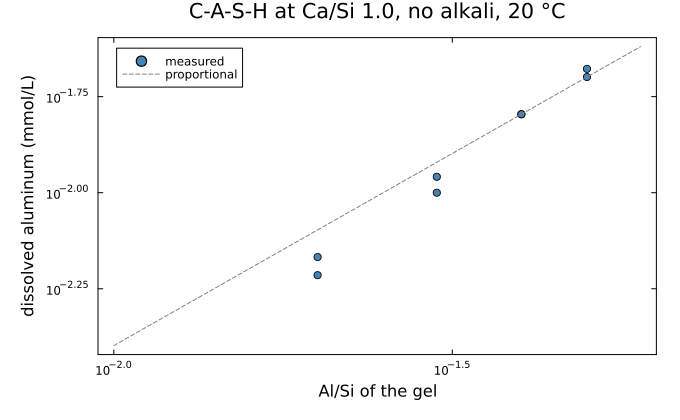
The dissolved aluminum is close to proportional to the aluminum of the gel, the slope on logarithmic axes being 1.3. In an ideal mixture an end-member carrying
3. Two ways, one energy each
Way A extends CASH+, whose gel is a mixture on two sites: the bridging tetrahedron of the silicate chain (a silicate, a vacancy or a calcium) and the interlayer cation (a proton, a calcium, a sodium or a potassium), every combination a compound (Kulik et al., 2022). It adds the aluminate the authors describe for the bridging site, AlO(OH)₂⁻, which carries the same charge as the silicate it replaces; their Table 1 lists Al(OH)₄⁻ instead, which differs by a molecule of water and changes the water of the gel, not its solubility in dilute solutions. Each new compound is the silicate compound of the same interlayer occupant with its bridging silicate exchanged:
gibbsite and amorphous silica of Cemdata18 on either side, so that TAvh is Ca₂Si₂AlO₁₁H₇, TACh Ca₃Si₂AlO₁₃H₉, and so on with sodium and potassium. Its Gibbs energy is that of the reaction's left-hand side minus the right-hand side's, plus one energy
Way B keeps CSHQ, the ideal mixture Cemdata18 ships, and adds one end-member: four formula units of 5CA, (CaO)₅(SiO₂)₄(Al₂O₃)₀.₅(H₂O)₆.₅, which carries one aluminum, its entropy, heat capacity and volume four times those of 5CA, its Gibbs energy four times that of 5CA plus
Each way has one energy to fit,
fit = csh_al_samples("fit")
δs = Dict(:A => [8.0, 9.0, 9.8, 11.0, 12.0], :B => [-10.0, -5.0, 0.0, 5.0, 10.0])   # kJ/mol
scan = Dict(way => [csh_al_misfit(csh_al_isotherm(way, 1000δ, fit)) for δ in δs[way]] for way in (:A, :B))
println("way   δ (kJ/mol)   rms log   bias    above a detection limit")
for way in (:A, :B), (δ, m) in zip(δs[way], scan[way])
    @printf("%-5s %8.1f   %8.2f   %+6.2f   %6.2f\n", way, δ, m.rms, m.bias, m.excess)
end
best = csh_al_isotherm(:A, 9.8e3, fit)
println("\nway A at 9.8 kJ/mol, by the Ca/Si of the synthesis: bias (log), or the excess over a detection limit")
for ca in sort(unique(x.Ca_Si for x in best))
    m = csh_al_misfit([x for x in best if x.Ca_Si == ca])
    @printf("Ca/Si %.1f: %s\n", ca, m.n > 0 ? @sprintf("bias %+.2f on %d", m.bias, m.n) : @sprintf("%.2f above the limit", m.excess))
end
way δ (kJ/mol) rms log bias above a detection limit
A 8.0 0.43 -0.32 1.99
A 9.0 0.32 -0.14 2.15
A 9.8 0.28 +0.00 2.28
A 11.0 0.36 +0.22 2.46
A 12.0 0.49 +0.39 2.60
B -10.0 1.57 -1.45 4.08
B -5.0 0.82 -0.56 4.11
B 0.0 0.66 +0.31 4.12
B 5.0 1.24 +1.14 4.12
B 10.0 1.89 +1.85 4.12
way A at 9.8 kJ/mol, by the Ca/Si of the synthesis: bias (log), or the excess over a detection limit
Ca/Si 0.6: 2.28 above the limit
Ca/Si 0.8: 1.45 above the limit
Ca/Si 1.0: bias +0.01 on 5
Ca/Si 1.2: bias -0.06 on 4
Ca/Si 1.4: bias -0.07 on 3
Ca/Si 1.6: bias +0.15 on 3fig = plot(δs[:A], [m.rms for m in scan[:A]]; marker = :circle, color = :steelblue, linewidth = 2,
label = "way A, CASH+ with the aluminate", xlabel = "exchange energy δ (kJ/mol)",
ylabel = "rms of log(computed / measured Al)", title = "fit on L'Hôpital et al. 2016a, no alkali",
legend = :top, size = (680, 420), left_margin = 6Plots.mm, bottom_margin = 6Plots.mm)
plot!(fig, δs[:B], [m.rms for m in scan[:B]]; marker = :diamond, color = :darkorange, linewidth = 2,
label = "way B, CSHQ with 4 × 5CA")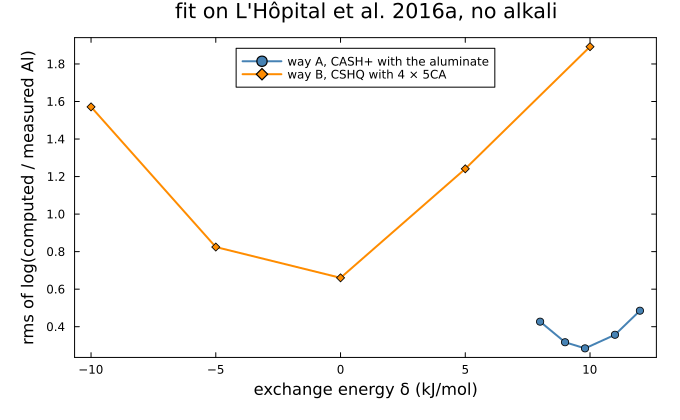
Way A is fitted at
4. On data the fit has not seen
The energies are now held, and the isotherm computed for syntheses in alkali hydroxide solutions, from three series none of the fits used:
δbest = Dict(:A => 9.8, :B => 0.0)
sets = ["lh16b" => "L'Hôpital et al. 2016b", "lh15" => "L'Hôpital et al. 2015", "yan" => "Yan et al. 2022"]
# The equilibria that do not certify warn; they are counted in the table and
# left out of the misfit.
val = Dict((way, set) => csh_al_isotherm(way, 1000δbest[way], csh_al_samples(set)) for way in (:A, :B), (set, _) in sets)
println("series                     way   n    rms log   bias   certified")
for (set, label) in sets, way in (:A, :B)
    r = val[(way, set)]
    m = csh_al_misfit(r)
    @printf("%-26s %-4s %3d   %7.2f  %+6.2f   %d/%d\n", label, way, m.n, m.rms, m.bias, count(x -> x.certified, r), length(r))
end
series way n rms log bias certified
L'Hôpital et al. 2016b A 68 0.97 +0.70 79/87
L'Hôpital et al. 2016b B 76 1.56 +1.25 87/87
L'Hôpital et al. 2015 A 3 0.57 -0.54 3/4
L'Hôpital et al. 2015 B 4 0.52 +0.52 4/4
Yan et al. 2022 A 29 0.44 -0.24 29/30
Yan et al. 2022 B 30 0.70 +0.67 30/30println("L'Hôpital et al. 2016b, way A, by the Ca/Si of the synthesis")
println("Ca/Si n bias (log)")
lh16b = val[(:A, "lh16b")]
for ca in sort(unique(x.Ca_Si for x in lh16b))
m = csh_al_misfit([x for x in lh16b if x.Ca_Si == ca])
@printf("%4.1f %3d %+6.2f\n", ca, m.n, m.bias)
endL'Hôpital et al. 2016b, way A, by the Ca/Si of the synthesis
Ca/Si n bias (log)
0.6 14 +1.63
0.8 8 +0.61
1.0 14 -0.07
1.2 12 +0.34
1.4 9 +0.56
1.6 11 +1.07fig = plot([1.0e-3, 10.0], [1.0e-3, 10.0]; xscale = :log10, yscale = :log10, color = :gray, linestyle = :dash,
label = "", xlabel = "measured aluminum (mmol/L)", ylabel = "computed aluminum (mmol/L)",
title = "way A, δ = 9.8 kJ/mol, alkaline syntheses", legend = :topleft, size = (680, 480),
left_margin = 6Plots.mm, bottom_margin = 6Plots.mm)
for ((set, label), (color, shape)) in zip(sets, [(:steelblue, :circle), (:darkorange, :diamond), (:seagreen, :utriangle)])
shown = [x for x in val[(:A, set)] if x.certified && x.qualifier == "measured"]
scatter!(fig, [x.Al for x in shown], [x.model for x in shown]; color, markershape = shape, label)
end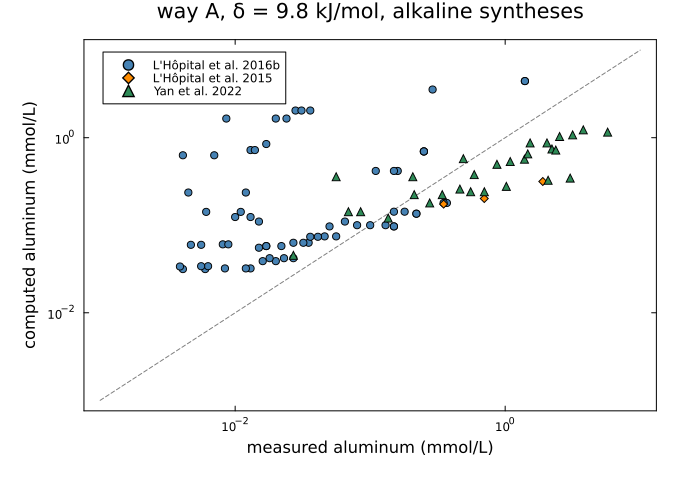
Way A carries over to the alkaline syntheses at a Ca/Si of 1.0: the series of Yan et al. (2022), in NaOH and KOH up to 1 M, within about 0.4 in decimal logarithm, and those of L'Hôpital et al. (2016) at that Ca/Si with a bias of −0.07. Away from it, it does not: at a higher Ca/Si it puts more aluminum in solution than was measured, increasingly so up to an order of magnitude at 1.6, and at a lower one the excess of the alkali-free syntheses returns. Way B is further off on the two larger series and about as close on the four syntheses of L'Hôpital et al. (2015). The interlayer occupants sodium and potassium were given the same
5. In a cement paste
The test that matters for a cement is a paste, where the gel shares the aluminum with the AFm, AFt and hydrogarnet phases. The pastes of De Weerdt et al. (2011) at 140 days, computed as on the validation page with the gel of way A in place of CSHQ, against the gel they measured:
include(joinpath(pkgdir(ChemistryLab), "scripts", "de_weerdt_2011.jl"))
cashplus = build_species(datapath("cemdata18-cashplus.json"); verbose = false)
base = phase_list_system(DW11_PHASES, cashplus; replace = Dict("CSHQ" => "CASH+NK"), exclude_aqueous = DW11_CASHPLUS_EXCLUDED)
gelA = csh_al_gel_A(9.8e3, ["v", "C", "N", "K"])
cs_paste = ChemicalSystem(
    vcat(base.species, [m for m in end_members(gelA) if !(symbol(m) in symbol.(base.species))]), CEMDATA_PRIMARIES;
    solid_solutions = vcat([p for p in base.solid_solutions if ChemistryLab.name(p) != "CASH+NK"], [gelA]),
)
paste_model = cemdata18_activity_model(:KOH)
println("paste       gel Ca/Si   gel Al/Si   measured Ca/Si, Al/Si   certified")
measured = Dict("OPC" => "1.8, 0.06", "OPC-L" => "1.8, 0.06", "OPC-FA" => "1.4, 0.13", "OPC-FA-L" => "1.4, 0.13")
for mix in DW11_MIXES
    rs = hydrate(dw11_recipe(mix), cs_paste, [140.0]; model = paste_model)
    e = solid_solution_totals(rs[1].state, "C-S-H").elements
    @printf("%-10s %9.2f %11.3f   %20s     %s\n", mix, e[:Ca] / e[:Si], e[:Al] / e[:Si], measured[mix], rs[1].certificate.optimal)
end
paste gel Ca/Si gel Al/Si measured Ca/Si, Al/Si certified
OPC 1.51 0.125 1.8, 0.06 true
OPC-L 1.54 0.011 1.8, 0.06 true
OPC-FA 1.52 0.135 1.4, 0.13 true
OPC-FA-L 1.56 0.011 1.4, 0.13 trueThe gel of way A reaches a Ca/Si of about 1.5, where the measured one is 1.8 without fly ash and 1.4 with it; that is the reach of CASH+ itself, not of the aluminate. Its aluminum is right in one paste of the four, the CEM II/B-V (OPC-FA), twice the measured one in the CEM I, and nearly nothing in the two pastes with limestone, where the gel was measured to hold 0.06 and 0.13 and the calculation puts the aluminum in the other aluminate hydrates. The energy fitted on syntheses does not carry over to the pastes, where the aluminum of the gel is set by its competition with those hydrates.
6. What is proposed, and why
Neither way is shipped. Way A is the better one by every test: it reproduces the uptake isotherm of the syntheses at a Ca/Si from 1.0 to 1.6 with one energy, and carries over to alkaline syntheses at a Ca/Si of 1.0. It fails below a Ca/Si of 1.0 and in alkaline solutions above it, and in cement pastes it gives the gel a wrong amount of aluminum in three of four. A fitted end-member in a database looks exactly like a published one, and this one would be used precisely where it fails: in pastes, at a high Ca/Si, in alkaline pore solutions.
What a calculation can do meanwhile is what the aluminum-uptake page concludes: CNASH_ss where the aluminum held by the gel matters, at a Ca/Si that cannot exceed about 1.2; CSHQ or CASH+NK where the calcium of a Portland cement's gel matters, the aluminum then going to the hydrates. What would settle the question is the extension of CASH+ its authors have announced (Kulik et al., 2022; ref. 25), fitted together with the energies of the aluminate hydrates, and measurements of the gel's isotherm at a high Ca/Si in alkaline solutions, which none of the series above reaches beyond 1.6. scripts/csh_aluminum.jlreproduces everything on this page, and the transcriptions it reads,data/literature/LHopital2015.jsonanddata/literature/Yan2022.json, record how each value was read and checked.
Where to go next
Aluminum uptake by C-S-H and Alkali uptake by C-A-S-H compute the syntheses with the gels the package ships, and The CASH+ model the gel way A extends.