
Carbon dioxide in water under pressure (Wiebe and Gaddy 1940)
Before this page
Real gases, for the equation of state of the gas, and Standard states §1, for the pressure terms of the solution.
Wiebe and Gaddy (1940) measured how much carbon dioxide dissolves in pure water from 12 to 40 °C and from 25 to 500 atm. At these pressures the gas is far from ideal: below 31 °C it condenses into a liquid above some 50 to 70 atm, and above, a dense supercritical fluid. This page computes their 42 solubilities with the gas ideal and with the equation of state of Peng and Robinson (1976), and separates what each term of the calculation contributes. Nothing is fitted: the critical constants of the gas are those of phreeqc.dat (Parkhurst and Appelo, 2013), the standard energies those of Cemdata18 (Lothenbach et al., 2019).
1. The measurements
Wiebe and Gaddy (1940), Table I give the volume of gas, reduced to 0 °C and 1 atm, dissolved per gram of water. Divided by the molar volume of the ideal gas at 0 °C and 1 atm, it is the molality of the dissolved carbon dioxide (wg40_measured); converted to mole fractions, it is the table Spycher et al. (2003) give in their Appendix A, to the last printed digit.
using ChemistryLab, DynamicQuantities, OptimaSolver, Printf
include(joinpath(pkgdir(ChemistryLab), "scripts", "wiebe_gaddy1940_co2.jl"))

d = wg40_measured()
temps = unique(d.T_C)
println("P (atm)  ", join((@sprintf("%8.2f °C", t) for t in temps)))
for P in sort(unique(round.(Int, d.P ./ 101325)))
    cells = map(temps) do t
        i = findfirst(k -> d.T_C[k] == t && round(Int, d.P[k] / 101325) == P, eachindex(d.T))
        i === nothing ? " "^11 : @sprintf("%11.3f", d.m[i])
    end
    println(rpad(P, 9), join(cells))
end
P (atm) 12.00 °C 18.00 °C 25.00 °C 31.04 °C 35.00 °C 40.00 °C
25 0.870 0.633 0.578 0.518
50 1.586 1.429 1.215 1.077 0.991 0.908
75 1.621 1.510 1.391 1.309 1.242 1.152
100 1.640 1.516 1.417 1.346 1.300 1.241
125 1.281
150 1.713 1.595 1.409 1.362 1.311
200 1.774 1.658 1.462 1.420 1.416
300 1.832 1.754
400 1.723 1.641 1.594 1.556
500 1.725 1.695 1.639The molality, in mol/kg, rises steeply up to 50 to 75 atm and then slowly: past that point the carbon dioxide is dense, and compressing it further raises its fugacity much less than its pressure.
2. The calculation
A kilogram of water is put in contact with twenty moles of carbon dioxide, which leaves a gas phase at every condition of the table, and brought to equilibrium (wg40_dissolved). The aqueous species are the water, its ions, the dissolved carbon dioxide and the bicarbonate and carbonate ions, with the extended Debye–Hückel model; the bicarbonate is a twentieth of a percent of the dissolved carbon. The gas is either the ideal gas of the database or the same species given the critical constants of phreeqc.dat by peng_robinson:
co2 = peng_robinson(WG40_DB["CO2"])
for (T_C, P_atm) in ((25.0, 50), (25.0, 100), (40.0, 100))
    st = ChemicalState(ChemicalSystem([co2], ["CO2"]); T = (T_C + 273.15) * u"K", P = P_atm * 101325.0u"Pa", n = [1.0u"mol"])
    @printf("%4.0f °C, %3d atm:  φ = %.3f,  Z = %.3f\n", T_C, P_atm, fugacity_coefficients(st)["CO2"], compressibility_factor(st))
end
25 °C, 50 atm: φ = 0.738, Z = 0.654
25 °C, 100 atm: φ = 0.464, Z = 0.229
40 °C, 100 atm: φ = 0.561, Z = 0.298At 25 °C the carbon dioxide is a vapor at 50 atm and a liquid at 100 atm, under a quarter of the volume of the ideal gas; at 40 °C the fluid has no such jump. In either case its fugacity is a fraction of its pressure, and that fraction is what the dissolved amount follows.
r = wg40_compute()
dev_real = 100 .* (r.real ./ r.m .- 1)
dev_ideal = 100 .* (r.ideal ./ r.m .- 1)
@printf("Peng–Robinson: mean %+.1f %%, mean absolute %.1f %%, largest %.1f %%\n",
    sum(dev_real) / 42, sum(abs, dev_real) / 42, maximum(abs, dev_real))
@printf("ideal gas:     from %+.0f %% to %+.0f %%\n", minimum(dev_ideal), maximum(dev_ideal))
Peng–Robinson: mean -2.1 %, mean absolute 3.0 %, largest 7.3 %
ideal gas: from +12 % to +464 %3. Measured and computed
using Plots
default(framestyle = :box, grid = false)
colors = palette(:viridis, length(temps) + 1)
cs_real, cs_ideal = wg40_system(:real), wg40_system(:ideal)
fig = plot(; xlabel = "P (atm)", ylabel = "dissolved CO₂ (mol/kg)", ylims = (0, 2.2), legend = :bottomright, size = (700, 430))
for (k, t) in enumerate(temps)
    T = t + 273.15
    Ps = 101325.0 .* (t < 15 ? (10:10:300) : (10:10:500))
    plot!(fig, Ps ./ 101325, [wg40_dissolved(cs_real, T, P) for P in Ps]; color = colors[k], label = @sprintf("%.4g °C", t))
    plot!(fig, Ps ./ 101325, [wg40_dissolved(cs_ideal, T, P) for P in Ps]; color = colors[k], linestyle = :dash, label = false)
    i = findall(==(t), r.T_C)
    scatter!(fig, r.P[i] ./ 101325, r.m[i]; color = colors[k], markersize = 4, label = false)
end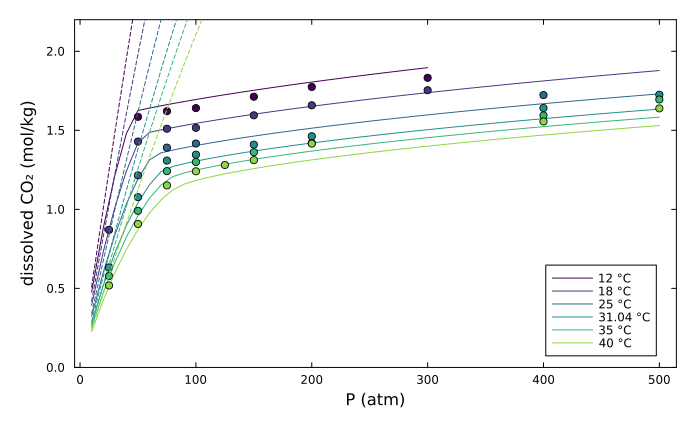
The markers are the measurements, the solid lines the real gas, the dashed lines the ideal gas, which leaves the frame above some 75 atm. The real gas follows the shape of every isotherm: the sharp rise to the saturation of the gas at 12, 18 and 25 °C and the plateau of the liquid above it, the smoother rise of the supercritical isotherms. The ideal gas, whose activity is its pressure, has neither: it dissolves 12 % too much at 25 atm and 40 °C, and 5.6 times the measurement at 300 atm and 12 °C.
4. What each term contributes
Under the pure gas and with unit activity coefficient, the molality of the dissolved carbon dioxide is the product of four factors, and its logarithm the sum of four terms (wg40_terms):
the Henry constant at the standard pressure, the pressure, the fugacity coefficient of the gas, and the work of the partial molar volume of the dissolved carbon dioxide, which its HKF equation of state (Helgeson et al., 1981) gives as about 33 cm³/mol. The four add up to the molality computed at equilibrium to 0.1 %, the share of the bicarbonate.
i40 = findall(==(40.0), r.T_C)
println("P (atm)   ln KH    ln P/P°   ln φ    volume   ln m: ideal  +φ      +volume  measured")
for i in i40
    t = r.terms[i]
    @printf("%5.0f   %7.3f  %7.3f  %7.3f  %7.3f      %7.3f  %7.3f  %7.3f  %7.3f\n", r.P[i] / 101325,
        t.henry, t.pressure, t.fugacity, t.volume,
        t.henry + t.pressure, t.henry + t.pressure + t.fugacity,
        t.henry + t.pressure + t.fugacity + t.volume, log(r.m[i]))
end
P (atm) ln KH ln P/P° ln φ volume ln m: ideal +φ +volume measured
25 -3.744 3.232 -0.122 -0.032 -0.512 -0.634 -0.666 -0.657
50 -3.744 3.925 -0.254 -0.064 0.181 -0.072 -0.137 -0.097
75 -3.744 4.331 -0.400 -0.097 0.587 0.187 0.090 0.141
100 -3.744 4.618 -0.577 -0.130 0.875 0.297 0.168 0.216
125 -3.744 4.841 -0.733 -0.162 1.098 0.364 0.202 0.248
150 -3.744 5.024 -0.856 -0.195 1.280 0.424 0.229 0.271
200 -3.744 5.311 -1.036 -0.260 1.568 0.531 0.272 0.348
400 -3.744 6.005 -1.359 -0.517 2.261 0.902 0.385 0.442
500 -3.744 6.228 -1.414 -0.645 2.484 1.070 0.425 0.494At 40 °C the fugacity coefficient takes 0.25 from the logarithm at 50 atm and 1.41 at 500 atm, a factor of four; the volume of the solute takes 0.06 and 0.65, a factor of two at the highest pressure. Neither is a correction: without the first the ideal gas misses the measurement by a factor of four, without the second the real gas overshoots it by 80 % at 500 atm.
fig2 = plot(; xlabel = "P (atm)", ylabel = "ln m", legend = :bottomright, size = (700, 400))
t40 = r.terms[i40]
P40 = r.P[i40] ./ 101325
plot!(fig2, P40, [t.henry + t.pressure for t in t40]; label = "ideal gas", linestyle = :dashdot, marker = :circle, markersize = 3)
plot!(fig2, P40, [t.henry + t.pressure + t.fugacity for t in t40]; label = "+ ln φ", linestyle = :dash, marker = :circle, markersize = 3)
plot!(fig2, P40, [t.henry + t.pressure + t.fugacity + t.volume for t in t40]; label = "+ volume", marker = :circle, markersize = 3)
scatter!(fig2, P40, log.(r.m[i40]); label = "measured, 40 °C", color = :black, markersize = 5)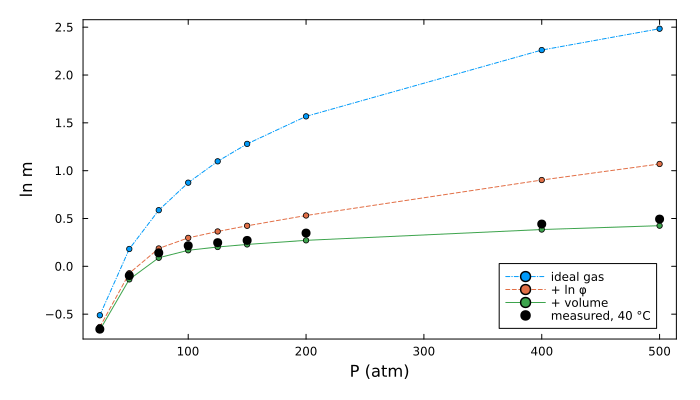
5. What remains
The real gas falls 2.1 % short of the measurements on average, 3.0 % in absolute value. Two systematic patterns remain, and one point:
Below the critical temperature, above saturation, at 12 °C, the calculation is 2 to 4 % high: the solubility follows the fugacity of liquid carbon dioxide, which the equation of Peng and Robinson (1976), built for the vapor pressures of hydrocarbons, describes less closely than the gas.
Above 31 °C, from 50 atm up, it is 3 to 7 % low. The gas phase is taken as pure carbon dioxide, whereas it holds a few parts per thousand of water, 2.3 to 4.8 ‰ at 31 °C between 25 and 500 bar according to the measurements Spycher et al. (2003) compile; counted, that water would lower the fugacity of the carbon dioxide by as much, and widen the gap rather than close it. The fugacity coefficient of the dense fluid, the partial molar volume of the solute and its activity coefficient, unit here, are the terms left to account for it.
The point at 40 °C and 200 atm, where the calculation falls 7.3 % short, is also off the trend of its own isotherm: it is within 0.3 % of the measurement at 35 °C, whereas at every other pressure the two isotherms are 2.5 to 11 % apart.
Spycher et al. (2003) fit these data, among others, with equilibrium constants and partial molar volumes of their own and a separate equilibrium constant for liquid carbon dioxide below 31 °C. The calculation here takes every constant from elsewhere, keeps one standard state for the gas whatever its density, and lets the equation of state carry the liquid.