
Validation against a silica fume shotcrete paste (Lothenbach et al. 2014)
Before this page
Validation against a measured paste, for the Portland paste whose phase list this page reuses, and the CASH+ model, for the C-S-H model it tests.
Lothenbach et al. (2014) followed a low-pH shotcrete cement, ESDRED, made for contact with the clay barrier of a repository: 60 % CEM I 42.5 N and 40 % silica fume, with 4.8 g of an aluminum sulfate set accelerator and 1.2 g of a polycarboxylate superplasticizer per 100 g of binder, at a water/binder ratio of 0.5, sealed at 20 °C for 3.5 years. They analyzed the pore solution from one hour on and followed the clinker and the silica fume by ²⁹Si NMR. Miron et al. (2022) computed this paste to test the alkali end-members of the CASH+NK model of the C-S-H on a binder whose gel ends at a low Ca/Si. This page computes it at the measured degrees of reaction, with the C-S-H as CSHQ and as CASH+NK, and compares the pore solutions.
using ChemistryLab, DynamicQuantities, Logging, OptimaSolver, Printf, Plots
default(framestyle = :box, grid = false)
include(joinpath(pkgdir(ChemistryLab), "scripts", "esdred_2014.jl"))
1. The binder and how far it has reacted
The silicates of the clinker and the silica fume are followed by NMR: the clinker's share of the silicon, and the silica fume left unreacted, which falls from 40 to 10 g per 100 g of binder in 3.5 years ((Lothenbach et al., 2014; Table 2)). They react here at those degrees; the aluminate and the ferrite, which the NMR does not see, by the law of Parrott and Killoh (1984) with the constants of this cement.
nmr = es14_nmr_extents()
println("  days   alite and belite   silica fume")
for d in (1, 7, 28, 360, 1310)
    @printf("%6d   %16.2f %13.2f\n", d, extent(nmr.silicates, d), extent(nmr.silica_fume, d))
end
days alite and belite silica fume
1 0.18 0.10
7 0.46 0.29
28 0.56 0.57
360 0.90 0.70
1310 0.97 0.75The binder is entered as Lothenbach et al. (2014) describe it: the normative phases of the CEM I (their Table 1, which sums to 100.31 g and is scaled to 100), the silica fume by its oxides, and the accelerator as an addition, its aluminum, sulfate and alkalis dissolved from the start. Miron et al. (2022) describe ESDRED as 40 % CEM I and 60 % silica fume; the paper they cite, and its Table 2, give 60 and 40, which is used here. The assumptions the script makes are listed at its head, scripts/esdred_2014.jl.
2. The formate of the accelerator
The accelerator brings organic carbon, which Lothenbach et al. (2014) identify as formate: 202 mM in the mixing water at the start, of which they estimate from the charge balance of each pore solution how much is still dissolved, 140 mM after one day and about 80 mM after a year (footnote a of their Table 3). Formate is an anion, and at these concentrations it is the main one. The measured solution after 28 days balances its charge only with it:
d = 28.0
cations = es14_measured(d, "K") + es14_measured(d, "Na") + 2es14_measured(d, "Ca")
anions = es14_measured(d, "OH-") + 2es14_measured(d, "S") + es14_measured(d, "formate")
@printf("at %d days: cations %.0f meq/L; anions %.0f meq/L, of which formate %.0f\n",
        d, cations, anions, es14_measured(d, "formate"))
at 28 days: cations 88 meq/L; anions 86 meq/L, of which formate 65Cemdata18 (Lothenbach et al., 2019) has no formate, and Miron et al. (2022) left it out, naming it as a possible cause of the gaps they found. The formate of the SUPCRT (Johnson et al., 1992) organic database can be added. It then has to stay formate, as it does in the paste: the reduced species of sulfur and iron of the database are left out, so that nothing in the system can oxidize it. But the model has no solid that takes formate up, where Lothenbach et al. (2014) estimate that the solids take a third to three-fifths of it. The two calculations below are therefore two bounds: without the formate, and with all of it in solution.
model = cemdata18_activity_model(:KOH)
days = es14_days()
runs = Dict((gel, f) => hydrate(es14_recipe(; formate = f), es14_system(gel; formate = f), days; model)
            for gel in (:CSHQ, :CASHNK), f in (false, true))
for gel in (:CSHQ, :CASHNK), f in (false, true)
    @printf("%-7s %-15s certified at %d of %d ages\n", gel, f ? "with formate" : "without formate",
            count(rs -> rs.certificate.optimal, runs[(gel, f)].states), length(days))
end
CSHQ without formate certified at 10 of 10 ages
CSHQ with formate certified at 10 of 10 ages
CASHNK without formate certified at 10 of 10 ages
CASHNK with formate certified at 10 of 10 ages3. The pore solutions
gel_name(gel) = gel === :CSHQ ? "CSHQ" : "CASH+NK"
println("  days  element  measured   CSHQ: no formate  formate   CASH+NK: no formate  formate")
for (k, d) in enumerate(days), e in ("K", "Na", "Ca", "pH")
    m = es14_measured(d, e)
    v = [e == "pH" ? pH(runs[(g, f)].states[k].state, model) : pore_solution_mmol(runs[(g, f)].states[k].state)[e]
         for g in (:CSHQ, :CASHNK) for f in (false, true)]
    @printf("%6.0f  %-7s %9.3g %15.3g %9.3g %18.3g %9.3g\n", d, e, m, v...)
end
days element measured CSHQ: no formate formate CASH+NK: no formate formate
1 K 217 148 220 59.2 170
1 Na 100 21.3 48.6 24.2 59.1
1 Ca 6.3 0.237 3.18 0.478 17.6
1 pH 13.2 13 12.1 13 12.1
2 K 236 128 226 51.4 165
2 Na 110 15.3 46.5 21.2 58.9
2 Ca 5.2 0.252 5.48 0.562 23.4
2 pH 13.3 13 12 12.9 12.1
4 K 139 101 240 43.2 158
4 Na 76 9.63 44.1 18.1 59
4 Ca 4.3 0.275 11.3 0.686 34.2
4 pH 13 12.9 11.9 12.9 12
7 K 85.7 104 247 17 111
7 Na 57 9.29 42.6 8.83 48.9
7 Ca 1.87 0.335 12.3 0.436 62
7 pH 12.7 12.6 11.6 12.4 11.4
14 K 39 141 273 12.4 58.4
14 Na 37 12.6 42.4 7.33 31.4
14 Ca 9.8 0.695 13.6 2.3 103
14 pH 12.3 11.9 11.1 11.1 10.2
28 K 29 226 321 18.2 44.9
28 Na 33 25.4 52.3 10.7 24.6
28 Ca 13 3.25 22.1 13.2 107
28 pH 12.2 11.1 10.4 10.3 9.94
56 K 24 160 308 17.1 44.8
56 Na 32 13.1 41.8 10.3 25.4
56 Ca 20 1.12 19.4 13.3 124
56 pH 12.1 11.5 10.8 10.3 9.92
207 K 19 127 327 11.9 47.1
207 Na 29 9.14 42.5 7.17 26.9
207 Ca 29 0.779 25.6 4.83 132
207 pH 11.7 11.8 10.9 10.8 10.1
360 K 14 101 344 8.43 53.2
360 Na 25 6.71 42.5 5.04 29.6
360 Ca 27 0.605 35.7 1.67 132
360 pH 11.3 12 11 11.2 10.4
1310 K 11 95.7 364 8.14 52.8
1310 Na 22 6.14 43.2 4.87 29.6
1310 Ca 29 0.597 42.9 1.69 139
1310 pH 11.7 12 11 11.2 10.4panels = map(("K", "Ca", "pH")) do e
# The legend sits above the curves of calcium, its axis raised to make room.
p = plot(; xscale = :log10, title = e == "pH" ? "pH" : "$e (mmol/L or mmol/kg)", xlabel = "time (days)",
legend = e == "Ca" ? :top : false, ylims = e == "Ca" ? (0, 240) : :auto)
for (gel, color) in ((:CSHQ, :darkorange), (:CASHNK, :steelblue)), (f, style) in ((false, :solid), (true, :dash))
y = [e == "pH" ? pH(rs.state, model) : pore_solution_mmol(rs.state)[e] for rs in runs[(gel, f)].states]
plot!(p, days, y; color, linestyle = style, linewidth = 2,
label = "$(gel_name(gel)), " * (f ? "all formate" : "no formate"))
end
scatter!(p, days, [es14_measured(d, e) for d in days]; color = :black, label = "measured")
p
end
fig = plot(panels...; layout = (1, 3), size = (1000, 380), left_margin = 6Plots.mm, bottom_margin = 7Plots.mm)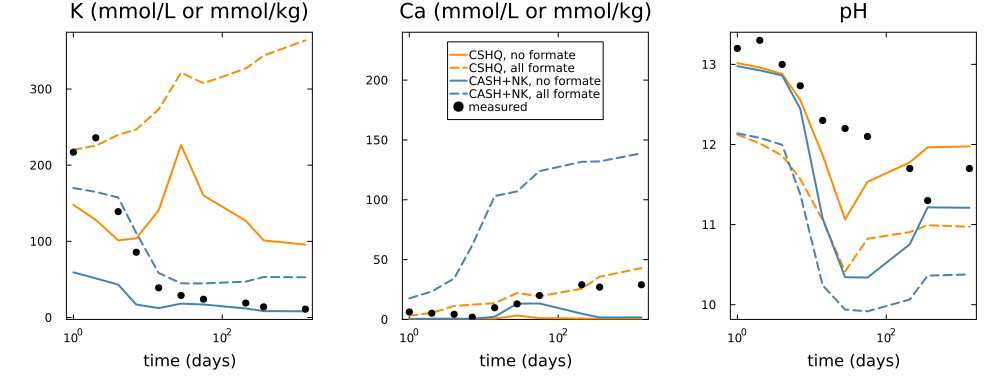
4. What the comparison says
Without the formate, CASH+NK follows the fall of the alkalis as the silica fume reacts and decalcifies the gel, from two weeks on: the potassium comes down to 8 mmol/kg after 3.5 years, where 11 mmol/L were measured, while CSHQ keeps 96. That is the result Miron et al. (2022) report for their fine-tuned model. In the first days CASH+NK takes too much of it, 43 to 59 mmol/kg where 139 to 236 were measured, and the sodium stays below the measurement throughout with both gels. The calcium is reproduced at 28 and 56 days by CASH+NK, 13 mmol/kg against 13 and 20 mmol/L, and by neither later, where the measured solution holds 27 to 29 and the computed ones 0.6 to 5. Between two weeks and two months the pH falls below the measured one, by half a unit to a unit with CSHQ and by one to two with CASH+NK; later CASH+NK comes back within a unit of it and CSHQ goes above it.
With all the formate in solution the calcium and the alkalis rise past the measured ones, the formate having to be balanced by cations, and the pH falls further. After the first weeks the measured calcium lies between the two bounds, as it should if the solids take up part of the formate. No model of the package, nor of Cemdata18, describes that uptake by the hydrates, and a calculation of this paste is only as good as what replaces it. What this page settles is narrower: the late alkalis of a silica fume binder are followed by CASH+NK and not by CSHQ, and its calcium and pH are not followed by either without an account of the formate of its accelerator.
Where to go next
The CASH+ model computes the Portland cement paste Miron et al. (2022) also used, and the CEM IV page a pozzolanic binder with CSHQ and CNASH_ss.