
The two laws, and what the Gibbs energy measures
The pages of this chapter use the enthalpy, the entropy and the Gibbs energy as familiar objects, although the relations between them are rarely obvious on a first reading: a calorimeter measures a change of enthalpy, whereas the solver minimizes a Gibbs energy. This page rebuilds both from the two laws of thermodynamics, mostly in the order in which (Anderson and Crerar, 1993) introduce them, and writes the laws as balances on a chosen boundary, which is where the conditions behind
Questions this page answers
Why does a calorimeter measure an enthalpy, and when does it not?
Why can a closed, insulated reaction heat up, and what fixes its final temperature?
What does the Gibbs energy measure, and are
and two flows of heat? If
is a state function, why does the path a reaction takes matter?
1. The system and its boundary
A system is the part of the world under consideration, and its state is fixed by a few variables, the temperature
| description | matter crosses the boundary | heat crosses the boundary | work crosses the boundary |
|---|---|---|---|
| closed | no | allowed | allowed |
| open | allowed | allowed | allowed |
| adiabatic | depends on the boundary | no | allowed |
| isolated | no | no | no |
These descriptions can be combined: a sealed, insulated piston-cylinder is closed and adiabatic, but can do expansion work. A sealed, insulated, rigid vessel with no other work exchange is isolated. A sealed sample can also be isothermal if a thermostat removes the heat of reaction.
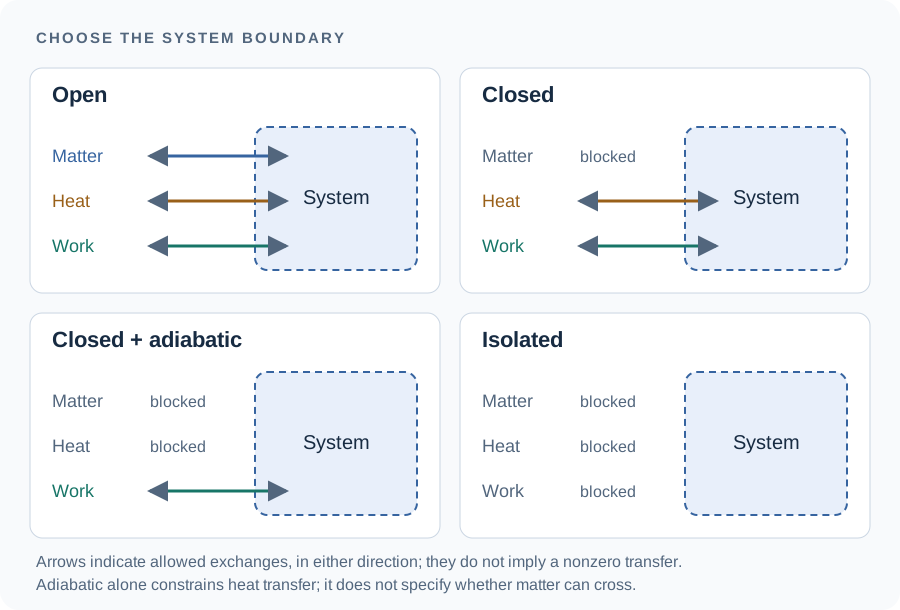
Arrows mark transfers that the boundary allows, in either direction. Closing the system blocks matter transfer; adding insulation blocks heat transfer. Work can still cross a closed adiabatic boundary, for example through a moving piston.
In a closed reacting system, the species amounts change even though no matter crosses the boundary. For example,
consumes lime and water and produces portlandite while conserving calcium, hydrogen, oxygen and charge. In the package's notation the fixed quantity is
This is classical chemical thermodynamics: nuclear transformations, and the contribution of exchanged energy to the mass of a sample, are outside the model.
2. Heat, work, and why a calorimeter measures an enthalpy
The internal energy
In a chemical system held at constant pressure, the only work exchanged is usually that of the pressure against the change of volume,
another state function, whose change at constant pressure is exactly the heat received,
The same balance written for an infinitesimal change makes its conditions explicit. Neglecting changes in bulk kinetic and gravitational potential energy, the first law for a closed system reads
Heat and work describe transfers along a process: neither is a stored property of the sample. This is why their infinitesimal transfers use
The pressure in expansion work is the external pressure. Replacing it by the system's pressure requires mechanical equilibrium. Constant pressure alone does not rule out electrical work, stirring or other forms of work. With
At constant pressure, with only pressure-volume work, this gives
An enthalpy change is an energy difference, in joules. A heat rate is an energy transfer per unit time, in watts. Enthalpy changes can include reaction, heating, phase change and mixing; they are not restricted to bond energies.
3. Heat capacity, and why an adiabatic reaction can raise the temperature
The heat capacity at constant pressure measures how the enthalpy grows with temperature at fixed composition,
and it governs the other kind of calorimeter, the one that exchanges no heat.
For a closed adiabatic system at constant pressure, with only pressure-volume work,
Consider the constant-pressure case. Let the initial state have composition
The first term is a difference between two compositions, not the enthalpy of either state alone. Both terms are total energies:
An exothermic composition change makes the first term negative, and heating can compensate it. The integral does not presume that
The
the second term being the configurational heat capacity of (Richet, 2001; Sec. 6.1d, Eqs. (6.10)–(6.11), p. 129), positive at a stable equilibrium. Reactions faster than the measurement, such as the aqueous speciation, follow the temperature; slower ones, such as the dissolution of the clinker, do not (Kinetics under partial equilibrium).
A semi-adiabatic vessel adds the heat it loses to this balance, and it is the subject of A CEM I 52.5 N mortar in a semi-adiabatic calorimeter, inside the kinetics.
4. Entropy: the inequality of Clausius, and entropy production
The first law says nothing about the direction of a change. The second law supplies it through a further state function, the entropy
the equality holding for a reversible transformation only. Unlike
The inequality becomes a balance once the entropy created inside the system is named. For a closed system exchanging heat at a boundary temperature
With several heat contacts, sum
To evaluate the difference between two thermodynamic states, one may use any reversible reference path connecting them:
This is a path integral of heat transfer divided by the temperature at which each transfer occurs. For reversible heating at fixed pressure and composition,
Entropy describes the thermodynamic availability of energy and the possible microscopic states. Reading it as disorder is a useful picture, but the picture alone does not establish a balance or the sign of a reaction entropy. The distinction between conservation and direction is developed in (Anderson and Crerar, 1993), Chapter 5.
5. The Gibbs energy, and what it measures
At constant pressure, with no work other than that of the pressure, the heat received is the change of enthalpy,
the Gibbs energy, that can only decrease in a spontaneous transformation at fixed
The derivation holds under stated constraints, and the entropy balance of §4 shows which.
Equilibrium minimizes
What vanishes at equilibrium is a slope, not a difference. The Gibbs energy of every reaction that can proceed both ways,
What
Why
The two terms are easily read as two heats, one chemical and one thermal. They are not.
At fixed
With the received-work convention, the maximum useful work delivered is
The natural variables of
For a closed system of fixed composition with only the work of the pressure, the first law combined with the second,
The terms in
The temperature derivative of
This is the Gibbs-Helmholtz relation, by which the enthalpy, the quantity calorimetry measures, is read on the temperature dependence of the Gibbs energy, the quantity equilibrium depends on. Applied to a reaction it becomes the van 't Hoff relation of The heat of reaction: measuring how an equilibrium constant changes with temperature gives the heat of the reaction without a calorimeter.
6. State functions and kinetic paths
A state includes temperature, pressure, composition and phase information. Two histories reaching exactly the same initial and final states have the same
At an observation time, a hydrating paste retains slowly reacting clinker and may contain phases whose formation or conversion is inhibited. The coupling of Kinetics under partial equilibrium integrates the slow amounts and re-equilibrates the remaining budget. It computes successive partial equilibria, not thermal jumps over molecular activation barriers. Rate laws supply the time dependence, and a thermal balance supplies a changing temperature when that is modeled.
A state held back by a slow transformation is often pictured as a local minimum of
What the package counts as heat
For a closed isothermal constant-pressure sample with only pressure-volume work, the heat released up to time
The rate depends on the trajectory; the cumulative value depends on the two states actually reached. Changing temperature, matter transfer or other work requires the corresponding balance terms. In particular, an adiabatic temperature rise is not an outward heat transfer.
The package evaluates enthalpy: the standard enthalpies of the species, without the excess enthalpies of the aqueous or solid-solution activity models, as Activity, and the enthalpy of a mixture explains. Using a non-ideal activity model for equilibrium therefore does not by itself add its heat of mixing to the reported calorimetry. For a concentration-based activity, the temperature derivative behind an excess enthalpy also includes the thermal expansion of the solution, which changes molarity but not molality.
heat_release differences this enthalpy between two certified speciations on the same conserved budget, so it counts the precipitation of hydrates as well as the dissolution of the clinker. In a kinetic run, the heat of cumulative_heat depends on the formulation. When the kinetic reactions themselves produce the hydrates, it is heat_rate, summed over those reactions. Under partial equilibrium the kinetic reactions only release ions, so the run instead balances missing_enthalpy lists such species. Its heat is then the one heat_release computes from the certified replay.
Waiting longer does not by itself guarantee a unique observed assemblage. Accessibility of transformations, boundary conditions, the species list and possible degeneracy of equilibrium all matter. The distinction between physical metastability, a constrained equilibrium and numerical stationarity is developed in Proving that an answer is the answer.
Where to go next
The chemical potential and reactions is the next page: it lets the composition of the system change, which brings in the chemical potential, and arrives at the equilibrium constant of a reaction.
- CEM I 52.5 N and slag in an isothermal calorimeter, read off the states and A CEM I 52.5 N mortar in a semi-adiabatic calorimeter, inside the kinetics, the two calorimeters of §2 and §3 on a cement.