
CEM I 52.5 N and slag in an isothermal calorimeter, read off the states
Before this page
CEM III/A, a blastfurnace cement, for a slag entered through its oxides.
An isothermal calorimeter holds the sample at one temperature and records the heat it gives off. Enthalpy is a state function, so that heat is what the enthalpy of the sample loses between two states at that temperature,
with the reactants, the ions and the hydrates each counted once and no reaction to write down (Eqs. 17–21 of Lavergne et al. (2018)). It is an output: once the states are computed, the heat is read off them. Along a kinetic trajectory that is heat_release, compared with measured curves on the calibration page; this page reads it at measured degrees of hydration instead, on the pastes of Gruyaert et al. (2010).
The pastes
A CEM I 52.5 N and a blast-furnace slag, pastes at w/b = 0.5 with 0 to 85 % slag. Gruyaert et al. (2010) report the oxide composition of both, the degree of hydration of the cement and of the slag by image analysis at 2 days and 28 months, and the heat by isothermal calorimetry at 20 °C, all in data/literature/Gruyaert2010.json. scripts/gruyaert2010.jl builds a paste from them; its assumptions are written there.
using ChemistryLab, DynamicQuantities, Printf, Plots
include(joinpath(pkgdir(ChemistryLab), "scripts", "gruyaert2010.jl"))

c = gruyaert_bogue("OPC-CAL")
for (ph, f) in c.clinker
    @printf("  %-5s %5.1f %%\n", ph, 100f)
end
@printf("  gypsum %4.1f %%, calcite %4.1f %%\n", 100c.gypsum, 100c.calcite)
C3S 56.2 %
C2S 11.5 %
C3A 7.9 %
C4AF 11.6 %
gypsum 6.7 %, calcite 1.6 %The cement alone
The heat of the plain paste at the degree of hydration the image analysis gives, against the heat the calorimeter measured at the same age. At 2 days that is the reaction degree of (Gruyaert et al., 2010; Table 6) times the total heat of its Table 2; at 28 months the cement is at 74 %, the ultimate degree the article computes for w/c = 0.5, and the total heat, extrapolated to infinite time, is the comparison.
cs = gruyaert_system()
J(st) = ustrip(us"J", enthalpy(st))
heat(p) = (J(p.initial) - J(p.eq)) / 100                 # J per g of binder
G10(table, column; where...) = only(getproperty(literature_table("Gruyaert2010", table; where...), column))
α(days, sb) = G10("hydration_degree", :alpha_cement; age_days = days * u"d", slag_to_binder = sb) / 100
Q_total(sb) = ustrip(us"J/g", G10("isothermal_total_heat", :heat_infinity; slag_to_binder = sb))
r2 = G10("reaction_degree", :r; age_days = 2u"d", slag_to_binder = 0.0) / 100

p2 = gruyaert_paste(cs; slag = 0.0, alpha_cement = α(2, 0.0), alpha_slag = 0.0)
p28 = gruyaert_paste(cs; slag = 0.0, alpha_cement = α(852, 0.0), alpha_slag = 0.0)
@printf("certified: %s, %s\n", p2.certificate.optimal, p28.certificate.optimal)
@printf("2 days:    α = %.2f, computed %5.0f J/g, measured %5.0f J/g\n",
        α(2, 0.0), heat(p2), r2 * Q_total(0.0))
@printf("28 months: α = %.2f, computed %5.0f J/g, measured total %5.0f J/g\n",
        α(852, 0.0), heat(p28), Q_total(0.0))
@printf("per unit degree of hydration: computed %.0f and %.0f J/g, measured %.0f and %.0f J/g\n",
        heat(p2) / α(2, 0.0), heat(p28) / α(852, 0.0), r2 * Q_total(0.0) / α(2, 0.0),
        Q_total(0.0) / α(852, 0.0))
certified: true, true
2 days: α = 0.54, computed 264 J/g, measured 247 J/g
28 months: α = 0.74, computed 355 J/g, measured total 433 J/g
per unit degree of hydration: computed 488 and 480 J/g, measured 457 and 585 J/gfig = bar([0.8, 1.8], [heat(p2), heat(p28)]; bar_width = 0.4, label = "computed from the states", color = :steelblue,
xticks = ([1, 2], ["2 days", "28 months"]), ylabel = "heat (J per g of binder)", legend = :topleft,
size = (700, 380), left_margin = 6Plots.mm, bottom_margin = 5Plots.mm,
title = "CEM I 52.5 N paste, w/b 0.5, 20 °C")
bar!(fig, [1.2, 2.2], [r2 * Q_total(0.0), Q_total(0.0)]; bar_width = 0.4, color = :black,
label = "measured (at 28 months: the total extrapolated)")
plot!(fig; ylims = (0, 1.15 * ylims(fig)[2]))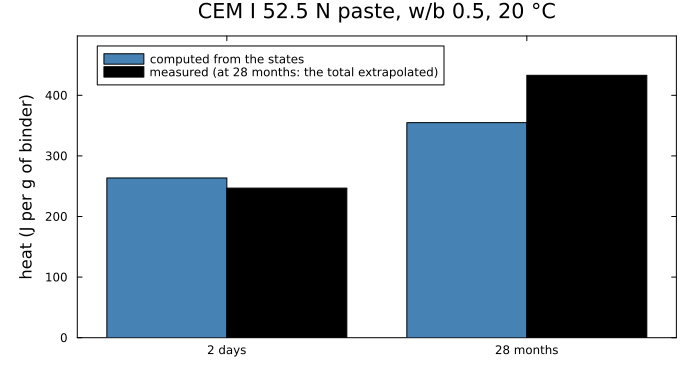
What the minimization made of the reacted cement and its water, at 28 months, in grams per 100 g of binder:
mass_of(st) = Dict(symbol(st.system.species[i]) => ustrip(us"g", st.n[i] * st.system.species[i][:M])
                   for i in eachindex(st.n) if !(i in st.system.idx_aqueous) || symbol(st.system.species[i]) == "H2O@")
before, after = mass_of(p28.initial), mass_of(p28.eq)
for d in (before, after)
    d["water"] = pop!(d, "H2O@")
end
keep = sort([k for k in union(keys(before), keys(after)) if max(get(before, k, 0.0), get(after, k, 0.0)) > 0.5];
            by = k -> -max(get(before, k, 0.0), get(after, k, 0.0)))
xs = collect(eachindex(keep))
fig = bar(xs .- 0.2, [get(before, k, 0.0) for k in keep]; bar_width = 0.4, label = "reacted cement and water",
          color = :grey60, xticks = (xs, keep), xrotation = 30, ylabel = "g per 100 g of binder", legend = :topright,
          size = (860, 400), left_margin = 6Plots.mm, bottom_margin = 12Plots.mm, title = "The plain paste, α = 0.74")
bar!(fig, xs .+ 0.2, [get(after, k, 0.0) for k in keep]; bar_width = 0.4, label = "at equilibrium", color = :steelblue)
plot!(fig; ylims = (0, 1.1 * ylims(fig)[2]))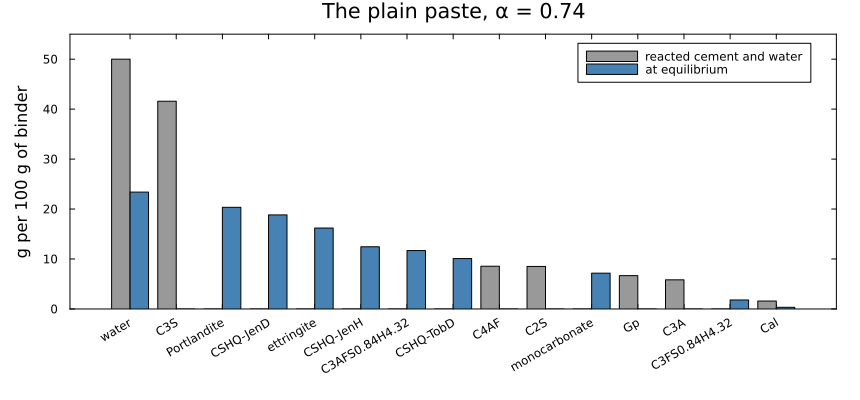
At 2 days the computed heat is 7 % above the measured one; at 28 months it is 18 % below the total extrapolated from the measurements. The calculation carries one heat per unit degree of hydration, fixed by the enthalpies of the phases, and it comes out at 488 and 480 J/g at the two ages. The measurements carry 457 at 2 days and 585 at infinite time, and the two cannot hold together with the degrees of hydration of the image analysis: Gruyaert et al. (2010) note it themselves, their reaction degree at 2 days being low against the degree of hydration once the ultimate degree of 74 % is accounted for. The calculation, which has no parameter to adjust, falls between them.
The slag, whose enthalpy no database holds
A glass has no formula, and none of the databases carries its enthalpy of formation: the slag enters the budget through its oxides, and its heat cannot be computed. What the measurements can give is the enthalpy the glass must have for the computed heat to be the measured one. At 28 months, with the cement and the slag at their measured degrees and the total heat of (Gruyaert et al., 2010; Table 2),
per gram of reacted slag, with H₀ the enthalpy of the reacted cement and the water and H_eq that of the computed paste. Two blends give it twice, and one glass should give one number.
αs(sb) = G10("hydration_degree_slag", :alpha_slag; age_days = 852u"d", slag_to_binder = sb) / 100
h_glass = map((0.5, 0.85)) do sb
    p = gruyaert_paste(cs; slag = sb, alpha_cement = α(852, sb), alpha_slag = αs(sb))
    m_c, m_s = 100 * (1 - sb) * α(852, sb), 100 * sb * αs(sb)
    h = (Q_total(sb) * 100 + J(p.eq) - J(p.initial)) / m_s
    @printf("slag %.2f: reacted cement %4.1f g, slag %4.1f g, certified %s, h_glass = %6.0f J/g\n",
            sb, m_c, m_s, p.certificate.optimal, h)
    h
end
(-13383.587792267304, -13314.979755885572)The two blends give the glass to within 0.5 %, although the reacted cement weighs 1.3 times the reacted slag in the first and 0.41 times in the second: an error in the heat computed for the cement would move the two apart, in that proportion. The enthalpy is derived, and it carries the uncertainty of the extrapolated totals and of the degrees of hydration; fed back into a calculation of these pastes, it would reproduce their heat by construction, and says nothing then.
The number means more against the crystalline oxides the glass is made of, taken from SLOP98 at the same temperature, the sulfate as anhydrite less its lime, and against two crystalline calcium silicates of the database, gehlenite and åkermanite, whose half-and-half mixture has nearly the slag's composition.
slop = Dict(symbol(s) => s for s in
            build_species(datapath("slop98-inorganic-thermofun.json"); verbose = false))
T0, P0 = temperature(p28.eq), pressure(p28.eq)
h(s) = ustrip(us"J/mol", slop[s][:ΔₐH⁰](T = T0, P = P0; unit = true))
M(s) = ustrip(us"g/mol", slop[s][:M])
oxide = Dict("CaO" => "Lim", "SiO2" => "Qtz", "Al2O3" => "Crn", "Fe2O3" => "Hem", "MgO" => "Per")
per_gram = Dict(o => h(s) / M(s) for (o, s) in oxide)
per_gram["SO3"] = (h("Anh") - h("Lim")) / (M("Anh") - M("Lim"))
bfs = gruyaert_oxides("BFS-CAL")
h_oxides = sum(ustrip(getproperty(bfs, Symbol(o))) / 100 * v for (o, v) in per_gram)
@printf("glass less its oxides: %4.0f and %4.0f J/g\n", (h_glass .- h_oxides)...)

# A crystal less its oxides, per gram, and its oxide mass fractions, from its formula.
function from_oxides(s)
    a = atoms(slop[s])
    n = Dict("CaO" => a[:Ca], "SiO2" => a[:Si], "Al2O3" => get(a, :Al, 0) / 2, "MgO" => get(a, :Mg, 0))
    dh = (h(s) - sum(Float64(k) * h(oxide[o]) for (o, k) in n)) / M(s)
    return dh, Dict(o => Float64(k) * M(oxide[o]) / M(s) for (o, k) in n)
end
(dh_gh, w_gh), (dh_ak, w_ak) = from_oxides("Gh"), from_oxides("Ak")
@printf("gehlenite less its oxides %4.0f J/g, åkermanite %4.0f J/g\n", dh_gh, dh_ak)
for o in ("CaO", "SiO2", "Al2O3", "MgO")
    @printf("  %-6s half and half %5.1f %%, slag %5.1f %%\n", o,
            50 * (w_gh[o] + w_ak[o]), ustrip(getproperty(bfs, Symbol(o))))
end
glass less its oxides: -403 and -334 J/g
gehlenite less its oxides -501 J/g, åkermanite -672 J/g
CaO half and half 41.0 %, slag 40.4 %
SiO2 half and half 33.0 %, slag 34.4 %
Al2O3 half and half 18.6 %, slag 11.4 %
MgO half and half 7.4 %, slag 7.6 %p_h = bar(["glass, 50 % slag", "glass, 85 % slag", "gehlenite", "åkermanite"],
[(h_glass .- h_oxides)..., dh_gh, dh_ak]; legend = false, color = [:steelblue, :steelblue, :grey60, :grey60],
ylabel = "enthalpy less the oxides (J/g)", size = (720, 380), left_margin = 6Plots.mm, bottom_margin = 5Plots.mm,
title = "Each less the crystalline oxides of its composition, SLOP98")
plot!(p_h; ylims = (1.1 * ylims(p_h)[1], 0))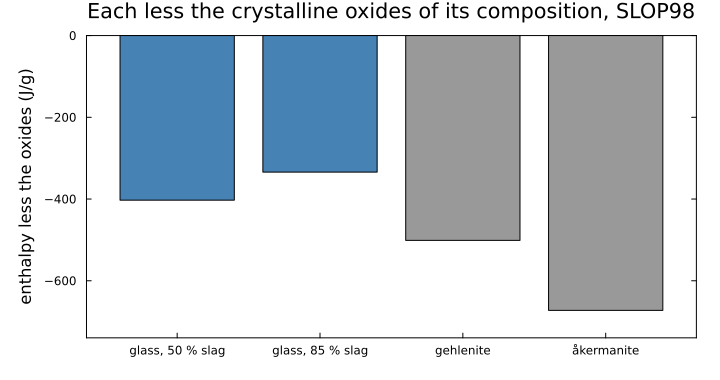
The glass lies 330 to 400 J/g below the crystalline oxides of its composition, and above the two crystals, which lie 500 and 670 J/g below theirs. A glass holds more enthalpy than the crystals of its composition, and that is the order found. The half-and-half mixture is richer in alumina than the slag, so the difference between them, some 200 J/g, gives an order of magnitude and not an enthalpy of vitrification.
See also
A CEM I 52.5 N mortar in a semi-adiabatic calorimeter, inside the kinetics, where the heat raises the temperature and the temperature the rates.
Calibrating the hydration kinetics of a CEM I on measured calorimetry, the heat along a trajectory against measured curves.
Bound water of CEM I 52.5 N and slag pastes, and the thermogram it integrates to, the other measurement read off the same pastes.